
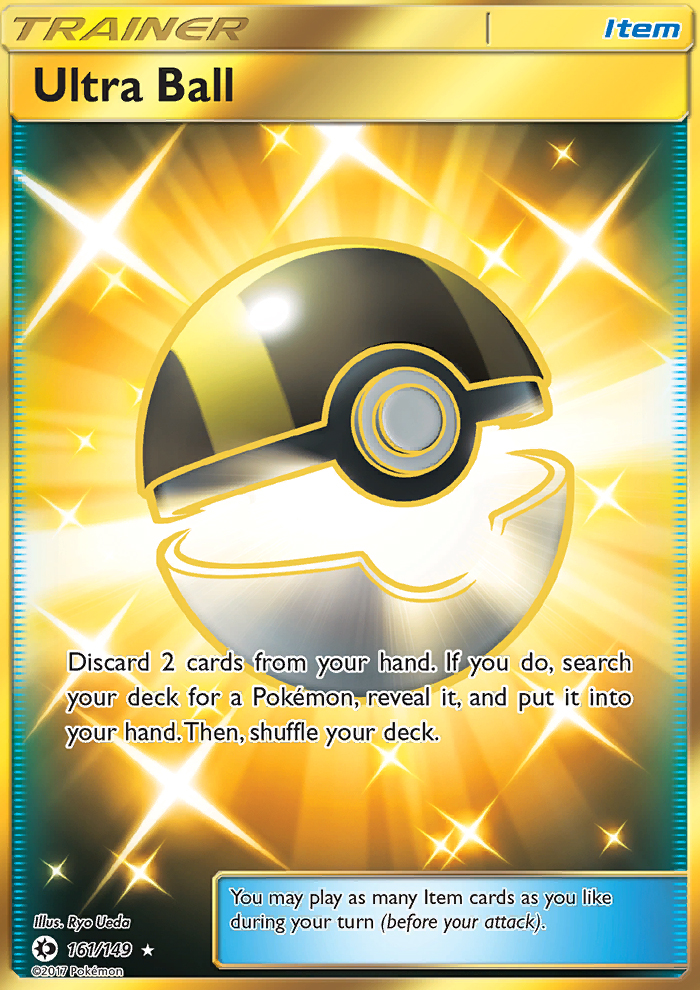
Image courtesy of TCGdex.net
Design constraints behind Ultra Ball’s deck-search mechanic
In the Sun & Moon era, Ultra Ball stands as a classic example of how Pokémon TCG designers balance power, tempo, and resource management. Created for the Sun & Moon set (SM1), the card carries the signature flourish of trainer-supporting mechanics while staying within tight printing constraints. The illustration by Ryo Ueda captures the gleam of a compact, almost surgical tool: a small device capable of turning the tide of a game if you’re willing to pay the price in your hand. The text is concise, yet the ripple effects are large: Discard 2 cards from your hand. If you do, search your deck for a Pokémon, reveal it, and put it into your hand. Then, shuffle your deck. This compact clause—short enough to fit the card’s space, long enough to influence your every turn—speaks to a deliberate design constraint: make a powerful accelerator that players must earn through resource costs and timing.
Two core constraints shaped this design. First, text length and readability had to be preserved for quick recognition in a fast-paced format. Trainers need to scan their options and decide during their turn whether the payoff justifies the cost. The two-card discard requirement is the minimal price that meaningfully gates the search: it prevents the card from being a one-card win condition and keeps deck-thinning in check. Second, the mechanic had to feel broadly useful across decks while staying manageable in head-to-head play. Allowing a player to search for any Pokémon from the deck and add it to the hand is powerful, but pairing that with a cost and a shuffle ensures that the outcome isn’t deterministic—luck and timing still matter.
Format constraints and strategic placement
Ultra Ball’s legal status reflects another layer of constraint: in this period, cards travel with format boundaries. The data shows this card is Expanded-legal but not Standard-legal. That split isn’t arbitrary. As new sets roll out, Nintendo and The Pokémon Company administrators manage resonance with older cards that could overstay their welcome in a constantly evolving meta. By placing Ultra Ball into Expanded, designers preserve its utility for players who love legacy decks while avoiding destabilizing Standard rotation with a card that rewards repeated fetches and consistency beyond a single season. This is a conscious trade-off: you retain a beloved engine for players who treasure older combos, while signaling that some power is cleaner within a longer-form ruleset.
From a gameplay standpoint, Ultra Ball’s constraint system nudges players toward thoughtful sequencing. You must decide when to discard two cards to guarantee a Pokémon fetch, and you must consider what pieces are already in hand and what the deck needs most. It’s a design that rewards planning—you might set up a critical pivot early, draw into a flawless pairing mid-game, or risk thinning your hand to chase a single Pokémon that unlocks your strategy. The payoff is a tempo swing: a trusted source of acceleration that can help you hit your ideal board state one turn earlier than the opponent. ⚡🔥
Art, rarity, and the collector’s lens
The Ultra Ball is a Secret Rare in the Sun & Moon line, and the card’s presence as a holo variant adds to its collector appeal. The rarity level isn’t just about shine; it reflects the set’s abundance of powerful tools that players chase in the long game. The SM1 set itself had a total of 172 cards, with 149 officially counted in its first-run lineup; Ultra Ball sits among the rarer pieces that players remember fondly as the meta evolved. The artwork by Ryo Ueda complements the card’s mechanical theme—a gleaming device framed with light that hints at the delicate balance between risk and reward. For collectors, the holo and reverse variants of these printings form a nostalgic bridge to the era when trainers were evolving from simple fetchers to sophisticated tempo engines. 🎴💎
In practice, Ultra Ball’s pricing patterns on the market give a window into its collectible status. While Cardmarket data points to modest averages for standard-era printings, holofoil and secret rares command a premium in certain markets. This tension between accessibility and scarcity is a familiar refrain for fans who chase the glow of a card that changed how decks are built and how opponents pace their responses. The market’s constellations—low averages, occasional spikes on holo versions, and the enduring demand for solid search tools—reflect Ultra Ball’s lasting imprint on both play and memory. The card’s enduring aura is as much about its face as it is about the choices it enables at the table. 💎🎮
How constraints shape strategy in practice
To maximize Ultra Ball’s impact, players typically build around two predictable forces: the need to thin two cards from the hand and the desire to grab a Pokémon that accelerates the board. In Expanded formats, this engine often fuels quick evolutions or rapid access to key bench threats. The line between “speed” and “risk” is subtle: discarding two cards can clear space for a critical draw or unlock a prized Pokémon, but it can also strip away nonessential cards that could protect you later. That tension is precisely why Ultra Ball remains so instructive for designers and players alike—it teaches you to value tempo and resource management as a core weapon rather than an afterthought. The card’s simple text hides a chessboard of decisions you must navigate every game. ⚡🎴
For readers who want to study Ultra Ball in action, pair this narrative with a closer look at how modern training-tool ecosystems have evolved. The move from Ultra Ball to newer searches like Quick Ball or Nest Ball reflects an ongoing negotiation: how to preserve reliability of Pokémon searches while reducing the cost or tailoring to evolving rule sets. The lessons here aren’t merely about a single card; they’re about the art of constraint-driven design—how a few sentences on a card page can shape an entire era of gameplay philosophy. 🔮
Neoprene Mouse Pad Round Rectangular Non-SlipMore from our network
- https://blog.crypto-articles.xyz/blog/post/polished-diorite-hardness-and-blast-resistance-explained-in-120/
- https://articles.digital-vault.xyz/blog/post/total-war-warhammer-iii-production-challenges-analyzed/
- https://wiki.digital-vault.xyz/wiki/post/pokemon-tcg-stats-petilil-card-id-xy9-7/
- https://donation.digital-vault.xyz/donation/post/support-accessible-ai-for-everyone-to-understand-and-grow/
- https://blog.crypto-articles.xyz/blog/post/nft-data-gib-1529-from-gib-collection-on-magiceden/
Ultra Ball
Set: Sun & Moon | Card ID: sm1-161
Card Overview
- Category: Trainer
- HP:
- Type:
- Stage:
- Dex ID:
- Rarity: Secret Rare
- Regulation Mark: —
- Retreat Cost:
- Legal (Standard): No
- Legal (Expanded): Yes
Description
Pricing (Cardmarket)
- Average: €0.16
- Low: €0.02
- Trend: €0.25
- 7-Day Avg: €0.27
- 30-Day Avg: €0.21
Support Our Decentralized Network
Donate 💠More from our network
- https://blog.crypto-articles.xyz/blog/post/polished-diorite-hardness-and-blast-resistance-explained-in-120/
- https://articles.digital-vault.xyz/blog/post/total-war-warhammer-iii-production-challenges-analyzed/
- https://wiki.digital-vault.xyz/wiki/post/pokemon-tcg-stats-petilil-card-id-xy9-7/
- https://donation.digital-vault.xyz/donation/post/support-accessible-ai-for-everyone-to-understand-and-grow/
- https://blog.crypto-articles.xyz/blog/post/nft-data-gib-1529-from-gib-collection-on-magiceden/