
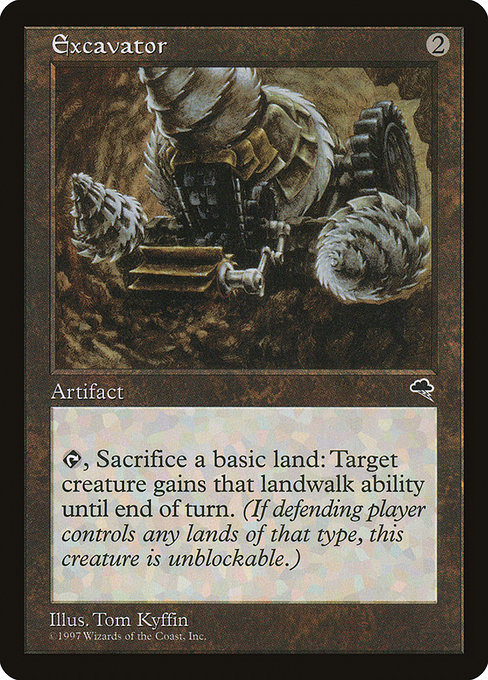
Image courtesy of Scryfall.com
Mapping Excavator: Uncovering MTG Card Relationships
In Magic: The Gathering, every card isn’t just a standalone line of text—it’s a node in a sprawling web of interactions. When you start framing deckbuilding and gameplay as a network graph, artifacts like Excavator become fascinating hubs that connect land, strategy, and tempo across multiple layers. 🧙♂️ This article uses Excavator as a lens to explore how a single, colorless artifact with a modest mana cost can ripple through the battlefield and the broader card ecosystem, revealing relationships that aren’t always obvious at first glance. 🔥
Excavator is a two-mana artifact from Tempest, printed in 1997 as an uncommon piece of the era’s artifact-focused toolkit. Its mana cost is {2}, so it’s perfectly approachable in a wide range of casual and semi-competitive builds. The card’s power lies not in raw stats or big flashy effects, but in its precise, condition-based ability: T, Sacrifice a basic land: Target creature gains landwalk of each of the land types of the sacrificed land until end of turn. In practical terms, you pick one of the five basic land types—Plains, Island, Swamp, Mountain, or Forest—and the targeted creature gains the corresponding landwalk for that turn, as long as the defending player controls a land of that type. It’s a reminder that “landwalk” isn’t just a gimmick; it’s a subtle key to timing and positioning in a game where line-of-sight matters. ⚔️
Graphically speaking, Excavator sits at the crossroads of two major axes in MTG’s vast graph: colorless utility and land-based reach. The edges sprouting from Excavator point to landwalk as a mechanic, and then extend into the wider ecosystem of basic-land economy, colorless acceleration, and artifact-supporting strategies. Because the effect requires sacrificing a basic land, the card inherently encourages players to consider board state beyond the moment: what lands are on the battlefield, what threats loom, and which creature you want to sneak past blockers this turn. In a world where a single Plains can change a creature’s fate, Excavator acts as the key that unlocks that small but dramatic advantage. 🧩
From a lore-tinged perspective, Excavator’s Tempest-era flavor evokes the long, resource-driven work of dungeon delvers and artifact tinkers. The card’s imagery—an artifact that can bend movement across terrain by consuming a basic land—feels like a practical tool in a world where land types shape the battlefield. It’s a classic example of how the set’s mechanical palette could be both flavorful and functional, bridging the gap between “this is what it does” and “this is what it enables.” The artist Tom Kyffin lends a grounded, industrial feel to the piece, which matches Tempest’s emphasis on rugged, earth-toned hardware. The result is a card that ages gracefully: a collectible snippet of late-90s design that nevertheless remains playable in certain formats. 🎨
In terms of deck-building psychology, Excavator’s value emerges when you map the edges in your own head. Consider a board where your opponent controls a mix of basic lands. By sacrificing a land type that corresponds to a key terrain you expect to encounter—say you’re aiming to slip a crucial attacker through on an Islandwalk—the card nudges you toward a land-aware play pattern. It also offers a reminder of how artifact support can create “soft locks” or tempo playlines without requiring delving into highly specialized sets. In that sense, Excavator is less about raw power and more about shaping the game’s flow, a hallmark of thoughtful network design. 🧙♂️🔥
“A single artifact can stitch together land, tempo, and surprise—turning a simple sacrificed land into a doorway for a creature to slip past blockers.”
From a collector’s perspective, this Tempest-printed artifact sits as an uncommon printed card with a modest market footprint. Its nonfoil status keeps it accessible, with prices historically hovering in the pennies to dimes range depending on condition and market demand. The card’s current price data reflects its status as a classic, not a chase rare, yet it remains a beloved piece for players who relish edge-case interactions and the memories of pre-Modern MTG’s flavor-rich era. For those who enjoy setting up elegant landwalk-based scenarios, Excavator offers a tangible payoff for thoughtful play, even if it rarely dominates the board in the way a bomb mythic might. 💎
Another layer to this discussion is how Excavator interacts with the broader MTG ecosystem. The set’s “landwalk” keyword interacts with various card types that care about land types, such as domain-themed or land-type-dependent strategies. While Excavator itself doesn’t create or fetch lands, it empowers a single creature to transcend blockers—temporarily—based on the sacrificed land type. In a graph model, that’s a powerful, location-sensitive edge: a directed, conditional link that can flip the balance of a combat phase when executed at the right moment. The result is a memorable example of how a compact artifact can tie together terrain, timing, and creature combat in a way that feels both clever and tactile. 🧲
For fans who enjoy digging deeper into MTG’s network of relationships, Excavator offers a compact case study in how a card’s core mechanics ripple outward. It’s a reminder that the strength of many MTG designs lies not in the biggest numbers but in the elegance of their connective tissue—the way a two-mana artifact can make a Plains become a strategic gateway, or an Island become a backdoor to tempo. If you’re cataloging relationships in your own collection, this card is a neat anchor point for exploring landwalk, basic land types, and the interplay between artifacts and lands across formats. 🔗
As you explore Excavator within a network graph framework, think of the five basic land types as five distinct nodes. Excavator provides a direct edge to each of them, via landwalk, with a potential downstream edge to any creature you choose to target. The more you map these edges, the more you appreciate how even modest cards can shape decision trees, timing windows, and the overall shape of a game. For fans of data-driven MTG write-ups, Excavator is a charming, approachable example of how to visualize card relationships and the way a single play can alter the momentum of a match. 🎲
Phone Case With Card Holder Impact Resistant Polycarbonate MagSafeMore from our network
- https://articles.digital-vault.xyz/blog/post/open-the-vaults-design-lessons-from-a-vault-focused-card/
- https://wiki.digital-vault.xyz/wiki/post/pokemon-tcg-stats-charmander-card-id-ecard1-97/
- https://crypto-acolytes.xyz/blog/post/nft-stats-ape-2488-from-entropy-acolytes-collection/
- https://blog.crypto-articles.xyz/blog/post/nft-data-bagtardio-10-from-bagtardio-collection-on-magiceden/
- https://wiki.digital-vault.xyz/wiki/post/pokemon-tcg-stats-magneton-card-id-sm12-69/
Excavator
{T}, Sacrifice a basic land: Target creature gains landwalk of each of the land types of the sacrificed land until end of turn. (It can't be blocked as long as defending player controls a land of any of those types.)
ID: 6dc3d5b4-b04f-4b34-afd2-72fb3de0a33b
Oracle ID: 2d5ebcd7-07c2-412e-b0d9-54e3a88895fd
Multiverse IDs: 4607
TCGPlayer ID: 5546
Cardmarket ID: 9012
Colors:
Color Identity:
Keywords:
Rarity: Uncommon
Released: 1997-10-14
Artist: Tom Kyffin
Frame: 1997
Border: black
EDHRec Rank: 25063
Penny Rank: 15847
Set: Tempest (tmp)
Collector #: 287
Legalities
- Standard — not_legal
- Future — not_legal
- Historic — not_legal
- Timeless — not_legal
- Gladiator — not_legal
- Pioneer — not_legal
- Modern — not_legal
- Legacy — legal
- Pauper — not_legal
- Vintage — legal
- Penny — not_legal
- Commander — legal
- Oathbreaker — legal
- Standardbrawl — not_legal
- Brawl — not_legal
- Alchemy — not_legal
- Paupercommander — not_legal
- Duel — legal
- Oldschool — not_legal
- Premodern — legal
- Predh — legal
Prices
- USD: 0.27
- EUR: 0.15
- TIX: 0.12
More from our network
- https://crypto-acolytes.xyz/blog/post/nft-stats-hiney-kin-896-from-hiney-kin-collection/
- https://blog.digital-vault.xyz/blog/post/draft-night-spotlight-lumen-class-frigate-at-your-local-game-store/
- https://crypto-acolytes.xyz/blog/post/nft-stats-hero-841-from-soul-gate-heroes-collection/
- https://donation.digital-vault.xyz/donation/post/fund-open-publishing-systems-to-support-open-access/
- https://blog.zero-static.xyz/blog/post/how-scry-shapes-depth-and-perspective-in-viscera-seer-art/