
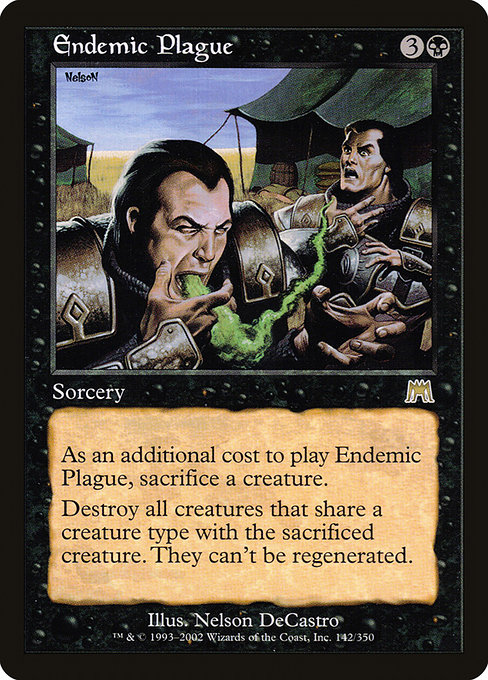
Image courtesy of Scryfall.com
Understanding Cognitive Load in Complex MTG Interactions
MTG isn’t just about drawing lands and slamming big creatures. It’s a mental marathon where the brain grapples with layers of decisions, timing, and potential outcomes. When you add a card like Endemic Plague to the board, the cognitive load spikes in a satisfying way 🧠🔥. The spell forces you to consider not only what you’ll sacrifice, but which creature types exist on the battlefield, how many you must wipe out, and what remains standing—if anything does at all ⚔️🎲. It’s a perfect study in how tribal dynamics can turn a single card into a multi-step puzzle you’re solving with every draw and attack step.
Endemic Plague is a rare black sorcery from Onslaught, costing {3}{B}. Its design hinges on an additional cost: sacrifice a creature. The payoff is brutal and surgical: destroy all creatures that share a creature type with the sacrificed one, and they can’t be regenerated. That means currency comes in the form of your sacrifice choice and the knowledge that your opponent’s board can implode in a single, well-timed moment 🧙♂️💎. The card’s flavor—plague sweeping through a shared lineage of creatures—lands with a visceral crack, and the black mana flavor shines through the inevitability of consequences when you gamble with what you’re willing to lose.
From a gameplay perspective, Endemic Plague introduces a type-aware sweep that players rarely see in a mass removal spell. It doesn’t wipe everything; it targets a tribe, with the sacrificial type acting as the switch. If you sacrifice a Zombie, you wipe all Zombies; if an Elf, you wipe all Elves; and so on. This precision invites heavy planning and careful risk assessment. The card is not a generic board wipe; it’s a selective apocalypse that rewards decks built around creature types and sacrifice synergies. The result is a memorable moment when tribal players realize their board can swing dramatically based on a single decision 🧙♂️🎨.
In terms of cognitive load, think of Endemic Plague as a multi-layered math problem: you calculate mana cost, you assess the sacrifice, you forecast the board state after the poison tide recedes, and you weigh how much collateral damage you’re willing to absorb. If you’re piloting a tribal deck—say, Elves, Goblins, or Zombies—the spell can either reset a tense board or become a trap for your own tribe if you misread the field. The learning curve is real, but that’s part of the joy: you’re constantly refining your mental model of which creature types proliferate in your meta and how to leverage or minimize their impact with precise timing 🧠💡.
Strategic takeaways: turning a liability into leverage
- Know your type density: Before you cast, survey the battlefield. If your opponent has four Elves and you’re sitting on a single Elf, Endemic Plague becomes a wrench that can stall or derail their tempo—but only if you’re prepared to face its consequences on your own board.
- Use sacrifice outlets wisely: In decks with sacrifice mechanisms or recursion, the cost can be a feature, not a flaw. A well-timed sacrifice can generate value in two ways: removing a threatening tribe and potentially fueling your own graveyard for reanimation tricks later 🎲.
- Timing matters: Casting this spell too early can leave you with a barren board. Waiting for a moment when your opponent’s threats coalesce around a single tribe can maximize impact while you rebuild in the wake of the wipe 🔥.
- Know the regeneration clause: The “they can’t be regenerated” line matters. It prevents a quick recast with a Sphere of Safety-type return effect, forcing a more deliberate approach to the post-sweep landscape ⚔️.
- Plan for retaliation: Your own board can also be decimated if you misjudge. Cognitive load isn’t only about what you destroy; it’s about forecasting what your opponent can summon to exploit the gaps left behind 💎.
Design-wise, Endemic Plague exemplifies the era’s tribal experimentation. Onslaught leaned into creature typing and battlefield interactions, and this card embodies that philosophy: a premium effect that speaks to tribal lore while demanding careful, calculated play. The art by Nelson DeCastro captures a sense of contagion sweeping through a crowded battlefield, a reminder that power in MTG often comes with a price tag that you pay in blood and board position 💥🎨.
For collectors and players alike, Endemic Plague is a compelling piece from a set that’s fondly remembered for its tribal experiments. It’s a rare that still shows up on the table, and while the non-foil price sits modestly around a few dimes, the foil version can fetch a few dollars—the sort of value that makes it a satisfying insert into an deck sleeve or a vintage binder. Beyond price, its cultural resonance in tribal strategy makes it a card you’ll cite in debates with fellow players about the ethics of wipe-with-cost interactions 🧿💎.
As you build around it, Endemic Plague invites a broader reflection on how MTG champions both strategic depth and communal storytelling. The moment you sac a creature and watch a cascade of type-specific destruction unfold, you’re not just playing a game—you’re engaging in a living, evolving puzzle that connects old-school design with modern, meta-aware play. And that, friends, is where the magic truly shines 🪄🧩.
Clear Silicone Phone Case Slim Durable Open Port Design 2More from our network
- https://blog.digital-vault.xyz/blog/post/team-up-memes-and-fan-reactions-fuel-mtg-community/
- https://blog.crypto-articles.xyz/blog/post/nft-data-pi-pyramid-15-from-pi-pyramide-collection-on-magiceden/
- https://blog.rusty-articles.xyz/blog/post/adapting-ageless-guardian-for-one-on-one-duels-strategies/
- https://blog.crypto-articles.xyz/blog/post/nft-data-himalaya-2182-from-himalaya-collection-on-magiceden/
- https://crypto-acolytes.xyz/blog/post/nft-stats-sir-orion-shattered-432-from-risen-collection/
Endemic Plague
As an additional cost to cast this spell, sacrifice a creature.
Destroy all creatures that share a creature type with the sacrificed creature. They can't be regenerated.
ID: 15326971-a53b-45f2-8f1d-1b82935286e1
Oracle ID: db982577-1c75-4bc9-ab15-1888ea0be16d
Multiverse IDs: 39612
TCGPlayer ID: 10546
Cardmarket ID: 1773
Colors: B
Color Identity: B
Keywords:
Rarity: Rare
Released: 2002-10-07
Artist: Nelson DeCastro
Frame: 1997
Border: black
EDHRec Rank: 26965
Set: Onslaught (ons)
Collector #: 142
Legalities
- Standard — not_legal
- Future — not_legal
- Historic — not_legal
- Timeless — not_legal
- Gladiator — not_legal
- Pioneer — not_legal
- Modern — not_legal
- Legacy — legal
- Pauper — not_legal
- Vintage — legal
- Penny — legal
- Commander — legal
- Oathbreaker — legal
- Standardbrawl — not_legal
- Brawl — not_legal
- Alchemy — not_legal
- Paupercommander — not_legal
- Duel — legal
- Oldschool — not_legal
- Premodern — legal
- Predh — legal
Prices
- USD: 0.21
- USD_FOIL: 1.55
- EUR: 0.26
- EUR_FOIL: 1.55
- TIX: 0.02
More from our network
- https://blog.crypto-articles.xyz/blog/post/nft-data-bagtardio-885-from-bagtardio-collection-on-magiceden/
- https://articles.zero-static.xyz/blog/post/nephalia-academy-grading-authenticity-tips-for-mtg-collectors/
- https://articles.zero-static.xyz/blog/post/clash-of-clans-hidden-secrets-you-probably-missed-this-year/
- https://blog.crypto-articles.xyz/blog/post/nft-data-solidskulls-1777-from-solidskulls-collection-on-magiceden/
- https://wiki.digital-vault.xyz/wiki/post/pokemon-tcg-stats-fighting-energy-card-id-tk-bw-e-6/