

Image courtesy of Scryfall.com
Empathy-Driven Design: Hulking Ogre as a Case Study
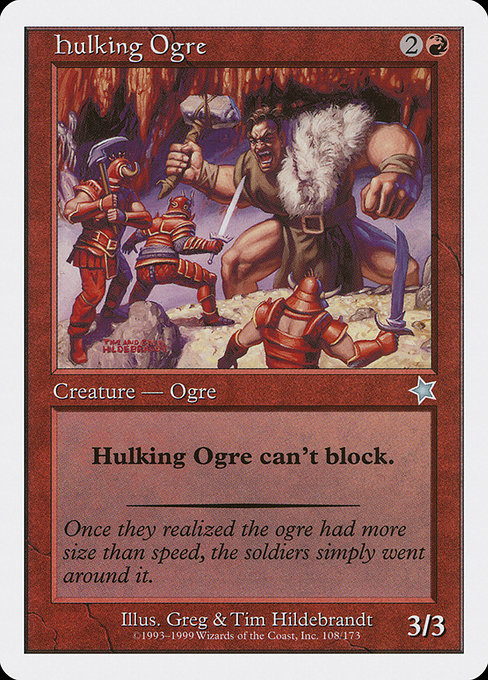
Magic: The Gathering thrives on the tension between bite-sized efficiency and big-picture strategy. Designers strive to honor diverse playstyles—from lightning-fast aggro to patient control—without bending the game into an incoherent mess. Hulking Ogre, a seemingly straightforward red creature from Starter 1999, offers a surprisingly clean lens on that goal. With a cost of 2R for a 3/3 body that cannot block, this uncommon ogre embodies a paradox: it hits hard and fast, yet its very limitation nudges players toward empathy for different routes to victory 🧙♂️🔥. Its flavor text—“Once they realized the ogre had more size than speed, the soldiers simply went around it.”—reads like a design manifesto: presence matters, but context matters more.
Red is the color of impulse, pressure, and tempo. Hulking Ogre arrives as a brick of raw aggression, a reminder that not every creature needs to be able to hold the line to be valuable. In an environment that rewards big swings, a card that can’t block still contributes meaningfully to the board by pressuring opponents to make rapid, careful decisions. This dynamic design invites players who crave early damage and quick board presence, while also prompting others to leverage removal, tricks, or evasive threats to get around the obstacle—an invitation to adapt your plan rather than forcing your plan to fit a single blueprint 🧨🎲.
What Hulking Ogre Teaches About Diverse Playstyles
First, its mana cost and stats are a study in balance. A 3/3 body for two red mana is robust enough to threaten early life total, but the full picture is nuanced: a creature that can’t block narrows avenues for traditional stalemates. This subtly rewards players who embrace tempo and risk, nudging them toward attack-forward strategies that still rely on discipline, not brute force alone. In turn, players who prefer control or midrange must plan around the ogre’s presence, choosing to eliminate it, pivot mid-combat, or set up opposing threats while the ogre charges forward 💥.
Second, Hulking Ogre’s rarity and reprint history in Starter 1999 highlight how early MTG design wrestled with accessibility. Uncommon by today’s standards, it’s a reminder that even “simple” cards carry design weight: they’re entry points for new players and anchors for nostalgic veterans. The white border and vintage frame of its era carry vibes that emphasize straightforward gameplay—yet the card’s restriction (no blocking) creates scarcity in how you can use it. It’s a small design choice with outsized impact on how players think about tempo, risk, and planning ⚔️.
Third, the flavor and art contribute to a broader cultural conversation about what “power” means in a red deck. The ogre’s size being more impressive than its speed invites players to chase clever deployment rather than raw swing power alone. It’s a design lesson in humility and improvisation: sometimes the most memorable plays come from seeing the map clearly and deciding to work around a perceived obstacle rather than smashing straight through it 🎨.
For designers, Hulking Ogre is a prompt to consider how your cards can validate multiple paths to victory. If your set leans toward aggressive beats, ensure there are safe openings and lots of follow-up threats. If your set leans control or midrange, provide meaningful ways to interact with the chaos, so that players aren’t punished for wanting to play safe or long-term. Empathy in design means giving players a voice—whether they’re rushing the opponent down the battlefield or weaving a slower climb to dominance. And occasionally, it means letting an ogre force you to pivot mid-game, which, in turn, makes every moment feel earned 🧙♂️💎.
From a collector’s lens, Hulking Ogre also reminds us that historical print quality and set context matter. Its Starter 1999 lineage places it within a broader nostalgia arc, where players remember the thrill of opening a box and meeting a familiar red figure that taught them to pace their ambitions. While its price might be modest—an everyday reminder of the era—the design philosophy behind it remains timeless: thoughtful constraints can enrich a deck’s identity and a player’s experience. The ogre doesn’t just swing; it teaches you to swing smarter, not just harder 🎲.
In practical terms for modern play, consider how you build around a card that can’t block. You’ll likely lean on removal, evasive threats, or insurance via burn and direct-damage options to keep the opponent from leveraging a stall strategy. The card’s presence adds a layer of decision-making: do you commit to pushing damage now, or do you preserve resources for later, knowing an opponent might deploy a blocker elsewhere? That tension is where player agency shines, and it’s exactly the kind of design empathy that makes MTG feel alive in every format 🧭.
Neon Phone Case with Card Holder MagSafe Card StorageMore from our network
- https://wiki.digital-vault.xyz/wiki/post/pokemon-tcg-stats-skeledirge-ex-card-id-sv02-258/
- https://blog.crypto-articles.xyz/blog/post/nft-data-radiants-axolotl-from-portals-backed-assets-collection-on-magiceden/
- https://crypto-acolytes.xyz/blog/post/nft-stats-captain-craftsky-2083-from-beer2-collection/
- https://wiki.digital-vault.xyz/wiki/post/pokemon-tcg-stats-magnemite-card-id-dp7-66/
- https://wiki.digital-vault.xyz/wiki/post/pokemon-tcg-stats-siebold-card-id-swsh6-221/
Hulking Ogre
This creature can't block.
ID: 7acfffab-0532-438d-978c-9fd986420ee6
Oracle ID: a95aa9ba-fa61-4a3d-a493-1ea790bd20ad
Multiverse IDs: 20197
TCGPlayer ID: 322
Cardmarket ID: 14542
Colors: R
Color Identity: R
Keywords:
Rarity: Uncommon
Released: 1999-07-01
Artist: Greg Hildebrandt & Tim Hildebrandt
Frame: 1997
Border: white
EDHRec Rank: 30086
Set: Starter 1999 (s99)
Collector #: 108
Legalities
- Standard — not_legal
- Future — not_legal
- Historic — not_legal
- Timeless — not_legal
- Gladiator — not_legal
- Pioneer — not_legal
- Modern — not_legal
- Legacy — legal
- Pauper — legal
- Vintage — legal
- Penny — legal
- Commander — legal
- Oathbreaker — legal
- Standardbrawl — not_legal
- Brawl — not_legal
- Alchemy — not_legal
- Paupercommander — legal
- Duel — legal
- Oldschool — not_legal
- Premodern — legal
- Predh — legal
Prices
- USD: 0.35
- EUR: 0.36
More from our network
- https://wiki.digital-vault.xyz/wiki/post/pokemon-tcg-stats-corphish-card-id-swsh9-032/
- https://donation.digital-vault.xyz/donation/post/support-non-profit-rd-for-real-world-innovation-and-growth/
- https://blog.crypto-articles.xyz/blog/post/elite-dangerous-community-reaction-roundup-shows-player-feedback/
- https://blog.crypto-articles.xyz/blog/post/nft-data-demian-218-from-dems-empire-collection-on-magiceden/
- https://wiki.digital-vault.xyz/wiki/post/pokemon-tcg-stats-nosepass-card-id-a2a-042/