

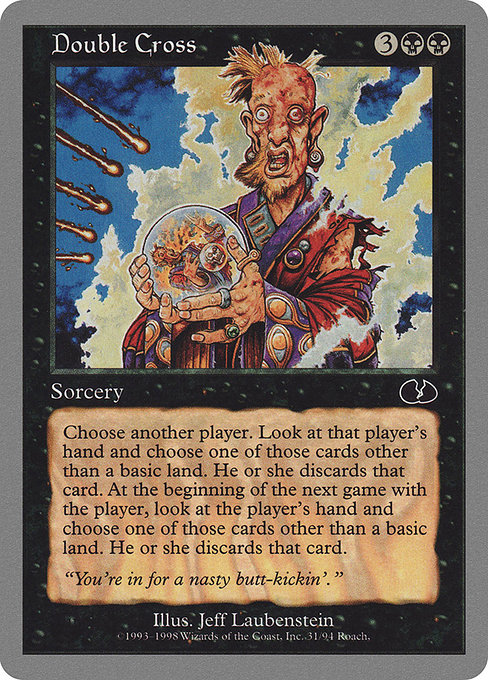
Image courtesy of Scryfall.com
Print Run Differences Across MTG Editions: A Closer Look at Double Cross
When we dip into the quirky corners of Magic: The Gathering, few cards scream “collectible and conversation-starting” like Double Cross. Born in the gleefully unorthodox Unglued set, this black-mana sorcery from 1998 rides the wave of silver border humor that defined a whole subgenre of the game. Its two-word, two-turn disruption effect invites players to think not just about what cards sit in a hand, but what narrative a table is willing to endure. 🧙♂️🔥
Print runs in MTG aren’t just a numbers game; they shape scarcity, foil opportunities, and the way a card ages in a collector’s eye. Double Cross exists in a rare niche: a common rarity card from a silver-bordered playful set. That means its distribution differs from modern print runs where border aesthetics, reprint frequency, and foil treatments skew toward high-volume releases and a wider pool of language variants. In Unglued, the river of copies is relatively shallow compared to mainstream sets, so seasoned players notice when a card appears in a binder or a sealed product and wonder, “How many copies did they actually print in this batch?” 🧭
From a design perspective, Double Cross is a perfect specimen for discussing how print runs interact with card design. Its mana cost—three generic and two Black—packs a hefty five-mana commitment for a strategic hand-disruption spell. The text asks you to choose a non-land card from an opponent’s hand and force a discard, then repeat the pressure at the beginning of the next upkeep in another game with that same player. The timing, the targeting, and the two-stage effect create a social dynamic that shines in multiplayer formats, where players weigh risk, alliance, and the possibility of getting blown up by a rival’s misplay. The art by Jeff Laubenstein—paired with a silver border that screams “funny but not tournament-legal”—cements the card as a relic of a particular era in MTG’s long history. The flavor text, “You’re in for a nasty butt-kickin’.”, mirrors the cheeky attitude of print runs designed to spark smiles and debates alike. 🎨⚔️
For collectors, the value of print-run differences often shows up in subtle places: edge quality in old scans, differences in border treatment, and the presence (or absence) of foil options in a given print run. Unglued cards, including Double Cross, typically carry a distinct market profile because they belong to a set whose identity rests on humor and novelty as much as on power. The card’s current price point—around a few dimes in USD and euros—reflects not only its utility on a tabletop but its enduring appeal as a conversation piece. A card with an enduring smile like this one reminds us that MTG’s print history isn’t just about values; it’s about memory and mischief interwoven through every edition. 💎
When evaluating print-run differences across editions in a broader sense, a few practical lenses help bridge nostalgia with data. Look for:
- Border and artwork presentation: Unglued’s silver border is a telltale sign of a playful, non-competitive stance. Reanalysis of border color, shrink-wrap texture, and printing processes can reveal how a card was distributed across print runs.
- Foil vs non-foil availability: Some sets emphasized foil variants; others did not. For a card like Double Cross, the nonfoil print is the documented standard, but cross-checking different print cycles can illuminate how scarcity shifted over time.
- Language and regional variants: A card’s reach can vary by language and market. Language variants can affect both value and availability in collectors’ circles, even if the card’s gameplay remains the same.
- Scarcity signals in first-run vs later reprints: If a card appears in later reprint sets or special products, the relative scarcity can flip quickly at markets and conventions, independent of its gameplay strength.
- Art and print quality over time: Restorations, high-resolution scans, and new print technologies can alter perceived quality. Wrestling with these signals is part of the fun of chasing print-run lore. 🧩
Beyond the numbers, Double Cross invites a broader reflection on MTG’s printing philosophy. The Unglued era leaned into taboo-breaking humor and playful rules-flouting, which in print form required a different balance of risk and reward than the standard sets. The “two-discard” mechanic is not about brute force; it’s about reading the table, calculating risk, and sometimes delivering a strategic misdirection that makes a night memorable. That is the sort of design flourish whose print-run story is as much about community memory as it is about raw stats. 🧙♂️🔥
For those who want to explore more about the network of MTG discourse and the wider world of card history, consider poking around the links below. Each portal offers a slice of the broader conversation on decks, editions, and the quirky corners where MTG fans gather to trade stories as freely as they trade cards. 🎲
Rugged Phone Case: Tough Impact-Resistant TPU/PC ShieldMore from our network
- https://blog.crypto-articles.xyz/blog/post/using-light-gray-stained-glass-in-minecraft-minigames/
- https://blog.crypto-articles.xyz/blog/post/nft-data-george-plays-clash-royale-954-from-gpcr-nft-collection-collection-on-magiceden/
- https://wiki.digital-vault.xyz/wiki/post/pokemon-tcg-stats-jumpluff-card-id-dp3-11/
- https://wiki.digital-vault.xyz/wiki/post/pokemon-tcg-stats-jynx-card-id-a3a-094/
- https://articles.zero-static.xyz/blog/post/predicting-deltarune-plot-twists-theories-and-clues/
Double Cross
Choose another player. Look at that player's hand and choose a card other than a basic land card from it. They discard that card. At the beginning of the first upkeep in your next game with that player, look at that player's hand and choose a card other than a basic land card from it. They discard that card.
ID: e8f90e34-3736-42ed-aade-e31247b3472d
Oracle ID: 34b44f16-f17d-47f5-aeaa-56bc7f13250e
Multiverse IDs: 5846
TCGPlayer ID: 848
Cardmarket ID: 11888
Colors: B
Color Identity: B
Keywords:
Rarity: Common
Released: 1998-08-11
Artist: Jeff Laubenstein
Frame: 1997
Border: silver
Set: Unglued (ugl)
Collector #: 31
Legalities
- Standard — not_legal
- Future — not_legal
- Historic — not_legal
- Timeless — not_legal
- Gladiator — not_legal
- Pioneer — not_legal
- Modern — not_legal
- Legacy — not_legal
- Pauper — not_legal
- Vintage — not_legal
- Penny — not_legal
- Commander — not_legal
- Oathbreaker — not_legal
- Standardbrawl — not_legal
- Brawl — not_legal
- Alchemy — not_legal
- Paupercommander — not_legal
- Duel — not_legal
- Oldschool — not_legal
- Premodern — not_legal
- Predh — not_legal
Prices
- USD: 0.19
- EUR: 0.17
More from our network
- https://wiki.digital-vault.xyz/wiki/post/pokemon-tcg-stats-komala-card-id-sv09-129/
- https://blog.digital-vault.xyz/blog/post/tel-jilad-stylus-classic-fantasy-art-homages-in-mtg/
- https://wiki.digital-vault.xyz/wiki/post/pokemon-tcg-stats-toedscool-card-id-sv03-118/
- https://transparent-paper.shop/blog/post/from-sketch-to-stitch-crafting-digital-embroidery-patterns/
- https://wiki.digital-vault.xyz/wiki/post/pokemon-tcg-stats-bronzong-g-card-id-pl1-41/