
Image courtesy of Scryfall.com
Divine Gambit as a Case Study in Mechanical Clustering
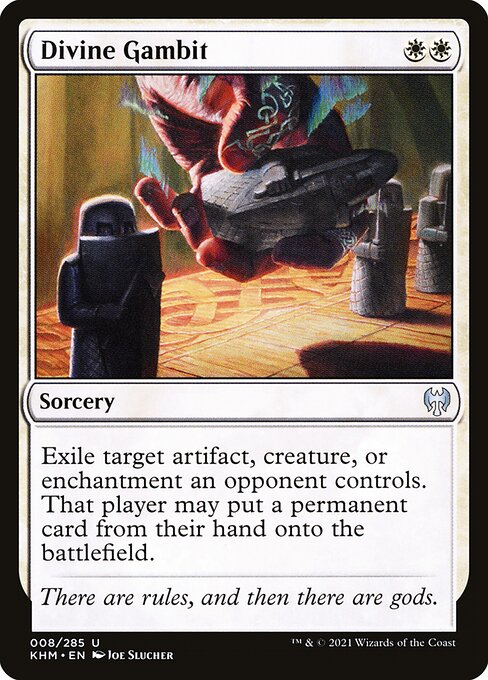
Magic: The Gathering fans love patterns. We cluster cards not just by color or mana cost, but by the rhythm of their abilities, the guarantees they offer, and the social dance they spark at the table. Divine Gambit, a white two-mana sorcery from Kaldheim, is a compact beacon for that kind of analysis. With a cost of {W}{W} and a two-part resolution, it embodies a classic MTG balancing act: remove the immediate obstacle, then hand your opponent a potential reward. It’s the kind of spell that makes you pause and think about the board state, your life total, and the shifting alliances around the table. 🧙♂️🔥💎
In practical terms, Divine Gambit exiles a target artifact, creature, or enchantment an opponent controls. The exile is the weapon—permanently removing a threat from play for the moment. But the spell’s second half is where the clustering magic happens: that same opponent may put a permanent card from their hand onto the battlefield. The choice created by that line folds timing, resource management, and table politics into a single decision point. This duality—hard disruption paired with a conditional accelerator—makes Divine Gambit a standout example of how white’s mechanics can mingle removal with opportunity in a way that feels declarative, not merely transactional. 🧩⚔️
Divine Gambit hails from Kaldheim, a set steeped in mythic flavor and Norse-inspired design. Its flavor text—“There are rules, and then there are gods.”—captures the tension between order and divine prerogative. The art by Joe Slucher reinforces that moment of judgment and consequence, a scene where a single spell can tilt a table, redefine threats, and upend immediate plans. The card’s rarity—uncommon—sits nicely in the spectrum of collectability, while its white color identity aligns with classic control and tempo impulses. The modern-era placement across formats like Historic, Modern (and, of course, Commander), reflects a design ethos where a compact payoff can scale from casual play to more serious strategic analysis. 🎨🧙♂️
Clustering by mechanics: two strong pillars
First pillar: exile as disruption with a political twist. Divine Gambit sits in a lineage of white spells that exile or remove threats, but its extra clause invites negotiation. The opponent’s option to drop a permanent from their hand onto the battlefield adds a layer of choice and risk, creating a dynamic where timing and intent matter as much as raw efficiency. In the broader clustering map, this places the card alongside other “exile-and-allow-play” archetypes—think of the family of spells that temporarily removes a problem, then introduces a new variable for the table to resolve. This is a recurring pattern in white’s toolbox, and Divine Gambit is a clean, teachable exemplar. 🧭
Second pillar: the social mechanics of a multiplayer meta. The card’s political charge is especially potent in Commander, where table talk, coalition-building, and threat-saturation drive many decisions. Exile removes a menace; the second half creates a moment of agreement or counterplay—who will capitalize on the opportunity, who will shield a locked-in plan, and who will pivot into a new engine? By clustering Divine Gambit with other control-to-political-transition spells, we can map how players anticipate risk, negotiate outcomes, and leverage face-to-face dynamics to gain advantage. It’s not just about what the spell does; it’s about how it reshapes the social game around it. 🔥🤝
Flavor, design, and the broader design space
Design-wise, Divine Gambit embodies a deliberate white-based tension between forceful removal and the mercy that grants a future option. The second clause—allowing the opponent to put a permanent onto the battlefield—serves as a design invitation: you’re not just pruning the board; you’re presenting a potential seed for the next phase of the game. This dual-track design supports clustering across sets that explore “control plus conditional advantage” as a core mechanic. The Kaldheim block’s mythic center and the art’s ceremonial tone reinforce the feeling that you’re weighing a divine decree against human decision-making. It’s a smart balance of flavor and function, and a vivid reminder that sometimes the most interesting cards are the ones that force you to negotiate every turn. 🎭✨
Beyond the math, Divine Gambit is a useful teaching tool for new players and veteran deckbuilders alike. It demonstrates how a single spell can be analyzed in multiple frames: as removal, as a tempo-lagger, as a social lever, and as a piece of a larger “exile-and-play” cluster. When you map these clusters across a metagame or a collection, you begin to see the recurring motifs that connect cards from different sets, eras, and formats. The result is not just a better deck builder; it’s a deeper appreciation of MTG’s mechanical grammar and its storytelling voice. 🧠🎲
Non-Slip Gaming Mouse Pad 9.5x8More from our network
- https://crypto-acolytes.xyz/blog/post/nft-stats-nunu-nft323-from-nunu-collection/
- https://crypto-acolytes.xyz/blog/post/nft-stats-planet-kaiju-6571-from-planet-kaiju-collection/
- https://crypto-acolytes.xyz/blog/post/nft-stats-george-plays-clash-royale-epic-260-from-gpcr-nft-collection-collection/
- https://10-vault.zero-static.xyz/2527b03f.html
- https://blog.crypto-articles.xyz/blog/post/nft-data-vintharis-shattered-54-from-risen-collection-on-magiceden/
Divine Gambit
Exile target artifact, creature, or enchantment an opponent controls. That player may put a permanent card from their hand onto the battlefield.
ID: 696a8c12-4a1f-4b96-a921-538fa1a2de43
Oracle ID: 25fcf381-6f0a-49ef-9c41-f202be7d8368
Multiverse IDs: 503612
TCGPlayer ID: 230198
Cardmarket ID: 530507
Colors: W
Color Identity: W
Keywords:
Rarity: Uncommon
Released: 2021-02-05
Artist: Joe Slucher
Frame: 2015
Border: black
EDHRec Rank: 16144
Set: Kaldheim (khm)
Collector #: 8
Legalities
- Standard — not_legal
- Future — not_legal
- Historic — legal
- Timeless — legal
- Gladiator — legal
- Pioneer — legal
- Modern — legal
- Legacy — legal
- Pauper — not_legal
- Vintage — legal
- Penny — not_legal
- Commander — legal
- Oathbreaker — legal
- Standardbrawl — not_legal
- Brawl — legal
- Alchemy — not_legal
- Paupercommander — not_legal
- Duel — legal
- Oldschool — not_legal
- Premodern — not_legal
- Predh — not_legal
Prices
- USD: 0.04
- USD_FOIL: 0.14
- EUR: 0.04
- EUR_FOIL: 0.25
- TIX: 0.03
More from our network
- https://wiki.digital-vault.xyz/wiki/post/pokemon-tcg-stats-persian-card-id-sv035-053/
- https://articles.digital-vault.xyz/blog/post/anoriths-cambrian-roots-tcg-card-design-revealed/
- https://crypto-acolytes.xyz/blog/post/nft-stats-vault-runners-1831-from-vault-runners-collection/
- https://crypto-acolytes.xyz/blog/post/understanding-solana-token-standards-spl-vs-erc-20/
- https://blog.crypto-articles.xyz/blog/post/nft-data-bagtardio-809-from-bagtardio-collection-on-magiceden/