
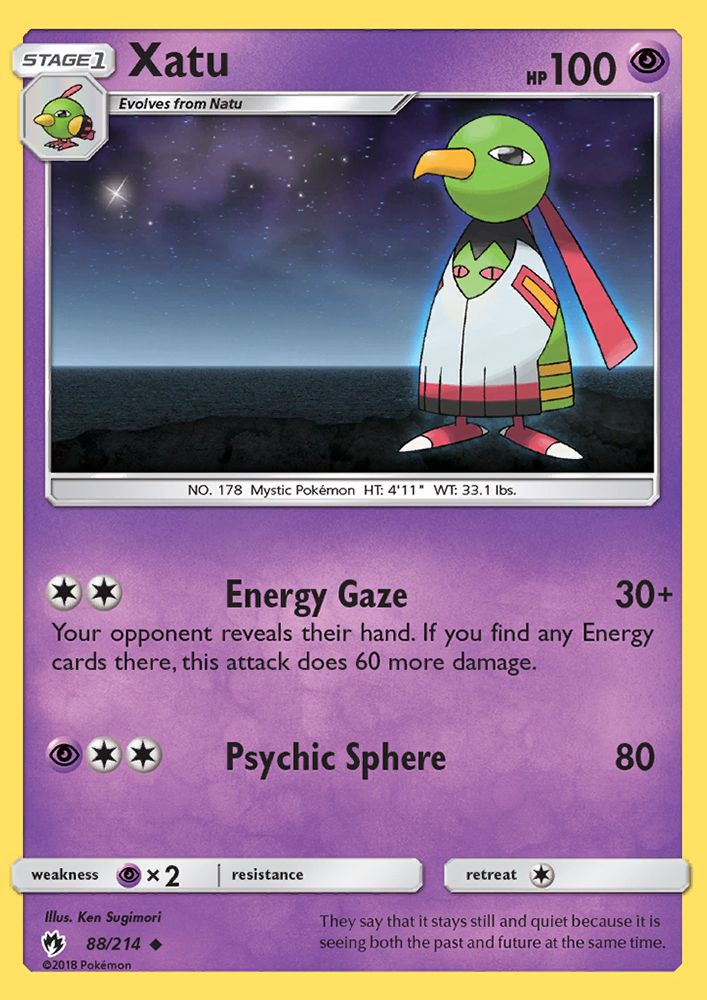
Image courtesy of TCGdex.net
Pricing Xatu: A practical approach to valuing Lost Thunder’s Psychic Scout
For Pokémon TCG collectors and players, understanding how to determine a card’s price is as much an art as a science. Xatu (sm8-88) from the Lost Thunder expansion sits in the Psychic family, a Stage 1 creature that evolves from Natu and boasts a respectable 100 HP. With two distinct attacks — Energy Gaze and Psychic Sphere — and a weakness to Psychic, this card sits at a crossroads between playability and collectibility. By examining both market data and the card’s unique characteristics, you can arrive at a thoughtful price range that reflects condition, variant, and demand. ⚡🔥
What this Xatu is and why it matters for price
- Rarity and set: Uncommon from Lost Thunder (SM8). The Lost Thunder set features a broad list of Pokémon from across the Sun & Moon era, making Uncommons like Xatu intriguing for binder completeness and niche deck builds.
- Stage and evolution: Stage 1, evolving from Natu. This lineage matters because price often increases when a stage evolution is critical to a deck’s early-game momentum or binder value.
- HP and offense: 100 HP with two attacks: Energy Gaze (30+ for Colorless, with an ability to add 60 more damage if the opponent reveals Energy cards in hand) and Psychic Sphere (80 for Psychic plus Colorless). The interplay between information disruption and solid damage makes it a desirable card for some players and collectors alike.
- Weakness and retreat: Weakness to Psychic (×2) and a low retreat cost (1) keep it friendly for casual and some semi-competitive play, which can support steady demand in the market.
- Legal status: Expanded format legality (not Standard). This expands the pool of potential buyers and traders, especially among collectors who still actively chase Expanded-era cards.
Illustrated by Ken Sugimori, Xatu’s artwork is part of the nostalgia that keeps older sets relevant. The aesthetics matter; cards with beloved art and recognizable artists often carry a premium to dedicated fans who want a complete Lost Thunder display. The holo, reverse holo, and regular variants each tell a slightly different price story, with holo copies typically commanding higher values than their non-holo counterparts. 🎨
Interpreting current price data: Cardmarket and TCGplayer snapshots
Two major marketplaces offer a window into Xatu’s market value: Cardmarket (EUR) and TCGplayer (USD). The card data for sm8-88 shows concrete numbers that help frame a practical price range today.
- Cardmarket (EUR) – non-holo typical averages sit around €0.24, with a broad low near €0.02. The holo variant shows higher activity and price signals, with an average around €0.56 for holo listings and a trend signal around 0.52. This difference highlights how variant type directly influences price and how supply can swing based on holo prevalence in Loose/Binders versus sealed product pull rates. The holo market often reflects stronger demand among collectors who chase shiny versions, while non-holo copies drift closer to the lower end of the spectrum.
- TCGplayer (USD) – non-holo normal copies range from a low around $0.08 to a high near $1.49, with a market price hovering around $0.18. For reverse-holo and holo copies, the ranges widen: low prices around $0.15 (non-holo) or slightly higher for holo, mid prices around $0.33 (holo) to $0.21 (non-holo), and highs climbing up to roughly $1.51 for holo variants. The market price for holo tends to be higher than non-holo, reflecting collector demand and visibility in search results. These figures illustrate how condition, listing format, and seller incentives shape real-world values day-to-day.
Together, these figures sketch a practical rubric: expect a modest baseline for plain copies, with a meaningful uplift for holo and reverse-holo varieties. Keep in mind that “avg” prices smooth over seasonal spikes; during market booms or card-scarcity events, you may see short-term deviations that traders quickly exploit or smooth out as listings refresh. The key is to compare like-for-like variants and confirm recent sold prices rather than relying solely on listed prices. 💎
How to determine value in practice: a step-by-step approach
- Identify the exact variant — Normal, Reverse Holo, or Holo. The pricing delta is the largest driver of value here.
- Check recent sold listings on both Cardmarket and TCGplayer. Sold data is more telling than asking prices, especially for uncommon cards with fluctuating supplies.
- Assess condition — binder-grade copies fetch less than near-mint copies. Consider grading or protective storage if you aim to maximize value over time.
- Account for legality and use — Expanded-legal Xatu remains relevant for collectors and players who favor older formats, which can sustain price levels even when Standard sets rotate.
- Compare across marketplaces — cross-listing can help you capture different buyer pools. A holo copy might sell quickly on one platform but linger on another, especially if shipping or fees differ.
- Be patient but strategic — market velocity varies with holidays, product releases, and local tournaments. If you’re a seller, time your listing to align with peak buyer interest.
In practice, a well-listed Xatu sm8-88 (holo or reverse-holo) can fetch a price that sits above the non-holo baseline, particularly if you’ve got a near-mint copy. For buyers, maintaining vigilance on price trends across the two major platforms helps you spot a fair deal before the next market swing. And if you’re curating a Lost Thunder binder, the aesthetics and narrative around Xatu—its Psychic gaze and the strategic edge of its Ego-driven mechanic—lend themselves to both play and display. 🎴
Pairing market sense with a touch of practicality
Beyond the math, there’s a subtle art to pricing that seasoned collectors recognize. Xatu’s place in Lost Thunder fans’ hearts, its evolving-from-Natu lineage, and Ken Sugimori’s art combine to create a card that’s both usable in certain decks and desirable in a finished collection. The price tends to reflect not only the card’s mechanical heft but also its resonance in the broader TCG story—older sets, beloved artists, and the thrill of seeing a complete Lost Thunder lineup on a shelf or a display binder. If you’re looking to upgrade your desk while you research prices, consider pairing your hunt with a clean, reliable surface accessory—like a Gaming Mouse Pad Custom 9x7 Neoprene with Stitched Edges. It’s a modern nod to the tactile world of TCG collecting while you navigate the market data. Gaming Mouse Pad Custom 9x7 Neoprene with Stitched Edges ⚡🎮
Whether you’re a buyer chasing a bargain or a seller aiming to optimize a listing, Xatu from Lost Thunder offers a reliable case study in how variant, condition, and market dynamics intertwine. The card’s 100 HP, Psychic typing, and dual-attack kit give it a practical niche in Expanded environments, while its Uncommon rarity keeps it accessible for many collections. As you monitor Cardmarket’s €0.24 baseline for non-holo and the higher holo bands on TCGplayer, you’ll develop an intuitive sense for when Xatu is a slam-dunk pickup and when it’s worth waiting for a dip in listings or a seasonal price shift. 🔍💎
Gaming Mouse Pad Custom 9x7 Neoprene with Stitched EdgesMore from our network
- https://blog.crypto-articles.xyz/blog/post/nft-data-george-plays-clash-royale-990-from-gpcr-nft-collection-collection-on-magiceden/
- https://blog.digital-vault.xyz/blog/post/sirfetchd-across-regions-a-tour-of-regional-art-styles/
- https://wiki.digital-vault.xyz/wiki/post/pokemon-tcg-stats-dratini-card-id-base5-53/
- https://blog.crypto-articles.xyz/blog/post/nft-data-george-plays-clash-royale-714-from-gpcr-nft-collection-collection-on-magiceden/
- https://blog.digital-vault.xyz/blog/post/tracking-bramblecrushs-silver-border-price-volatility/
Xatu
Set: Lost Thunder | Card ID: sm8-88
Card Overview
- Category: Pokemon
- HP: 100
- Type: Psychic
- Stage: Stage1
- Evolves From: Natu
- Dex ID: 178
- Rarity: Uncommon
- Regulation Mark: —
- Retreat Cost: 1
- Legal (Standard): No
- Legal (Expanded): Yes
Description
Attacks
| Name | Cost | Damage |
|---|---|---|
| Energy Gaze | Colorless, Colorless | 30+ |
| Psychic Sphere | Psychic, Colorless, Colorless | 80 |
Pricing (Cardmarket)
- Average: €0.24
- Low: €0.02
- Trend: €0.2
- 7-Day Avg: €0.25
- 30-Day Avg: €0.16
Support Our Decentralized Network
Donate 💠More from our network
- https://blog.crypto-articles.xyz/blog/post/nft-data-george-plays-clash-royale-990-from-gpcr-nft-collection-collection-on-magiceden/
- https://blog.digital-vault.xyz/blog/post/sirfetchd-across-regions-a-tour-of-regional-art-styles/
- https://wiki.digital-vault.xyz/wiki/post/pokemon-tcg-stats-dratini-card-id-base5-53/
- https://blog.crypto-articles.xyz/blog/post/nft-data-george-plays-clash-royale-714-from-gpcr-nft-collection-collection-on-magiceden/
- https://blog.digital-vault.xyz/blog/post/tracking-bramblecrushs-silver-border-price-volatility/