

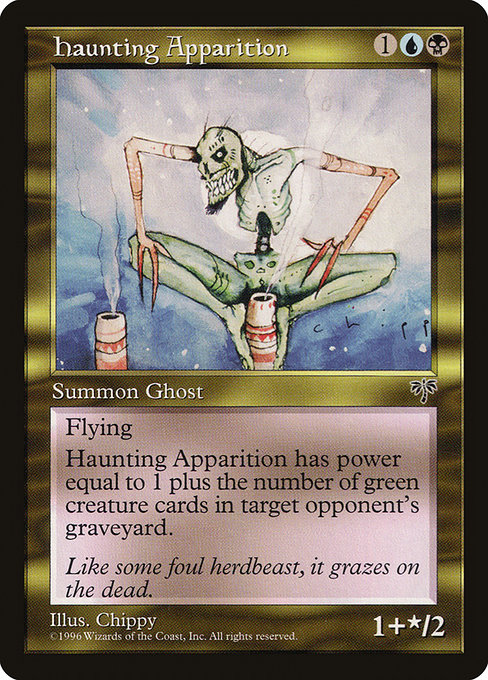
Image courtesy of Scryfall.com
Innovation Within Constraints: Haunting Apparition and the Mirage Era
Magic: The Gathering has always thrived on the tension between imagination and limitation. Designers sketched worlds with bright ideas while wrangling them into clean, balanced cards that feel inevitable once you lean into the colors and mechanics. The Mirage era — a mid-90s sandbox where אלchemy met the limits of power with a dash of experimentation — is a masterclass in making the most of constraints. One standout example is Haunting Apparition, a blue-black creature with Flying that arrives with a clever twist: its strength scales with the graveyard of a chosen opponent. 🧙♂️🔥
With a mana cost of {1}{U}{B}, Haunting Apparition sits in the all-important three-mana range, a sweet spot for tempo plays and evasive pressure. The card is an uncommon from Mirage, a set that embraced more hybrid and multi-color opportunities before the modern color-pie rigidity became the norm. That flexibility is precisely the kind of constraint-driven design that yields innovation. The card’s text — “Flying. As this creature enters, choose an opponent. Haunting Apparition's power is equal to 1 plus the number of green creature cards in the chosen player's graveyard.” — reads like a design puzzle: how do you make a 3-cost sprite of a Spirit feel impactful without bending the power curve? The answer is a carefully calibrated mechanic that rewards strategic thinking and inter-player interaction. 🎲🎨
Like some foul herdbeast, it grazes on the dead. — Mirage flavor text
Consider the constraints of Mirage’s era: the limited print runs, the pre-dominance of multi-color experimentation, and the need to keep each card from breaking the developing game balance. Haunting Apparition leans into those boundaries with a clean, elegant condition. The “choose an opponent” ETB trigger creates a social dimension to combat, nudging players to consider which opponent carries the gravestyard of green creatures. In a blue-black two-color shell, you get a blend of evasion (flying) and graveyard-aware planning that feels both strategic and thematic. The result is a design that anticipates future iterations: a card that invites you to think about your opponent’s board state, not just your own. 🧙♂️⚔️
How the constraint shapes play
- Evasion with a variable punch: The baseline is a 1/2 flyer for three mana, a respectable deliverable for midgame pressure. But because its power scales with the opponent’s graveyard greens, it can spike if an opponent’s graveyard is dense with green creatures. This creates a dynamic where you must weigh which opponent you select at entry — a tiny but meaningful allocation of agency that mirrors classic control-versus-midrange battles.
- Cross-color synergy within the color pie: The blue-black color pair traditionally leans on disruption, card draw, and graveyard interaction. Haunting Apparition doesn’t break that mold; it exerts pressure while inviting you to leverage the graveyard as a resource. The constraint—power tied to an opponent’s graveyard—transforms a straightforward evasive creature into a micro-puzzle piece that rewards careful planning and timing.
- Rarity and pacing considerations: Placed as an uncommon in Mirage, Haunting Apparition maintains the set’s pace by offering a deck-building incentive without overpowering limited formats. It’s the kind of card that players draft around, rather than through, because its true value lies in how its power grows with the game state rather than a static stat line. 💎
For players who love the interplay between graveyards and the battlefield, Haunting Apparition is a reminder that constraints can be a muse, not aLimit. Its three-mana cost, restricted power dynamic, and the requirement to select an opponent at the moment it enters all push you toward planning ahead—just enough to reward smart play without sacrificing the elegant, old-school vibe of Mirage. 🎲
Design takeaways for modern builders
- Constraint as a feature: When you tether a card’s power to a variable external condition (here, the chosen opponent’s graveyard), you invite variability and tactical depth without needing an inflated mana cost or a complex keyword suite. This is a blueprint for reusing simple rules to generate emergent play patterns.
- Flavor guiding mechanics: The flavor text and the card art reinforce the design: a phantom that borrows from the dead to menace the living. Thematically, the constraint aligns with the haunting motif and helps players remember why the card exists beyond numbers on a page. 🧙♂️
- Accessibility and nostalgia: Mirage’s era was a playground of early MTG experimentation. Designing within constraints that were, at the time, practical and fair yields a nostalgia-rich toolkit for contemporary designers who want to honor old-school sensibilities while pushing new ideas forward.
From a collector’s perspective, Haunting Apparition marks a moment in time when designers balanced novelty with accessibility. It’s not the flashiest card of the Mirage set, but for thrifty collectors and theory-minded players, it remains a vivid reminder of how constraints can become a creative engine. Its rarity as an uncommon and its Mirage provenance contribute to its charm, especially for players who savor historical design alongside modern mechanics. The art by Chippy captures the ethereal nature of the scare while the green-centered interaction hints at a broader meta-game about which graveyards matter most in a given matchup. 🎨🧊
In today’s design conversations, we still see this line of thinking: constraints aren’t walls; they’re templates for elegant solutions. Haunting Apparition demonstrates that a card doesn’t need to do everything at once to be meaningful. It can instead do a few things exceptionally well, then invite the table to decide how much it will matter in each game. That’s the essence of innovation within limits—and it’s timeless in the MTG design diary. 🔥
If you’re hunting for a touch of Mirage-era magic in your collection or just love pondering how constraints shape creative outcomes, there’s a practical parallel in today’s tech-accessory world as well. For a modern bit of utility that keeps your device safe without sacrificing style, consider a sleek, ultra-thin case from our shop. The product below echoes the spirit of minimalism and thoughtful design—compact, efficient, and sharp enough to ride the edge of the latest trends.
Slim Phone Case for iPhone 16More from our network
- https://crypto-acolytes.xyz/blog/post/nft-stats-non-fungible-token-1626-from-non-fungible-tokens-collection/
- https://blog.rusty-articles.xyz/blog/post/neon-custom-mouse-pad-non-slip-low-profile-consistent-day-one-performance/
- https://blog.crypto-articles.xyz/blog/post/nft-data-pumpixels-227-from-pumpixels-collection-on-magiceden/
- https://blog.digital-vault.xyz/blog/post/analyzing-thousand-legged-kami-flavor-text-sentiment/
- https://blog.crypto-articles.xyz/blog/post/nft-data-planet-kaiju-3283-from-planet-kaiju-collection-on-magiceden/
Haunting Apparition
Flying
As this creature enters, choose an opponent.
Haunting Apparition's power is equal to 1 plus the number of green creature cards in the chosen player's graveyard.
ID: 8ce9c58f-6470-4e0f-8f6b-457fbaac7451
Oracle ID: ced9130c-2865-49df-abdd-84069aa1b180
Multiverse IDs: 3538
TCGPlayer ID: 5098
Cardmarket ID: 8378
Colors: B, U
Color Identity: B, U
Keywords: Flying
Rarity: Uncommon
Released: 1996-10-08
Artist: Chippy
Frame: 1997
Border: black
EDHRec Rank: 29715
Penny Rank: 14730
Set: Mirage (mir)
Collector #: 267
Legalities
- Standard — not_legal
- Future — not_legal
- Historic — not_legal
- Timeless — not_legal
- Gladiator — not_legal
- Pioneer — not_legal
- Modern — not_legal
- Legacy — legal
- Pauper — not_legal
- Vintage — legal
- Penny — legal
- Commander — legal
- Oathbreaker — legal
- Standardbrawl — not_legal
- Brawl — not_legal
- Alchemy — not_legal
- Paupercommander — not_legal
- Duel — legal
- Oldschool — not_legal
- Premodern — legal
- Predh — legal
Prices
- USD: 0.18
- EUR: 0.12
- TIX: 0.04
More from our network
- https://wiki.digital-vault.xyz/wiki/post/pokemon-tcg-stats-apricorn-forest-card-id-ecard2-118/
- https://wiki.digital-vault.xyz/wiki/post/pokemon-tcg-stats-eelektrik-card-id-sm11-65/
- https://crypto-acolytes.xyz/blog/post/nft-stats-pedale-ale-1830-from-beer2-collection/
- https://wiki.digital-vault.xyz/wiki/post/pokemon-tcg-stats-hisuian-basculegion-card-id-swshp-swsh205/
- https://blog.crypto-articles.xyz/blog/post/nft-data-heavenware-6-from-heavenware-collection-on-magiceden/