
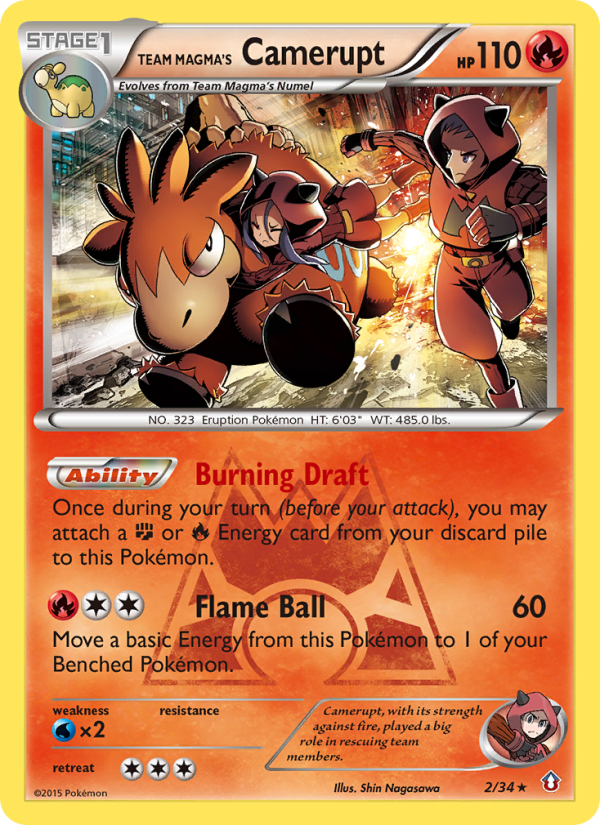
Image courtesy of TCGdex.net
Design Constraints Behind Team Magma's Camerupt Mechanics
When you open a Forbidden-Volcano of strategies in the Double Crisis era, Team Magma's Camerupt stands as a textbook example of how a Pokémon card’s mechanics are squeezed by a tangle of flavor, balance, and limited toolkits. At first glance, Camerupt is a fiery Stage 1 with 110 HP, evolving from Team Magma's Numel, and sporting an ability and an attack that feel purposefully constrained to a single theme: accelerate your own energy while fueling a board-wide tempo shift. The card’s Fire typing, fighting a common Energy-typing pair in the era, nods to the Team Magma narrative—volcanic power that must be carefully tamed to avoid steamrolling a match. ⚡🔥
From a design perspective, the Burning Draft ability is a masterclass in constraint-driven utility. Once per turn, you may attach a Fighting or Fire Energy card from your discard pile to Camerupt. This is not a free energy cheat; it requires you to manage the discard pile and to plan energy flow across turns. The constraint encourages players to weave Camerupt into decks that leverage discard-energy recursion, rather than simply piling onto a single heavy attacker. In practice, that means balancing “what to discard” with “what to pull back,” a delicate dance that keeps the card honest in both early-game skirmishes and late-game finishers. The design echoes a broader tactic in the game’s early 2010s: synergy between niche abilities and energy acceleration, without letting any single mechanic overshadow the rest of the deck. 💎🎴
The Flame Ball attack, costing Fire plus two Colorless, delivers a solid 60 damage and carries a practical battlefield effect: move a basic Energy from this Pokémon to a benched one. This energy shunting is not merely damage output; it’s a tempo engine. It invites players to engineer a bench to receive the moved energy, enabling Camerupt to set up the next attacker or to enable quick “wipe-and-rotate” plays. The mechanic embodies a core constraint of the era: power must be earned through careful energy budgeting and board positioning, not through raw, repeatable power. The retreat cost of 3 reinforces the pricing of risk—Camerupt is sturdy enough to withstand hits but costly to relocate once entrenched on a single zone of the board. The effect also nudges players toward multi-attacker strategies, a hallmark of Double Crisis’s thematic pairing of Team Magma and Team Aqua. 🔥⚡
Balancing Theme and Mechanics
Illustrated by Shin Nagasawa, Camerupt’s art is a visual echo of its mechanical constraints: molten energy, volcanic energy rails, and a creature designed to be both a force-in-wight and a flexible energy conduit. The card’s rarity—Rare—reflects its status as a key piece in a specific archetype rather than a ubiquitous engine. This rarity choice hints at a crafted role: Camerupt should be powerful enough to justify a strategic slot, yet rare enough to leave space for players to experiment with other Fire-type and Team Magma tools within the Double Crisis ecosystem. The card sits in the expanded pool for modern play, with standard play off-limits in this particular snapshot of the era, a constraint that nudges players toward nostalgic, tempo-based builds rather than raw, all-in power. 🕯️🎨
From a collecting and market perspective, the card’s price narrative adds another layer to its design constraints. Cardmarket data shows a typical holo trend around a few euros, with average values hovering in the low-to-mid range and occasional spikes for holofoil prints. TCGplayer’s holofoil values tell a similar story: a broad spectrum from sub-dollar entries to single-digit highs for a handful of copies. This price structure rewards players who lean into complete archetypes or chase pristine holo cards, while still offering budget options for those who want to experience the mechanic’s thrill without a premium sticker. Such market dynamics reinforce the idea that Camerupt was designed to be a recognizable, thematic staple that could anchor a deck while remaining accessible to a broad audience. 💎📈
Design Constraints in Practice: Deckbuilding and Strategy
- Tempo and energy management: Burning Draft creates a target for discard-pile interactions, compelling players to sequence their energy pulls and bench setups. You’ll want to plan which Fire or Fighting Energy to pull and when to attach it, all while ensuring Camerupt’s own Energy remains aligned with Flame Ball’s payoff. 🔥
- Energy mobility as a core mechanic: Flame Ball’s energy-shifting effect rewards smart bench placement. Move energy to a future threat instead of keeping it tethered to Camerupt, enabling follow-up turns with built-up threat density. ⚡
- Risk vs. reward in retreat management: With a retreat cost of 3, Camerupt invites thoughtful retreat decisions—when to pull Camerupt back to protect your board versus forcing a risky push with a more vulnerable attacker on the field. 🛡️
- Flavor supports function: The Team Magma theme—volcanic fury that requires careful handling—drives the disruption-versus-sustain balance, ensuring that the card remains thematic while still being a practical choice in theExpanded format. 🔥🎭
For players who relish lore and visuals, Camerupt’s evolution from Numel adds another layer of constraint: you’re telling a narrative of growth and power, not just stacking numbers. The art by Shin Nagasawa captures the magnetic pull between magma and battlefield strategy, inviting collectors to appreciate the synergy between story and play. This blend—mechanics tethered to narrative, and rarity tied to usefulness—helps explain why Camerupt remains a memorable piece from Double Crisis. 🎮🧩
Putting It All Together: Why These Constraints Work
In the end, Team Magma's Camerupt isn’t just a card with a neat combo. It embodies a design philosophy that values: strategic energy circulation, thematic alignment with the Fire- and Team Magma-centered arc, balanced but meaningful power, and a collectible aura that remains accessible. The constraints push players toward thoughtful deck construction rather than brute force, rewarding those who map out long-term energy trajectories and bench readiness. The result is a card that feels at once iconic and instructive—a snapshot of a specific moment in the Pokémon TCG’s ongoing evolution. ⚡💥
Neon Phone Case with Card Holder MagSafe (Impact Resistant)More from our network
- https://crypto-acolytes.xyz/blog/post/cryengines-influence-on-pc-graphics-redefining-realism/
- https://blog.rusty-articles.xyz/blog/post/shantotto-tactician-magician-sideboard-tech-to-neutralize-it/
- https://blog.crypto-articles.xyz/blog/post/nft-data-solidskulls-1236-from-solidskulls-collection-on-magiceden/
- https://crypto-acolytes.xyz/blog/post/iconic-mmorpg-raids-that-shaped-gaming-history/
- https://wiki.digital-vault.xyz/wiki/post/pokemon-tcg-stats-aerodactyl-card-id-a3a-098/
Team Magma's Camerupt
Set: Double Crisis | Card ID: dc1-2
Card Overview
- Category: Pokemon
- HP: 110
- Type: Fire
- Stage: Stage1
- Evolves From: Team Magma's Numel
- Dex ID: 323
- Rarity: Rare
- Regulation Mark: —
- Retreat Cost: 3
- Legal (Standard): No
- Legal (Expanded): Yes
Description
Abilities
-
Burning Draft — Ability
Once during your turn (before your attack), you may attach a Fighting or Fire Energy card from your discard pile to this Pokémon.
Attacks
| Name | Cost | Damage |
|---|---|---|
| Flame Ball | Fire, Colorless, Colorless | 60 |
Pricing (Cardmarket)
- Average: €3.54
- Low: €1
- Trend: €3.28
- 7-Day Avg: €3.6
- 30-Day Avg: €3.65
Support Our Decentralized Network
Donate 💠More from our network
- https://crypto-acolytes.xyz/blog/post/cryengines-influence-on-pc-graphics-redefining-realism/
- https://blog.rusty-articles.xyz/blog/post/shantotto-tactician-magician-sideboard-tech-to-neutralize-it/
- https://blog.crypto-articles.xyz/blog/post/nft-data-solidskulls-1236-from-solidskulls-collection-on-magiceden/
- https://crypto-acolytes.xyz/blog/post/iconic-mmorpg-raids-that-shaped-gaming-history/
- https://wiki.digital-vault.xyz/wiki/post/pokemon-tcg-stats-aerodactyl-card-id-a3a-098/