
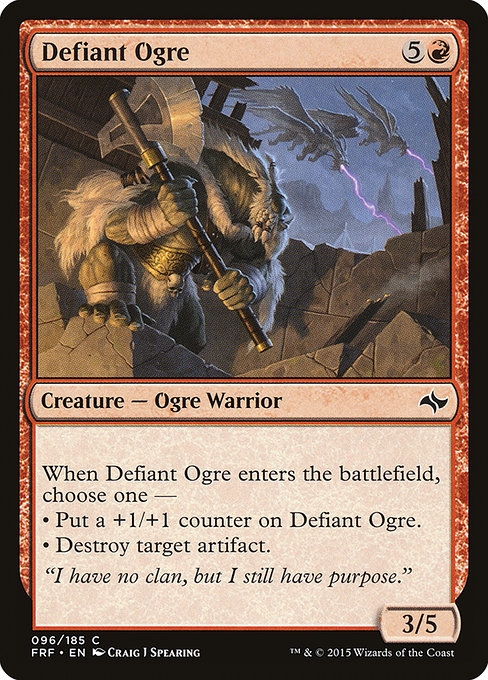
Image courtesy of Scryfall.com
The Evolution of Enchantment Design in MTG
Enchantment design in Magic: The Gathering has long stood as the game’s quiet engine, shaping how players interact with the battlefield long after the initial spell resolves. From the earliest auras that attached to creatures to the grand, color-drenched lodestars of modern design, enchantments have evolved into a language of strategic nuance that rewards foresight, board presence, and a little bit of risk. 🧙♂️ In recent years, we’ve seen designers lean into modular choices, modal effects, and durable interactions that feel equally at home on a kitchen-table table as on a high-level tournament stage. The story of this evolution isn’t just about mechanics; it’s about how the game teaches you to read the board and think two or three turns into the future. 🔥
To anchor this exploration in a concrete moment, consider Defiant Ogre from Fate Reforged (FRF). This red creature is a reminder that MTG’s enchantment-inspired thinking often lives in the fringes—where a single, flexible line of play can tilt the outcome. For a red creature spell with a hefty mana cost of five and a single red mana (total converted mana cost 6), its presence on the battlefield introduces a classic red tension: raw power intersecting with utility. Defiant Ogre is a 3/5 Ogre Warrior that arrives with an Enter-the-Battlefield mode: either put a +1/+1 counter on itself or destroy a target artifact. It’s a design that dances along the border of auras, artifacts, and creature-based ETB triggers, and that dance is exactly where enchantment design has learned to grow. Flavor text—“I have no clan, but I still have purpose.”—gives the card character and a sense of personal destiny that mirrors how enchantments can tell stories beyond their stat lines. 🧠⚔️
What makes this card a touchstone isn’t just the mechanics themselves, but how they reflect a broader arc in enchantment design. Enchantments have always offered players a way to invest in the long game: auras that buff, shield, or enchant a key threat, then stick around to pressure the board. Over time, designers started to blur the lines between enchantments and other permanent types with flexible, one-card decisions that resemble both spells and auras. Defiant Ogre embodies that evolution in spirit: it’s a creature with a choice that reveals two paths—growth (a counter) or removal (artifact destruction). That duality is the DNA of enchantment design maturing into modular, choice-driven tempo. 🧙♂️
“I have no clan, but I still have purpose.”
The echo of that line can be heard in the way modern enchantments frame decisions as meaningful moments—when you choose to pump a creature to enable a bigger combat blow later, or when you pick off a troublesome artifact to prevent a late-game swing. Fate Reforged sits at a hinge point in MTG’s timeline, where the game began weaving more concrete, color-affine identity into its cards. Defiant Ogre, as a red, common creature with a just-right mana cost, exemplifies how designers can push red’s archetypal strengths—aggression, artifact hate, and a dash of chaotic utility—without sacrificing clarity. And because it’s common, this concept reaches a broad audience: everyday decks, budget builds, and new players all feel the weight of a well-designed ETB choice. 💎
From a collector and player perspective, the card’s artwork by Craig J. Spearing and its 3/5 body deliver a compelling impression of stubborn resilience and battlefield inevitability. The flavor of being unaligned with a clan but still driven speaks to a broader design philosophy: cards don’t need to be dramatic splashy removals to influence choice; they can present a compact, thematic decision that rewards smart play and careful timing. The “choose one” effect is a miniature enchantment within a creature frame, proving that enchantment design isn’t confined to a single card type—it’s a philosophy about how players anticipate, react, and encode information on the table. 🎨
Why modal and ETB effects feel like enchantments in practice
Modal effects—choose one or more options at resolution—offer a template that enchantments have long exploited: the idea that a single card can present multiple, distinct lines of play. Defiant Ogre’s two paths echo the way enchantments fold multiple advantages into one artifact or spell. In the years since Fate Reforged, MTG has embraced modal spells, kicked-up multi-option effects, and cards that scale with the board state. These are all threads in the same tapestry: enchantment design that rewards foresight and board-state reading. The Ogre’s ETB trigger is a microcosm of this trend, a reminder that the most elegant design often sits at the edge of two discrete outcomes—growth and removal—and asks you to decide which path defines your moment of momentum. 🧭⚡
As we trace this arc, it’s hard not to notice how newer enchantments lean into durability and versatility. From mana-cost-efficient auras that enable quick interactions to enchantments that hinge on creature- or artifact-centric synergies, the field has grown into a landscape where the best cards are those that teach players to see two or three turns ahead. Defiant Ogre may not be an enchantment by card type, but its design language—flexible ETB choices, synergy with artifacts, and a strong board presence—embodies the way MTG has evolved its enchantment design ethos: modular, readable, and rewarding deep tactical planning. 🔥💎
For readers who love the interplay of lore, art, and mechanics, this is where the magic of MTG truly shines. The Fate Reforged era introduced a sense of branching destiny in a red card’s soul—the Ogre’s purpose outside its clan, the story behind its fight, and the practical impact of its choices on the battlefield. It’s a reminder that enchantment design isn’t just about what a card does; it’s about how a card invites you to craft a narrative on the table, one well-placed decision at a time. 🧙♂️🎲
Rugged Phone Case for iPhone & Samsung – Impact ResistantMore from our network
- https://wiki.digital-vault.xyz/wiki/post/pokemon-tcg-stats-basculin-card-id-sv105w-108/
- https://crypto-acolytes.xyz/blog/post/nft-stats-solzilla-182-from-solzillas-collection/
- https://articles.zero-static.xyz/blog/post/how-purugly-teaches-balance-in-pokemon-tcg-design-principles/
- https://blog.crypto-articles.xyz/blog/post/nft-data-boom_1-140-from-branches-of-our-mind_1-collection-on-magiceden/
- https://blog.crypto-articles.xyz/blog/post/nft-data-goatys-724-from-goatys-collection-on-magiceden/
Defiant Ogre
When this creature enters, choose one —
• Put a +1/+1 counter on this creature.
• Destroy target artifact.
ID: 09cfd3d5-1b44-4dc7-b35d-703f3a75da88
Oracle ID: db849660-1ad4-4af4-8822-40ba6c0b6d73
Multiverse IDs: 391817
TCGPlayer ID: 95407
Cardmarket ID: 271688
Colors: R
Color Identity: R
Keywords:
Rarity: Common
Released: 2015-01-23
Artist: Craig J Spearing
Frame: 2015
Border: black
EDHRec Rank: 26608
Set: Fate Reforged (frf)
Collector #: 96
Legalities
- Standard — not_legal
- Future — not_legal
- Historic — not_legal
- Timeless — not_legal
- Gladiator — not_legal
- Pioneer — legal
- Modern — legal
- Legacy — legal
- Pauper — legal
- Vintage — legal
- Penny — legal
- Commander — legal
- Oathbreaker — legal
- Standardbrawl — not_legal
- Brawl — not_legal
- Alchemy — not_legal
- Paupercommander — legal
- Duel — legal
- Oldschool — not_legal
- Premodern — not_legal
- Predh — not_legal
Prices
- USD: 0.06
- USD_FOIL: 0.18
- EUR: 0.04
- EUR_FOIL: 0.18
- TIX: 0.04
More from our network
- https://crypto-acolytes.xyz/blog/post/nft-stats-nuddies-1205-from-nuddies-collection/
- https://wiki.digital-vault.xyz/wiki/post/pokemon-tcg-stats-lickitung-card-id-xy3-78/
- https://blog.digital-vault.xyz/blog/post/luminous-blue-giant-reveals-hidden-stellar-companions/
- https://crypto-acolytes.xyz/blog/post/nft-stats-mebananas152-from-monkeyseatbananas-collection/
- https://blog.crypto-articles.xyz/blog/post/nft-data-frat-bro-713-from-fratbros-collection-on-magiceden/