
Image courtesy of Scryfall.com
Deepwood Tantiv: Design Lessons from Playtesting Feedback
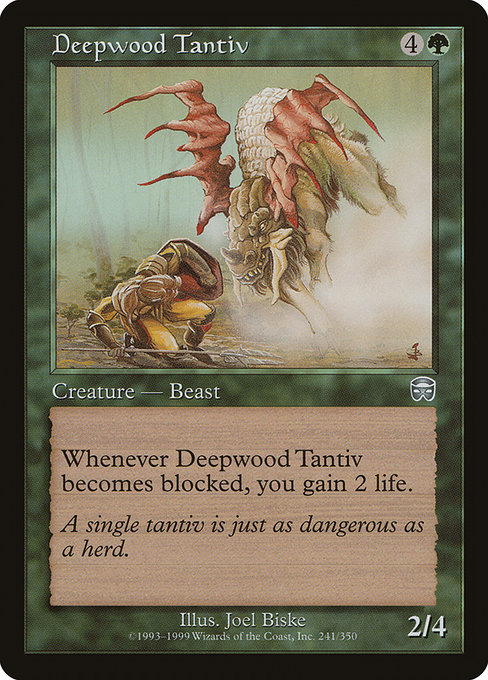
In the sprawling tapestry of MTG design, some cards look straightforward on the surface and reveal surprising depth once you see them through playtesting eyes 🧙♂️. Deepwood Tantiv, a green Beast from Mercadian Masques, is one of those creatures that teaches a lot about balancing green's robust combat ethos with subtle strategic twists. With its {4}{G} mana cost, a sturdy 2/4 body, and a later-life-gain trigger—“Whenever this creature becomes blocked, you gain 2 life”—this uncommon card becomes a case study in how a single ability can nudge players toward different combat calculus and deck-building decisions 🔥🎲.
First glance suggests a big-bodied, reliable beater. Green often leans into efficient stats and creature-based resilience, and Tantiv fits that mold at a five-mana price point. The team’s playtesting feedback, however, highlighted a delicate edge: the life gain on being blocked can subtly shift the tempo of a match when multiple Tantivs see play or when paired with other defense-oriented green tools. That feedback underscored a core design lesson: tiny, well-timed effects can alter how players value engagement in combat, even for a five-mana creature. The result is a card that rewards thoughtful blocking and trade decisions without dominating the battlefield on its own 🧭💎.
Why the trigger mattered in practice
The trigger is deceptively simple: if Deepwood Tantiv is blocked, you gain 2 life. In practice, that creates a few meaningful patterns. When you attack with Tantiv, your opponent has to decide whether to block, trades, or risk letting the creature slip through and apply pressure. If they choose to block, you’re rewarded with a life swing that can push the game into longer, grindier territory—especially in multiplayer formats or Révolution-style... er, long, involved games. This makes the card a natural anchor for green’s resilience archetypes, where attrition and incremental advantages matter as much as raw damage ⚔️💚.
“A single Tantiv is dangerous; a herd is deadly.” — flavor design rationale behind the set’s green defense theme
From a playtesting standpoint, the life-gain trigger helped ensure that Tantiv didn’t feel like a glorified roadblock despite its modest power-toughness. It also nudged players toward zero-turn planning: if you know your opponent might gain life off a blocked attack, you start weighing whether the trade is worth it or if you should pivot to a different plan. The result? More nuanced combat decisions and a wider variety of deck choices in green-focused games 🧙♂️🎨.
Key design takeaways for limited and constructed play
- Cost vs. payoff balance: A 5-mana, 2/4 green beater with a defensive trigger sits at a critical inflection point. Playtesting confirmed that this spot rewards gradual board development without enabling too-predictable stall tactics. The life gain helps offset the cost in longer games, encouraging players to lean into blocking and attrition games where green shines 🔥.
- Micro-interactions drive macro decisions: The “blocked” trigger nudges players to consider how an opponent’s board presence interacts with your life total. This magnifies the importance of sequencing, removal timing, and the value of leaving blockers up—an influential design lesson for future green cards that seek to reward careful combat math ⚔️.
- Rarity and distribution: Uncommon status paired with a meaningful ability demonstrates how rarities can convey power without overshadowing more potent rares. Tantiv sits in that sweet spot where it feels valuable in its slot, especially in Cube or Casual formats where the life-gain edge becomes a measurable swing 🧭.
- Flavor-text alignment with mechanical identity: The line “A single tantiv is just as dangerous as a herd” reinforces the idea that even a solitary beast can loom large when players must navigate its life-gain incentive during combat. This synergy between flavor and function helps players internalize the card’s strategic role 🎨.
- Designer-friendly versatility: The trigger can be leveraged in more complex green shells that emphasize life gain, stalemates, or late-game stabilization. Playtesters appreciated how Tantiv could slot into both midrange and resilience-oriented builds, broadening its usefulness beyond a single archetype 🔄.
In the broader arc of Mercadian Masques, Deepwood Tantiv occupies a memorable niche: it’s not the flashiest creature, but its design nudges players toward thoughtful defense and tempo-aware play. The card’s identity—green, bloc-driving, with a life-gain kicker—reflects a careful balance between aggression and durability that modern design continues to chase. The team’s takeaway was clear: small, well-timed triggers can drive deeper combat psychology without sacrificing the creature’s fundamental role on the battlefield 🧙♂️💎.
Connecting it to today’s MTG design conversations
As designers and players alike hash out the next era of MTG, Tantiv’s example shows how a single mechanic—life gain on being blocked—can ripple through deck-building decisions, combat math, and even the way players read board state. It’s a reminder that the most impactful design tweaks are often the ones that feel inevitable in hindsight: they simply make the game more satisfying, more strategic, and a touch more flavorful 🔥🎲.
For collectors and historians, Deepwood Tantiv also stands as a watermark of Mercadian Masques’ green strategy experiments—where bold bodies met subtle life-driven outcomes. It’s a card that invites you to revisit late-game stalemates and remember how a five-mana beast helped shift the tempo in small, meaningful ways 💎.
More from our network
- Why Un-Cards Matter to Design Theory: Acorn Catapult
- NFT Stats: Solidskulls and the Case for Data-minded Collecting
- NFT Data Nuggets: Nuddies on Magic Eden
- Custom Neon Rectangular Mouse Pad: Elevating Desk Routines
- How Generative AI Accelerates Citizen Engagement
Deepwood Tantiv
Whenever this creature becomes blocked, you gain 2 life.
ID: bfa2028e-4e73-4ff2-a9e2-9ac347d67893
Oracle ID: 3b31a9a7-6c97-4e82-bf72-de83034f81a9
Multiverse IDs: 19866
TCGPlayer ID: 6504
Cardmarket ID: 11614
Colors: G
Color Identity: G
Keywords:
Rarity: Uncommon
Released: 1999-10-04
Artist: Joel Biske
Frame: 1997
Border: black
EDHRec Rank: 29991
Set: Mercadian Masques (mmq)
Collector #: 241
Legalities
- Standard — not_legal
- Future — not_legal
- Historic — not_legal
- Timeless — not_legal
- Gladiator — not_legal
- Pioneer — not_legal
- Modern — not_legal
- Legacy — legal
- Pauper — not_legal
- Vintage — legal
- Penny — not_legal
- Commander — legal
- Oathbreaker — legal
- Standardbrawl — not_legal
- Brawl — not_legal
- Alchemy — not_legal
- Paupercommander — not_legal
- Duel — legal
- Oldschool — not_legal
- Premodern — legal
- Predh — legal
Prices
- USD: 0.16
- USD_FOIL: 0.99
- EUR: 0.03
- EUR_FOIL: 1.80
- TIX: 0.09
More from our network
- https://blog.crypto-articles.xyz/blog/post/nft-data-golden-boy-183-from-golden-boy-collection-on-magiceden/
- https://blog.crypto-articles.xyz/blog/post/why-casual-players-love-gyarados-g-in-pokemon-tcg/
- https://articles.zero-static.xyz/blog/post/the-last-of-us-part-i-next-gen-upgrade-details-on-ps5/
- https://wiki.digital-vault.xyz/wiki/post/pokemon-tcg-stats-growlithe-card-id-dp3-89/
- https://wiki.digital-vault.xyz/wiki/post/pokemon-tcg-stats-lysandre-card-id-sm6-110/