

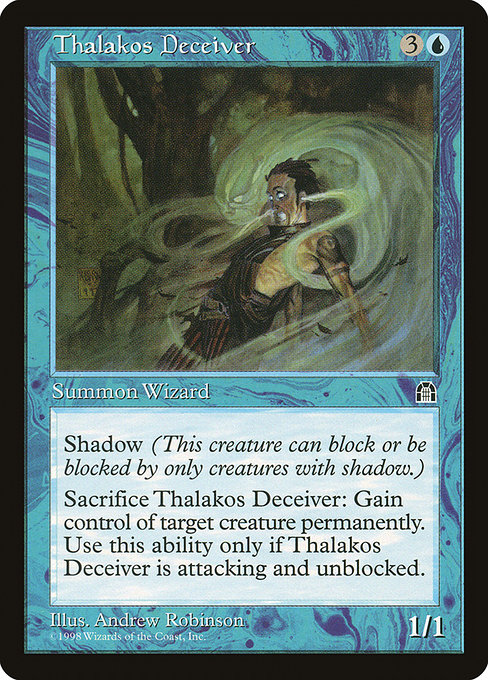
Image courtesy of Scryfall.com
Decoding Narrative Clues: Artwork and Storytelling in Thalakos Deceiver
Magic: The Gathering is a tapestry of color, cadence, and clue-laden imagery, and Thalakos Deceiver is a classic case study in how a single card image can spark a thousand story ideas 🧙♂️. The eye is drawn first to the muted blues and the elusive, hooded silhouette. You sense someone who moves in the gray spaces between truth and illusion, a trait that perfectly mirrors the card’s mechanical identity. This is not just a creature on a table; it’s a prompt for a larger tale about shadowy alliances, whispered bargains, and the cost of unguarded honesty 🔮.
From the Stronghold subset of 1998, this rare creature arrives with a straightforward silhouette but a highly interpretive aura. The artwork, attributed to Andrew Robinson, presents a Thalakos Wizard who seems to float just at the edge of perception. The read is intentional: a blue mage who trades in information and covert action. The surface elegance—cool blues, angular robes, a gaze that isn’t quite meeting yours—invites players to ask what the figure is really after. Is it merely a trick of light, or is there a more pointed bargain being offered? That ambiguity makes the image a fertile ground for narrative expansion beyond the board edges 🎭.
What the card tells us about the story beneath the surface
Thalakos Deceiver costs 3 mana of blue mana plus a single generic, landing at a respectable but not explosive four converted mana cost. Its stat line—1 power and 1 toughness—singles it out as a fragile theater piece rather than a hulking brute. Yet the card’s true horsepower lies in its Shadow ability, a keyword that defines what the art implies: this creature can interact in the dim corners of the battlefield, where only other Shadow creatures can block or be blocked. The flavor aligns with the image: a figure who thrives in the liminal spaces, where lines blur and nobody notices the subtle exchange taking place 🧩.
The activated line—“Whenever this creature attacks and isn’t blocked, you may sacrifice it. If you do, gain control of target creature. This effect lasts indefinitely.”—reads like a plot beat: you set up a risky, bluffing attack, the risk pays off in a dramatic twist, and the payoff rewrites a portion of the board’s narrative. This isn’t just card text; it’s a miniature heist tale: lure your opponent into a situation, then quietly seize control of a key asset and watch the plot unfold over the next turns. The “indefinite” control emphasizes the long shadow cast by the decision, echoing the lingering consequences of a choice made in a dim-lit alley of the Multiverse 🔒⚡️.
Artistically, the Deceiver’s pose and surroundings can be read as a deliberate invitation to imagine who is being deceived and why. The silhouette becomes a mirror: what would you do if you knew you could bend a creature to your will with a single, unblocked moment? The image nudges players toward the thrill—and the risk—of deception as a strategic tool, a core theme that resonates with commanders, control players, and those who love the puzzle of interaction between cunning and consequence 💎.
Strategies that turn narration into board presence
- Leverage Shadow’s opening into late-game control. Since Shadow restricts blocking, you can maximize deception by pointing your assault at unsuspecting corners of the battlefield. The Deceiver’s trigger rewards bold, unblocked attacks, turning a fragile 1/1 into the spark that flips a critical asset to your side.
- Pair with other control engines. Cards that tap or untap, steal, or reanimate can extend the Deceiver’s influence beyond a single moment. Think of it as a narrative arc: you commence the scene with a bluff, and subsequent spells extend the tale—drama that’s as satisfying in a game as it is in a story written on a page 🧙♂️⚔️.
- Guard against fragile bodies with protection or tempo pressure. Because the Deceiver is a 1/1 on a 3 mana investment, protect it with bounce, counterplay, or evasive threats to ensure the critical moment—your untapped, unblocked attack—arrives and you conclude with a heist that changes the board’s power balance.
- Consider the lore-friendly theme of misdirection. The art and mechanics align with broader MTG themes of thieves, informants, and the social contract of deception. Even if you aren’t stacking a blue control deck, the Deceiver can inspire narrative-driven builds where your win condition is less about raw damage and more about shaping the battlefield story arc 🧭.
“In the dim glow of the moonlit table, every choice to attack becomes a whispered bargain.”
In practice, Thalakos Deceiver excels in formats that reward tricky plays and manipulation. Its rarity and price point as a rare in Stronghold mirror the nostalgia for era-specific card design—where cleverness could outpace raw power. Its unique combination of Shadow with a high-reward recall mechanic invites players to think about the “story beat” of each match: who holds the pen in this moment, and which creature’s fate is about to be rewritten? 🎲
Design, history, and player culture
From a design perspective, Thalakos Deceiver embodies a classic era of magic where complexity lived in nuance. The blue color identity—on a 4-mana body that becomes meaningful only when unblocked—encourages layered decisions, not simply one-shot wins. The art’s emphasis on a masked, deliberate figure reinforces the theme that in Shadow-rich environments, there is always more happening beneath the surface. The card’s place in Stronghold also anchors it in the late-90s MTG zeitgeist, when players explored the edges of legality, legality, and the thrill of uncharted tactical territory 💎.
Collectors still chase such pieces for both the memory of tactile cardboard and the thrill of the reveal: when you sacrifice the Deceiver to steal a creature, the moment can feel cinematic, as if a chapter of a larger story has just turned a page. The cross-promotion of art, playstyle, and narrative is what keeps MTG’s community vibrant—each card a possible doorway to a new tale, each match a fresh scene in a sprawling saga 🧙♂️🔥.
iPhone 16 Slim Phone Case Glossy Lexan Ultra-SlimMore from our network
- https://crypto-acolytes.xyz/blog/post/nft-stats-depressol-304-from-depressol-collection/
- https://blog.crypto-articles.xyz/blog/post/warframe-100-hour-review-is-it-still-worth-playing/
- https://crypto-acolytes.xyz/blog/post/nft-stats-clops-342-from-clops-collection/
- https://wiki.digital-vault.xyz/wiki/post/pokemon-tcg-stats-potion-card-id-tk-bw-e-23/
- https://blog.crypto-articles.xyz/blog/post/nft-data-planet-kaiju-6020-from-planet-kaiju-collection-on-magiceden/
Thalakos Deceiver
Shadow (This creature can block or be blocked by only creatures with shadow.)
Whenever this creature attacks and isn't blocked, you may sacrifice it. If you do, gain control of target creature. (This effect lasts indefinitely.)
ID: ae4cc2f5-3a50-40c8-87ea-6b92f081f55c
Oracle ID: c304777a-39a9-4a2a-8cec-8116afb34c5b
Multiverse IDs: 5253
TCGPlayer ID: 5430
Cardmarket ID: 9130
Colors: U
Color Identity: U
Keywords: Shadow
Rarity: Rare
Released: 1998-03-02
Artist: Andrew Robinson
Frame: 1997
Border: black
EDHRec Rank: 15865
Set: Stronghold (sth)
Collector #: 45
Legalities
- Standard — not_legal
- Future — not_legal
- Historic — not_legal
- Timeless — not_legal
- Gladiator — not_legal
- Pioneer — not_legal
- Modern — not_legal
- Legacy — legal
- Pauper — not_legal
- Vintage — legal
- Penny — legal
- Commander — legal
- Oathbreaker — legal
- Standardbrawl — not_legal
- Brawl — not_legal
- Alchemy — not_legal
- Paupercommander — not_legal
- Duel — legal
- Oldschool — not_legal
- Premodern — legal
- Predh — legal
Prices
- USD: 1.37
- EUR: 2.29
- TIX: 0.02
More from our network
- https://blog.rusty-articles.xyz/blog/post/neon-card-holder-magsafe-case-slim-wallet-for-iphone-13-galaxy-s21s22/
- https://blog.crypto-articles.xyz/blog/post/nft-data-xp-168-from-xp-collection-on-magiceden/
- https://crypto-acolytes.xyz/blog/post/nft-stats-lion-of-liquania-684-from-lions-of-liquania-collection/
- https://crypto-acolytes.xyz/blog/post/unleash-dc-superpowers-with-minecraft-mods/
- https://blog.rusty-articles.xyz/blog/post/balancing-cascoons-flavor-and-gameplay-in-pokemon-tcg/