

Image courtesy of Scryfall.com
Scorched Earth and the Color-Distribution Heatmap of Red
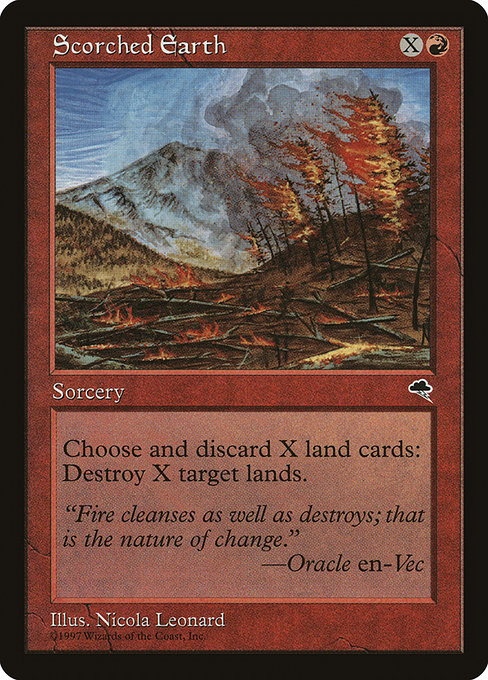
When you think of a color distribution heatmap in MTG, imagine a living map of mana—how often a deck wields red’s fiery punch, how quickly X can ignite a battlefield, and how land destruction reshapes the board. Scorched Earth sits at a fascinating crossroads of design, lore, and strategy. A rare from Tempest released in 1997, this sorcery wears its red-hot aggression on its sleeve: pay X plus a single red mana, discard X land cards, and you destroy X lands. It’s not just a blow to your opponent’s mana base; it’s a study in risk, tempo, and the beauty of red’s scorch-and-burn ethos. 🧙♂️🔥
Heatmaps in MTG are not merely about color pie; they reveal the tempo scars left by spells that demand you sacrifice resources to gain control of the board. Scorched Earth makes that trade explicit. The spell’s cost structure—{X}{R} with an additional cost of discarding X lands—forces a choice: how much do you invest, and how much land can you afford to shed? In red decks, where the aim is often to accelerate into threats or destabilize the board before opponents draw their answers, Scorched Earth becomes a gauge of how aggressively you’re willing to redraw a map of your own terrain. The heat map shifts as you increase X, turning a simple “destroy lands” effect into a cascading decision tree: you’re trading land cards in hand for land destruction on the battlefield, balancing the potential for a wide-reaching wipe against the risk of depleting your own resources. 🔥🔎
Flavor and design synergy is a big part of why heatmaps feel alive in MTG. Scorched Earth’s flavor text—“Fire cleanses as well as destroys; that is the nature of change.” —Oracle en-Vec—frames destruction as a form of renewal. The mechanical effect mirrors that philosophy: sometimes burning away the old land layout clears space for something new to rise from the ash. Nicola Leonard’s art on the Tempest card conjures a landscape raked by red energy, a reminder that red’s strength often comes from turning the battlefield into a stage for bold improvisation. The card’s rarity (rare) and its Tempest heritage place it in a hunter-gatherer era of early modern MTG, a time when players built around dramatic, one-shot effects that could swing a game in a handful of turns. 🎨⚔️
From a gameplay perspective, Scorched Earth shines in decks that want to push through clearing waves of threats while denying the opponent a reliable land base. In formats where land-based strategies dominate—especially in multiplayer settings where the board state explodes with value from multiple players—the decision to discard X lands becomes a crucial tempo choice. If you can set up a situation where X is large enough to wipe a sizable portion of the opponent’s resources and still leave you with a functional board, you’ve turned heat into leverage. This is where color distribution heatmaps become practical: they visually encode the likelihood of land destruction aligning with red’s acceleration curve, letting players forecast land-based pressure over several turns. 🧭🔥
Strategically, Scorched Earth is especially potent in Commander games where everyone plays a mix of basics and nonbasics. The card’s X-cost scaling means you can tailor the swing to your table’s mana development, and the requirement to discard X lands adds an element of hand management that isn’t always present in other land destruction spells. It also invites a careful consideration of “land tax” dynamics—the more you deplete lands, the more you reveal your own hand and curtail your own future draws if you’re over-committing to the spell. Like many red tools, it rewards bold timing and careful read of the tempo, rather than lazy “draw-destroy-repeat” plays. 🧙♂️💎
In terms of deck-building philosophy, Scorched Earth nudges us toward a heatmap mindset: measure your mana, map your land count, and chart the point at which land destruction becomes an engine rather than a one-off. The card’s color identity is crimson through and through, with a single red mana symbol anchoring a variable X. That combination makes the spell both a flashy finisher and a strategic conditioning spell—your endgame might hinge on how many lands you can discard while creating a window to swing the game with your threats. For collectors and designers, Scorched Earth embodies a classic approach to “paying the cost to blow up resources,” a motif that resonates across red’s history—from classic burn to modern value-based pressure. 🧲🎲
Price-wise, vintage collectors often reflect on Tempest-era staples with nostalgia, and Scorched Earth sits in a modestly accessible range today. For players chasing the vivid memory of a pre-3D magic era, this card offers a tangible link to the past while still performing in casual or kitchen-table formats. Its high-variance nature—depending on X and the lands you hold—keeps it relevant in discussions about heatmap-driven deck tuning. If you’re curious to see how hearth and horizon collide at the table, Scorched Earth is a perfect case study in red’s wheelhouse of risk-reward exploration. ⚔️🔥
As you explore color distribution heatmaps in your own playgroup, remember that red’s strength often lies in dynamic, high-variance impacts. Scorched Earth embodies that principle: a spell that promises dramatic shifts by design, inviting you to read the board, count your resources, and decide how far you’re willing to push the heat for a potential blowout. And if you’re a fan of fiery moments and dramatic table talk, this Tempest relic delivers a memorable spark—even if the wind of fortune is as unpredictable as an X spell’s outcome. 💎🧙♂️
Slim Glossy Phone Case for iPhone 16 Lexan PolycarbonateMore from our network
- https://wiki.digital-vault.xyz/wiki/post/pokemon-tcg-stats-caterpie-card-id-sm3-1/
- https://articles.zero-static.xyz/blog/post/guild-wars-2-console-vs-pc-frame-rates-compared/
- https://blog.crypto-articles.xyz/blog/post/scizor-cosplay-and-themed-decks-for-pokemon-tcg-fans/
- https://articles.digital-vault.xyz/blog/post/paleoloth-unearthing-hidden-defensive-tricks-with-its-ability/
- https://crypto-acolytes.xyz/blog/post/nft-stats-nuddies-2049-from-nuddies-collection/
Scorched Earth
As an additional cost to cast this spell, discard X land cards.
Destroy X target lands.
ID: e6a97817-d1fd-4ba4-9ced-c2702b081523
Oracle ID: fd1ce3e0-9c2d-48b6-9a14-4e71921cdfa4
Multiverse IDs: 4842
TCGPlayer ID: 5711
Cardmarket ID: 8935
Colors: R
Color Identity: R
Keywords:
Rarity: Rare
Released: 1997-10-14
Artist: Nicola Leonard
Frame: 1997
Border: black
EDHRec Rank: 25455
Penny Rank: 3299
Set: Tempest (tmp)
Collector #: 200
Legalities
- Standard — not_legal
- Future — not_legal
- Historic — not_legal
- Timeless — not_legal
- Gladiator — not_legal
- Pioneer — not_legal
- Modern — not_legal
- Legacy — legal
- Pauper — not_legal
- Vintage — legal
- Penny — not_legal
- Commander — legal
- Oathbreaker — legal
- Standardbrawl — not_legal
- Brawl — not_legal
- Alchemy — not_legal
- Paupercommander — not_legal
- Duel — legal
- Oldschool — not_legal
- Premodern — legal
- Predh — legal
Prices
- USD: 0.56
- EUR: 0.59
- TIX: 0.17
More from our network
- https://blog.zero-static.xyz/blog/post/mastering-tribal-decks-with-implement-of-improvement/
- https://blog.rusty-articles.xyz/blog/post/bloodsworn-steward-and-the-rise-of-mtg-joke-cards/
- https://blog.crypto-articles.xyz/blog/post/smart-toilets-with-cameras-trends-and-privacy-concerns/
- https://blog.crypto-articles.xyz/blog/post/nft-data-cryostria-from-terr-cities-collection-on-magiceden/
- https://blog.crypto-articles.xyz/blog/post/nft-data-folder-2035-from-folder-free-collection-on-magiceden/