

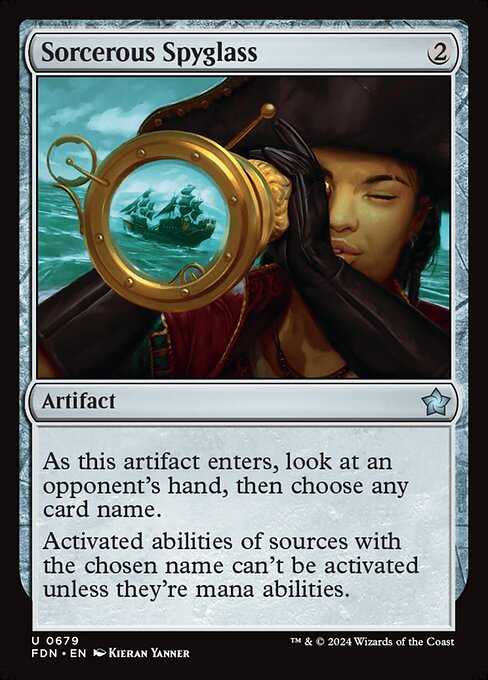
Image courtesy of Scryfall.com
Understanding Power and Toughness Ratios in MTG
When you lay down a creature in a crowded battlefield, the first glance is often toward its power and toughness—its numeric identity on the battlefield. These numbers aren’t mere decoration; they’re your blade and shield in the ongoing dance of combat. But as any veteran of the multiverse knows, a creature’s survivability isn’t solely a matter of numbers. The tempo of a game, the timing of spells, and the ability to deny or redirect threats all shape outcomes in ways that power and toughness alone can’t capture. 🧙♂️🔥💎
Take a card like Sorcerous Spyglass, a thoughtful artifact from the Foundations set, as a perfect case study in how ratios of risk, tempo, and control weave together. This little 2-mana artifact may not swing for big numbers, but its impact on game state can tilt the balance in your favor in ways that echo the broader theme of MTG ratios: what you own on the board, what you deny your opponent, and how quickly you close the gap between offense and defense. ⚔️🎲
What power and toughness tell you—and what they don’t
Power and toughness set the baseline for combat outcomes. A 3/2 creature, for instance, will trade efficiently with most 2/2s and survive a lot of early aggression. Yet, the real story emerges when you add static abilities, triggered effects, or conditional grants that can shift the expected results. A creature may look strong on paper, but if you’re staring down a board full of removal spells or a stalled format where answers come in waves, that stat line becomes one piece of a larger strategic mosaic. The art of MTG is learning when to lean on raw numbers and when to leverage the non-numeric levers—protection, evasion, removal, and tempo. 🧙♂️
“Power in a vacuum is loud, but strategy speaks in whispers—subtle moves that outpace raw stats.”
Consider how a single card’s interaction can redefine the value of a creature you’ve invested in. A 2/2 might seem unimpressive at first glance, yet if you can force favorable trades, pressuring an opponent without overcommitting, you stretch the margin between victory and loss. The art and flavor of MTG often reward players who think in ratios: how much they invest versus what they gain, how quickly they can convert defense into offense, and how effectively they convert card advantage into board presence. 🧭🧪
Sorcerous Spyglass: a different lens on value
Sorcerous Spyglass enters the game as a humble artifact with a precise purpose: it lets you peek at an opponent’s hand, name a card, and deny activated abilities of sources bearing that name—unless those abilities are mana-based. In practical terms, this is a tempo play wrapped in a mind-game. You’re not increasing your creature’s power; you’re compressing your opponent’s options. It’s a reminder that MTG’s most potent ratios aren’t always measured in raw numbers on a card, but in the ability to dictate what those numbers can even achieve on the battlefield. 🧙♂️ The Foundations era gave us this compact, clever tool—2 mana for a moment of strategic clarity, a nudge toward more thoughtful combat decisions, and a nudge away from chaotic, unanswerable combos. 🔒
With Spyglass in play, the mat leans toward a slower, more methodical pace. If your opponent depends on a non-mana ability from a key card—whether to draw a storm, tap a blocker, or activate a combo—you’ve inserted a deliberate friction into their plan. The power/toughness of your creatures may stay fixed, but the ratio of options on the table shifts: your board stays lean and efficient, while your opponent must adapt to the new constraint. It’s a cerebral move that rewards players who read the battlefield as a living scoreboard. 💎
From a design standpoint, Spyglass embodies a classic MTG principle: the best tools aren’t always the loudest. A two-mana artifact that quietly erodes the ability to execute a plan demonstrates how design can finesse the “ratio” between what a card costs and what it enables or forbids. It’s a reminder that the MTG metagame values both brute power and the elegance of tactical gating. The card’s rarity—uncommon—signals that players should hunt for it, not just for its tactical value, but for how it encourages us to rethink the way we measure a card’s worth. 🧭⚔️
Gameplay implications and player psychology
In practice, Spyglass shines when you’re trying to dodge a critical play from a careless opponent or when you’re trying to stabilize after a furious start. It’s most potent in decks that prize tempo, disruption, and chokepoints. You don’t need a towering creature to win fights—you need the right moment when your opponent’s options dwindle. The artifact’s 2 CMC means it slides into a mulligan-heavy start with grace, and its colorless identity makes it a versatile pick in many deck archetypes. And while its price tag on the secondary market isn’t breathtaking, the strategic value it unlocks can be priceless in the right meta. In EDH or other multiplayer formats, Spyglass often earns a place as a flexible crown jewel—quietly shaping long games where the late-game grind tests your control of the narrative. 🏰
For collectors and builders alike, Sorcerous Spyglass offers a neat convergence of lore, utilitarian design, and practical play. Its artwork by Kieran Yanner captures a crisp, arcane gadgetry vibe that fans of Foundations appreciate, and its mechanical idea resonates with players who love thinking in terms of tempo and resource denial. If you’re chasing a retro-chic addition to your commander toolbox or a curious artifact to pilot in modern formats, this card checks a lot of boxes without breaking the bank. 💎
And because we all love to pair MTG with other curiosities, here’s a curated peek into related corners of the digital vault world—a reminder that the magic of ratios extends beyond the battlefield and into the data streams that feed our hobby. 🧙♂️
Neon Card Holder Phone Case MagSafe iPhone 13 Galaxy S21-22More from our network
- https://wiki.digital-vault.xyz/wiki/post/minecraft-block-stats-light_blue_concrete/
- https://crypto-acolytes.xyz/blog/post/nes-hidden-gems-underrated-classics-worth-playing/
- https://wiki.digital-vault.xyz/wiki/post/pokemon-tcg-stats-pansage-card-id-swsh8-7/
- https://crypto-acolytes.xyz/blog/post/nft-stats-lil-chiller-1421-from-lil-chillers-collection/
- https://crypto-acolytes.xyz/blog/post/nft-stats-deschizo-388-from-deschizo-collection/
Sorcerous Spyglass
As this artifact enters, look at an opponent's hand, then choose any card name.
Activated abilities of sources with the chosen name can't be activated unless they're mana abilities.
ID: 0f99356b-eed0-4d92-818b-80754bcb75f3
Oracle ID: b2187f45-80ae-4ac4-9f83-5eb7a00978e2
Multiverse IDs: 680818
TCGPlayer ID: 589365
Cardmarket ID: 796126
Colors:
Color Identity:
Keywords:
Rarity: Uncommon
Released: 2024-11-15
Artist: Kieran Yanner
Frame: 2015
Border: black
EDHRec Rank: 14653
Penny Rank: 716
Set: Foundations (fdn)
Collector #: 679
Legalities
- Standard — legal
- Future — legal
- Historic — legal
- Timeless — legal
- Gladiator — legal
- Pioneer — legal
- Modern — legal
- Legacy — legal
- Pauper — not_legal
- Vintage — legal
- Penny — legal
- Commander — legal
- Oathbreaker — legal
- Standardbrawl — legal
- Brawl — banned
- Alchemy — legal
- Paupercommander — not_legal
- Duel — legal
- Oldschool — not_legal
- Premodern — not_legal
- Predh — not_legal
Prices
- USD: 0.09
- EUR: 0.12
- TIX: 0.02
More from our network
- https://crypto-articles.xyz/tmp0rzxu76y/c2b4c6b5.html
- https://crypto-acolytes.xyz/blog/post/best-sega-saturn-imports-you-need-to-play/
- https://crypto-acolytes.xyz/blog/post/nft-stats-hiney-kin-443-from-hiney-kin-collection/
- https://crypto-acolytes.xyz/blog/post/nft-stats-pigger-488-from-piggers-collection/
- https://blog.digital-vault.xyz/blog/post/tawnoss-coffin-keyword-showdown-similar-abilities/