

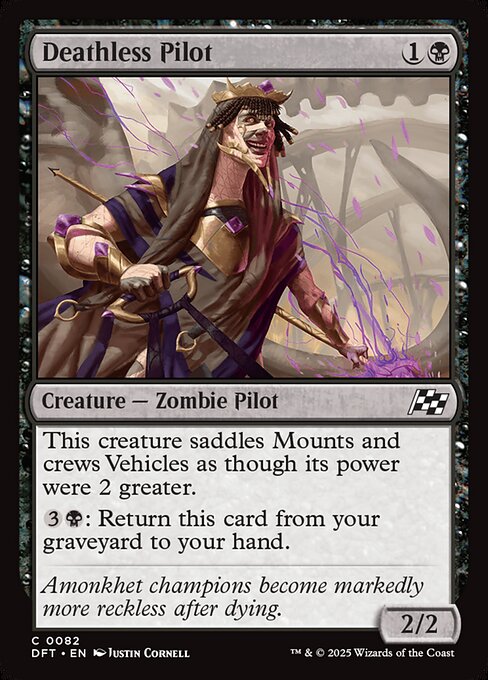
Image courtesy of Scryfall.com
Rarity scaling and set balance in MTG: a closer look through Deathless Pilot
Magic: The Gathering has always walked a tightrope between accessibility and power, especially when designers tune cards for different rarities. A common creature that carries dual roles—one in the graveyard, one on the battlefield—can become a bellwether for how a set negotiates tempo, value, and long-term strategy. 🧙♂️ The Deathless Pilot, a black creature from a modern expansion, sits squarely in that conversation: a 2/2 Zombie Pilot for {1}{B} whose abilities bend the rules of both mounting and maintaining presence long after it’s put into the graveyard. The very idea of a common card granting power-based interactions for Vehicles, and then looping back to hand with mana in the bank, invites a broader talk about rarity scaling and set balance in MTG. 🔥
Card snapshot: what this common brings to the table
- Mana cost: {1}{B} with a Converted Mana Cost of 2
- Type: Creature — Zombie Pilot
- Power/Toughness: 2 / 2
- Rarity: Common
- Abilities: “This creature saddles Mounts and crews Vehicles as though its power were 2 greater.”
- Graveyard recursion: “{3}{B}: Return this card from your graveyard to your hand.”
- Flavor: Amonkhet champions become markedly more reckless after dying, a flavorful thread that nudges color and risk together. 🎨
In practical terms, Deathless Pilot is a low-cost engine that enables slotted synergy with two very MTG-specific concepts: Mounts and Vehicles. The first is a nod to mounted or horseback-mounted strategies that rely on evasive or big-impact creatures delivering crowd control or punch. The second—Vehicles—has been a recurring lane of design since Kaladesh introduced the artifact-creature dynamic and the famous “crew” mechanic. This little Zombie Pilot makes both lanes friendlier to black’s typical attrition toolbox. By treating its power as effectively 4 when evaluating mounting or crew costs, it helps smaller threats punch above their weight, especially in decks that lean on cheap creatures to enable larger vehicles or to loosen up crew costs. ⚔️
Then there’s the graveyard return. In a color identity that prizes inevitability and the value of threats returning from the grave, {3}{B} for a hand-return Sorcery-like effect is a solid bargain in this slot. It creates a resilient loop that can outlast removal, while keeping the mana curve gentle enough for draft and sealed. That combination—cheap aggression, power-level leverage for Vehicles, and graveyard-retrieval value—illustrates how a single card can anchor a broader design philosophy: ensure that common creatures can influence late-game decisions without eclipsing rarer versions or pushing set power creep. 💎
Rarity scaling in practice: how common cards can carry weight without breaking balance
Rarity scaling is about calibrating two levers: expected power and accessibility. In many sets, commons do the legwork of establishing early-game tempo, removing “feel-bad” starts, and offering just enough payoff to invite experimentation. Deathless Pilot exemplifies that approach. Its power-boosting line for Mounts and Vehicles meaningfully nudges those archetypes in black-dominant metas, while its graveyard recursion provides late-game resilience. The net effect is a card that remains fair in limited play, yet interesting enough for casual constructed decks to explore. 🧙♂️
From a design lens, this approach avoids two classic pitfalls. First, it avoids creating a must-include common that warps formats around a single card; the effect is strong, but not dominating. Second, it keeps set ecosystems vibrant by layering synergy options instead of stacking raw card advantage. When a set uses a common to unlock or accelerate specific themes—like black’s suite of reanimation and disruption, or Vehicles’ crew strategies—the result is a richer, more cohesive sandbox rather than a straight power-shift. This is where set balance truly shines: players feel smart about their multi-step plays, not simply lucky to draw a big bomb. 🔥
Set balance considerations: a closer look at a framework that might spin off Deathless Pilot
Balance teams weigh how a card interacts with the broader ecosystem: tempo, interaction with removal, and the pace of the format. Some factors in this Deathless Pilot case include:
- Interaction with black’s attrition suite: The graveyard-to-hand recursion mirrors classic black themes and keeps the card relevant in longer games without over-accelerating tempo.
- Vehicles and Mounts synergy: A common that helps these archetypes has a greater chance of appearing in multiple packs, reinforcing the set’s color identity rather than overshadowing rarer picks.
- Accessibility versus power: A 2/2 for 2 is solid, but the double utility—buffing mounts/vehicles and graveyard recursion—needs to be carefully tamed by cost and availability. The result is a card that can slot into several decks without becoming a “must-answer” threat in every format.
In the long arc of MTG design, the most memorable rares often emerge when a mechanism is introduced in a common and then grows with the set’s breadth. If a future set introduces more Mount or Vehicle support, Deathless Pilot’s utility can look even more elegant, not because it becomes unbeatable, but because it remains a reliable enabler—scrappy, resilient, and thematically consistent. And that steady-state balance matters in a game built on infinite combos and evolving meta. 🧙♂️
Neon Card Holder Phone Case MagSafeMore from our network
- https://crypto-acolytes.xyz/blog/post/nft-stats-goatcoin-nft-804-from-goatcoin-nft-collection/
- https://transparent-paper.shop/blog/post/how-mtg-marketplaces-shape-ancestor-dragon-pricing/
- https://wiki.digital-vault.xyz/wiki/post/pokemon-tcg-stats-ivysaur-card-id-ex14-34/
- https://crypto-acolytes.xyz/blog/post/case-study-how-meme-coin-communities-took-control/
- https://crypto-acolytes.xyz/blog/post/a-beginners-guide-to-minecraft-rtx-ray-tracing/
Deathless Pilot
This creature saddles Mounts and crews Vehicles as though its power were 2 greater.
{3}{B}: Return this card from your graveyard to your hand.
ID: e704fb95-17b7-432a-831c-18abe7d9cc73
Oracle ID: 31284a0b-9bd5-4186-bd27-6b16a3597e27
Multiverse IDs: 690519
TCGPlayer ID: 615781
Cardmarket ID: 809114
Colors: B
Color Identity: B
Keywords:
Rarity: Common
Released: 2025-02-14
Artist: Justin Cornell
Frame: 2015
Border: black
EDHRec Rank: 19161
Set: Aetherdrift (dft)
Collector #: 82
Legalities
- Standard — legal
- Future — legal
- Historic — legal
- Timeless — legal
- Gladiator — legal
- Pioneer — legal
- Modern — legal
- Legacy — legal
- Pauper — legal
- Vintage — legal
- Penny — not_legal
- Commander — legal
- Oathbreaker — legal
- Standardbrawl — legal
- Brawl — legal
- Alchemy — legal
- Paupercommander — legal
- Duel — legal
- Oldschool — not_legal
- Premodern — not_legal
- Predh — not_legal
Prices
- USD: 0.05
- USD_FOIL: 0.08
- EUR: 0.03
- EUR_FOIL: 0.04
- TIX: 0.03
More from our network
- https://blog.rusty-articles.xyz/blog/post/fletchling-sealed-product-trends-across-scarlet-and-violet/
- https://articles.digital-vault.xyz/blog/post/how-silvally-gx-fosters-intergenerational-appeal-in-pokemon-tcg/
- https://wiki.digital-vault.xyz/wiki/post/pokemon-tcg-stats-slaking-card-id-sm7-115/
- https://crypto-acolytes.xyz/blog/post/nft-stats-nft-cryptobullkt-714-from-cryptobullkt-collection/
- https://blog.crypto-articles.xyz/blog/post/nft-data-pullo-1312-from-pullo-collection-on-magiceden/