
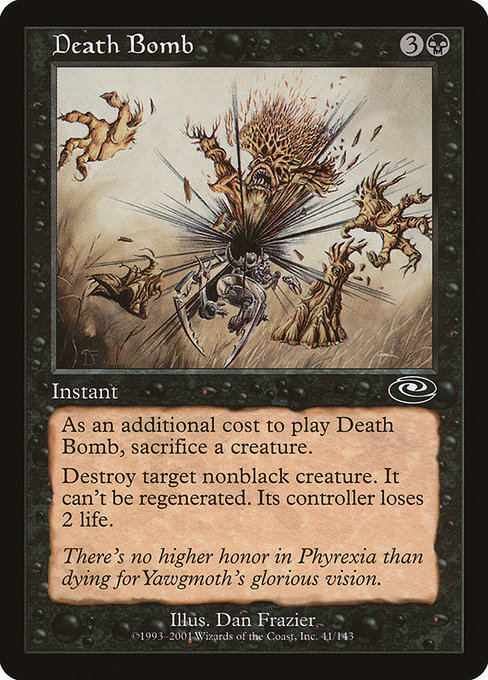
Image courtesy of Scryfall.com
Reimagining a Classic: Pushing Creative MTG Design Forward
Magic: The Gathering has always thrived on the tension between danger and strategy, a dance of costs and effects that rewards players who read the board as a narrative. When we look at Death Bomb, a Planeshift instant from early 2000s black, we catch a glimpse of how design constraints can birth memorable decisions. This card, with its {3}{B} cost, demands you sacrifice a creature to obliterate a nonblack foe—an act that carries both immediate impact and a moral cost. It’s a snapshot of how future designers can push creativity while staying true to color identity and mechanical clarity. 🧙♂️🔥💎
Death Bomb is not just a removal spell; it’s a compact case study in risk-reward design. As an instant, it offers tempo play, but the sacrifice cost leans into black’s theme of exchange—pressure on the battlefield in exchange for a powerful, targeted effect. The spell then destroys a nonblack creature and prevents regeneration, while the caster’s opponent takes 2 life. The net effect is a nuanced, board-state decision: you’re not simply removing a threat; you’re paying a price to shape the late-game landscape. The flavor line—“There’s no higher honor in Phyrexia than dying for Yawgmoth’s glorious vision.”—adds ruthless fiction to the math, reminding us that design is not only about function but about storytelling. ⚔️
Card at a glance
- Set: Planeshift (PLS)
- Mana cost: {3}{B}
- Type: Instant
- Rarity: Common
- Oracle text: As an additional cost to cast this spell, sacrifice a creature. Destroy target nonblack creature. It can't be regenerated. Its controller loses 2 life.
- Color: Black
- Flavor: “There’s no higher honor in Phyrexia than dying for Yawgmoth's glorious vision.”
“Death Bomb” is a reminder that removal can be both brutal and elegant—a two-step puzzle where cost and payoff are tightly braided. The nonblack target constraint invites interesting cross-color dynamics, a theme designers will chase as they imagine more thoughtful color interactions. 🧙♂️
What Death Bomb teaches about design today
First, the card showcases the power of as an additional cost mechanics. Forcing a sacrifice before the effect creates meaningful decisions about creature tempo, creature utility, and the timing of threats. It introduces a paradox: you’ll often want to hold back a crucial creature to pay the cost, yet you risk losing the very engine you’re attempting to protect. That emotional tension is fuel for memorable plays and story arcs. 🔥
Second, the targeting constraint—destroy a nonblack creature—embodies a deliberate color-pie alignment that can spark creative counterplay in future sets. By anchoring the effect to a specific color class, designers can explore interactions that feel inevitable yet surprising, inviting players to think about how color identity evolves through eras. ⚔️
Third, the life-loss clause to the opponent adds a subtle but persistent pressure: even when you answer a board state, you’re nudging the game toward a finish line. In modern design, this can be a springboard for creative win conditions that aren’t purely damage-based—perhaps a card that grants ongoing value or a shifting board state that rewards long-term planning. The life swing is a small but meaningful nudge toward a more dynamic, story-forward metagame. 🧭
Future directions inspired by a bygone classic
As we imagine the next wave of MTG design, Death Bomb can serve as a quiet blueprint for innovation. Here are some directions designers might explore, blending nostalgia with forward-looking mechanics:
- Thematic costs that reflect flavor across colors. Imagine a red spell that requires sacrificing a creature to deal extra damage, or a green spell that costs life to ramp but also temporarily strengthens your board. Costs tied to narrative motifs help players feel the world more deeply. 🎨
- Conditional destruction where the effect’s strength shifts with board state, encouraging players to sculpt their battlefield to unlock bigger payoffs. This keeps play interactive and reduces dead cards in slower matchups. 🎲
- Color-pie-aware single-targets that push players to think about color interactions beyond the obvious. Could a blue instant remove a non-blue threat if you discard something first? The question invites clever deckbuilding and new lines of play. 🧠
- Alternative costs that reward player creativity—costs paid in artifacts, tokens, or life in ways that reward strategic planning without punishing players too harshly in multiplayer formats. 🔧
- Flavor-forward rulings where the card’s legend ties directly to its effect, turning gameplay into storytelling. The synergy between flavor text and mechanical consequence can become a design compass for future sets. 🗺️
Art, flavor, and value in a design-forward era
The artist Dan Frazier’s work on Death Bomb captures the era’s mood: stark lines, a foreboding color palette, and a sense that danger lurks just beyond the next line of play. When art and mechanics align, players don’t just react to a card; they feel the world it inhabits. In contemporary design, art direction becomes a tool for signaling mechanics—color, tone, and imagery guide expectations about how a card will function in a given metagame. A well-tuned flavor line helps fans remember the moment, making a simple removal spell feel like a chapter in a larger saga. 🎨
For collectors, Death Bomb’s Planeshift era represents a window into early 2000s design philosophy: accessible mana costs, straightforward text, and reliable performance in the trenches of Standard and eternal formats. Even as the game grows, these foundational choices offer a touchstone for debates about card power, rarity, and playability. And yes, the card remains a handy reminder that sometimes the simplest answers—sacrifice, destroy, life swap—can carry the boldest stories. 💎
Gaming Mouse Pad 9x7 Neoprene with Stitched EdgesMore from our network
- https://donation.digital-vault.xyz/donation/post/support-underserved-open-data-initiatives-and-fund-innovation/
- https://crypto-acolytes.xyz/blog/post/nft-stats-planet-kaiju-3531-from-planet-kaiju-collection/
- https://crypto-acolytes.xyz/blog/post/nft-stats-fish-356-from-f-i-s-h-m-a-n-s-collection/
- https://blog.crypto-articles.xyz/blog/post/nft-data-yzmari-shattered-356-from-risen-collection-on-magiceden/
- https://crypto-acolytes.xyz/blog/post/nft-stats-klout-genesis-hashtag-437-from-klout-genesis-hashtags-collection/
Death Bomb
As an additional cost to cast this spell, sacrifice a creature.
Destroy target nonblack creature. It can't be regenerated. Its controller loses 2 life.
ID: f8a84715-c5dc-4a19-af6a-796c6ee912c2
Oracle ID: e323d468-def5-4090-af5b-19481289168f
Multiverse IDs: 26782
TCGPlayer ID: 7781
Cardmarket ID: 3296
Colors: B
Color Identity: B
Keywords:
Rarity: Common
Released: 2001-02-05
Artist: Dan Frazier
Frame: 1997
Border: black
EDHRec Rank: 28007
Set: Planeshift (pls)
Collector #: 41
Legalities
- Standard — not_legal
- Future — not_legal
- Historic — not_legal
- Timeless — not_legal
- Gladiator — not_legal
- Pioneer — not_legal
- Modern — not_legal
- Legacy — legal
- Pauper — legal
- Vintage — legal
- Penny — legal
- Commander — legal
- Oathbreaker — legal
- Standardbrawl — not_legal
- Brawl — not_legal
- Alchemy — not_legal
- Paupercommander — legal
- Duel — legal
- Oldschool — not_legal
- Premodern — legal
- Predh — legal
Prices
- USD: 0.15
- USD_FOIL: 0.66
- EUR: 0.04
- EUR_FOIL: 0.53
- TIX: 0.04
More from our network
- https://blog.crypto-articles.xyz/blog/post/nft-data-mirix-troumbach-shattered-602-from-risen-collection-on-magiceden/
- https://wiki.digital-vault.xyz/wiki/post/pokemon-tcg-stats-raichu-card-id-base3-29/
- https://wiki.digital-vault.xyz/wiki/post/pokemon-tcg-stats-delibird-card-id-dp4-36/
- https://wiki.digital-vault.xyz/wiki/post/pokemon-tcg-stats-gengar-card-id-swsh11-066/
- https://crypto-acolytes.xyz/blog/post/nft-stats-planet-kaiju-979-from-planet-kaiju-collection/