

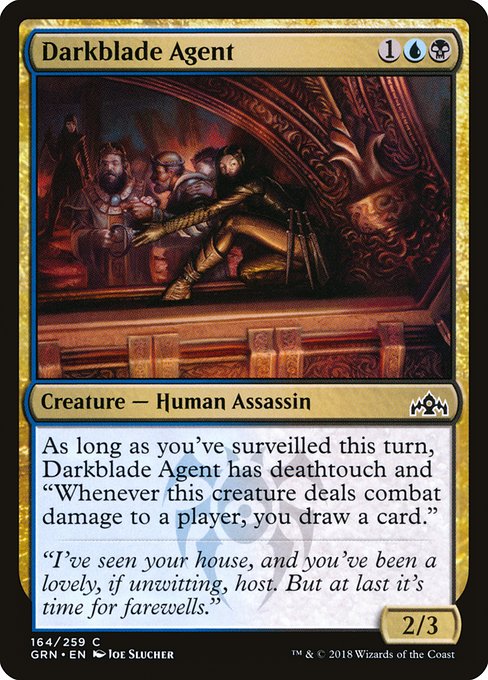
Image courtesy of Scryfall.com
Variance in Play: Darkblade Agent and the Allure of Surveil-Driven Mechanics
Magic: The Gathering loves turning the knobs of chance, information, and tempo until players feel the breathless thrill of a well-timed decision. Darkblade Agent, a blue-black creature from Guilds of Ravnica, sits squarely in that wheelhouse. For three mana (1 generic, one blue, one black), you get a 2/3 Human Assassin whose true power awakens only when you’ve surveilled this turn. That subtle gating—“As long as you’ve surveilled this turn”—transforms a straightforward stats line into a dynamic, variance-driven engine. On the surface, it looks like another midrange cookie-cutter—a 2/3 body with a potential deathtouch and card draw—but the variance is what makes it sing in the hands of a thoughtful pilot 🧙♂️🔥.
Surveil is a quintessentially Dimir toolset feature: information economy, risk management, and a dash of misdirection. When you surveil, you’re choosing which cards to put into the graveyard and which to keep at the top of your library, shaping what your opponent can expect and what you can draw in a later turn. Darkblade Agent leverages that information advantage into a power spike that only appears for one turn at a time. If you surveilled this turn, the Agent not only gains deathtouch—making this otherwise modest body a terrifying blocker or attacker—but also unlocks a built-in card advantage engine: damage to a player while routing a card to your hand. It’s a microcosm of variance in action: the exact moment you surveil determines whether the Agent is merely a 2/3 with a duty, or a crunchy, unblockable threat that punishes opposition while fueling your hand 💎⚔️.
How Surveil Fuels the Meta-Play
Variance in MTG often comes from conditional effects that flip a game state with minimal commitment. Darkblade Agent embodies this by tying its most potent capabilities to a single turn’s surveillance outcome. When you surveil early, you set the stage for the Agent to swing with deathtouch and draw a card on every successful combat connection with an opposing caster or player. If you whiff on surveil—perhaps you drew the top card you already knew or simply kept a less-than-ideal line—your Agent remains a sturdy 2/3 with a modest evasion profile at best. This pinch-and-press rhythm is what makes Dimir decks feel so lively: you’re constantly weighing how much you reveal, what you exile, and whether a single combat swing will snowball into card advantage. It’s spicy, it’s a little cheeky, and it’s absolutely in line with Guilds of Ravnica’s guildscape where information control meets surgical removal 🔮🧩.
Deckbuilding in the Murky Waters of Surveil
When you build around Darkblade Agent, you’re leaning into a pair of core pillars: surveil-enabled card selection and efficient removal. A typical Dimir shell can slot this card into midrange builds that prize inevitability through repeated card advantage. The deathtouch toggle adds bite to trades, encouraging you to pressure planeswalkers or commanders with small but meaningful bursts of damage, while the card-draw upside ensures you don’t run dry on fuel. In terms of color identity, blue-black is the perfect home for this engine: blue’s dig effects and counterplay rhythm pair with black’s graveyard interaction and hand disruption to create a well-rounded plan. On the battlefield, you’ll often see Darkblade Agent tucked behind a wall of countermagic or removal, waiting for your surveil window to reveal its lethal potential 🎯💡.
Strategically, you’ll want to time your surveil trigger with care. Early in the game, surveil can feel like a luxury, a way to sculpt your top-deck destiny. Midgame, it becomes a tactical resource: you expose exactly what you need to fuel the Agent’s deathtouch line and card draw. Late-game, you may chain multiple draws as you connect, compounding value and pressuring opponents who rely on careful mana management and long-term plan construction. The result is a design that rewards tempo in small increments and punishes hesitation with a swift, if delicate, tempo swing 🃏🎲.
Flavor, Art, and Collectibility in the Dimir Mindset
Darkblade Agent carries flavor text that feels like a whispered farewell in a dim corridor: "I’ve seen your house, and you’ve been a lovely, if unwitting, host. But at last it’s time for farewells." The lines hint at the Dimir guild’s penchant for secrets and calculated exits, a perfect echo to the card’s surveil-driven volatility. Joe Slucher’s art—shadowed figures, a cloak of whispers—caps the mechanic with a visual cue: information is power, but power can be dangerous to exposing what you truly want to keep hidden 🕵️♂️. On the table, the card’s rarity is common, but the strategic weight it carries in the right shell makes it feel like a hidden gem in a crowded rarity tier. The set, Guilds of Ravnica, carries the big-picture puzzle of guild-matched mechanics, and Darkblade Agent is a neat piece of that puzzle—modest in raw stats, mighty in its turn-based window of influence.
Design Philosophy: Variance as a Feature, Not a Fluke
Darkblade Agent demonstrates a deliberate design choice: empower players to tilt the odds through information management. Surveil isn’t about guaranteed card draw or a one-turn spike; it’s about shaping the moment when your engine awakens. This mirrors MTG’s broader trend toward mixed-consistency engines—cards that can be great in one context and merely solid in another, depending on how you sequence your plays. The result is a game state that rewards careful planning, flexible play, and a willingness to bend the plan to the information you’ve gathered. If you love the elegance of a well-timed reveal, if you enjoy reading the board and knowing you hold the right card in the graveyard, Darkblade Agent is your kind of puzzle 🧠💎.
Gameplay Takeaways
- Plan surveils around turns where you anticipate key threats or want to unlock the deathtouch draw engine.
- Use Darkblade Agent as a disruption tool, trading with larger creatures while holding back just enough to force a favorable damage-on-player moment.
- Pair with other surveil or mill-oriented cards to maximize the likelihood that you’ll hit the turn where the Agent truly shines.
- Remember: without surveil, it’s a sturdy 2/3 with a capable stat line; the variance is the edge you’re chasing 🧭.
More from our network
- https://blog.rusty-articles.xyz/blog/post/marshtomp-auction-showcases-top-pokemon-tcg-sales-trends/
- https://blog.crypto-articles.xyz/blog/post/unearthing-easter-eggs-in-ting-lu-ex-flavor-text/
- https://blog.digital-vault.xyz/blog/post/blue-sideboard-tech-to-neutralize-triton-wavebreaker/
- https://wiki.digital-vault.xyz/wiki/post/pokemon-tcg-stats-solosis-card-id-bw1-55/
- https://wiki.digital-vault.xyz/wiki/post/pokemon-tcg-stats-meloetta-ex-card-id-sv105b-167/
Darkblade Agent
As long as you've surveilled this turn, this creature has deathtouch and "Whenever this creature deals combat damage to a player, you draw a card."
ID: f0b610c5-61e5-43df-a87b-3eaaa915402b
Oracle ID: 9a293c87-ad40-4c6c-9fa4-9a8b5f081ac9
Multiverse IDs: 452914
TCGPlayer ID: 176574
Cardmarket ID: 364108
Colors: B, U
Color Identity: B, U
Keywords:
Rarity: Common
Released: 2018-10-05
Artist: Joe Slucher
Frame: 2015
Border: black
EDHRec Rank: 21150
Penny Rank: 13003
Set: Guilds of Ravnica (grn)
Collector #: 164
Legalities
- Standard — not_legal
- Future — not_legal
- Historic — legal
- Timeless — legal
- Gladiator — legal
- Pioneer — legal
- Modern — legal
- Legacy — legal
- Pauper — legal
- Vintage — legal
- Penny — legal
- Commander — legal
- Oathbreaker — legal
- Standardbrawl — not_legal
- Brawl — legal
- Alchemy — not_legal
- Paupercommander — legal
- Duel — legal
- Oldschool — not_legal
- Premodern — not_legal
- Predh — not_legal
Prices
- USD: 0.05
- USD_FOIL: 0.34
- EUR: 0.08
- EUR_FOIL: 0.15
- TIX: 0.03
More from our network
- https://wiki.digital-vault.xyz/wiki/post/pokemon-tcg-stats-machamp-card-id-ecard3-16/
- https://wiki.digital-vault.xyz/wiki/post/pokemon-tcg-stats-lucario-card-id-pop8-2/
- https://crypto-articles.xyz/tmpt4x81i4e/eb7deac0.html
- https://wiki.digital-vault.xyz/wiki/post/pokemon-tcg-stats-water-energy-card-id-base1-102/
- https://crypto-acolytes.xyz/blog/post/nft-stats-meta-betties-2156-from-meta-betties-collection/