

Image courtesy of Scryfall.com
Craven Knight and the Set-by-Set Meta Stability Journey
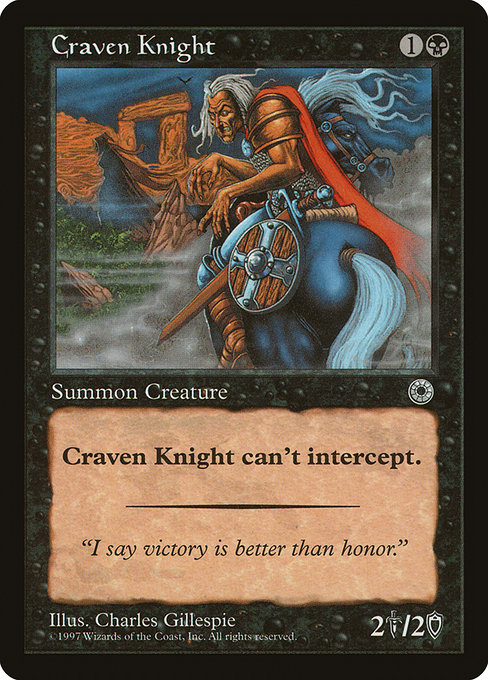
If you’ve spent any time spelunking through MTG’s early print lines, you’ve probably run into Craven Knight more for its flavor than for domination on the battlefield. This common creature from Portal, released in 1997, wears the black mana color with pride: a single {B} in its mana cost and a sturdy 2/2 body that trades on tempo rather than sheer power. Its ability is brutally simple and elegantly cruel: This creature can't block. That line flips the usual knightly identity on its head—armor and chivalry aside, Craven Knight is a marauder who pushes through defenses rather than standing guard. The flavor text seals the mood: “I say victory is better than honor.” 🔥⚔️🧙♂️
In gameplay terms, Craven Knight hits the board as a two-mana threat that refuses to be a defender. It slides in as a headlong attacker, pressuring opponents who may expect a more traditional blocker from a Knight. The card’s mana cost of {1}{B} keeps it within reach of a wide swath of decks in the Portal-era ecosystem, offering a glimpse into the early design philosophy: put pressure on the opponent quickly, then weather the counterpunch with efficient removal and tempo plays. The 2/2 body isn’t a slam dunk by today’s standards, but in the right tempo shell, Craven Knight delivers predictable transitions from opening pressure to mid-game complications for opponents to manage. And in the spirit of Portal’s approachable design, it rewards players who lean into the bite-sized decisions of early aggression. 🧙♂️💎
Let’s take a step back and map its stability across the set-by-set landscape. Portal (POR) was crafted as a starter-friendly gateway, designed to pair familiar mechanics with streamlined drafting and gameplay. In that context, Craven Knight’s role is unmistakably that of a low-cost, tempo-oriented creature that can threaten before blockers are fully deployed. It doesn’t block because it’s built to disrupt the opponent’s defense in the first few turns, aligning with a broader black strategy that leans on pressure, inevitability, and the occasional sacrifice to swing momentum. While the Portal format itself is a niche today, the card persists in formats where its color identity and cost curve are relevant. The rarity is common, and that combination means many collectors and players encountered Craven Knight in its youth, making it a familiar footprint in MTG’s history. 🔥🎨
Looking across eras, Craven Knight’s stability is a study in contrast. In a Legacy context, a 2/2 for {B} that can’t block might feel like a weak brick in a sprawling card pool, yet it still exists in the fabric of the format as a reminder of where black tempo once stood—then and now. In Pauper, where common cards dominate, a reliable black 2/2 with a built-in constraint can become a usable piece in specific archetypes and sideboard considerations, especially when paired with other evasive or aggressive tools. Vintage, with its vast suite of options, tends to overlook a modest common like Craven Knight, but the card’s presence echoes through every era’s obsession with tempo and pressure. In Commander, its fit is more about flavor and nostalgia than raw power—an homage to the Portal era more than a cornerstone of any solid, modern strategy. And across all these horizons, its lore-laden flavor text keeps the knight’s vow to victory alive, even as the meta shifts like sands in a dune sea. 💎⚔️
From a design perspective, Craven Knight embodies a moment when Magic balanced speed, theme, and color identity with a lean stroke. The artwork, contributed by Charles Gillespie, channels a moody, medieval vibe that pairs surprisingly well with the set’s experimental aura. It’s a card that’s a little rough around the edges by today’s standards, but it carries a certain charm that recalls the plastic-wrapped excitement of late-90s boosters and the communal joy of early draft nights. The black border, the modest frame, and the common rarity converge to remind players that not every powerful memory in MTG is about a game-winning combo; often, it’s about the moment you drop a 2/2 creature and swing through a startled defense, a memory etched in the minds of many players who started their journeys in the Portal era. 🧙♂️🎲
Collectors may notice the card’s price point—the listed market values reflect a small but enduring interest. As a non-foil common from a foundational set, Craven Knight isn’t chasing the ultra-premium tiers, but it remains a cozy piece of MTG history for those who savor the underdog stories of the game. For players who appreciate how a single line of rules text can alter entire timelines on a board, Craven Knight is a neat case study in tempo and posture. And if you’re chasing nostalgic vibes with a side of strategic reflection, it’s a small, steady beacon that reminds us how far the game—and our memories—have traveled. 🧙♂️💎
As you plan your next trip through MTG’s multiverse, consider how a seemingly modest card like Craven Knight can anchor a meta-stability narrative across sets. The Portal era was a crucible for ideas about how creatures of different costs should behave, how blockers shape the tempo, and how flavor can age gracefully alongside mechanics. If you’re someone who collects the echoes of early MTG design or simply loves a well-timed attack without overextending, Craven Knight offers a microcosm of that timeless tension: advance, threaten, and let the opponent decide how to block—or not. 🧙♂️⚔️
Mobile Phone Stand: Two-Piece Wobble-Free Desk DisplayMore from our network
- https://transparent-paper.shop/blog/post/hot-blue-giant-at-26-kpc-guides-spiral-arms/
- https://blog.rusty-articles.xyz/blog/post/why-eevees-colorless-typing-symbolizes-endless-evolution-in-tcg/
- https://wiki.digital-vault.xyz/wiki/post/pokemon-tcg-stats-wingull-card-id-swsh2-41/
- https://wiki.digital-vault.xyz/wiki/post/pokemon-tcg-stats-ponyta-card-id-pl4-72/
- https://wiki.digital-vault.xyz/wiki/post/pokemon-tcg-stats-wooper-card-id-sma-sv9/
Craven Knight
This creature can't block.
ID: d4cbae27-4a1a-4e16-8876-9a2925c45302
Oracle ID: 27d138af-7c5d-4c7e-a310-63d5b03f039d
Multiverse IDs: 4213
TCGPlayer ID: 643
Cardmarket ID: 9992
Colors: B
Color Identity: B
Keywords:
Rarity: Common
Released: 1997-05-01
Artist: Charles Gillespie
Frame: 1997
Border: black
EDHRec Rank: 29961
Set: Portal (por)
Collector #: 85
Legalities
- Standard — not_legal
- Future — not_legal
- Historic — not_legal
- Timeless — not_legal
- Gladiator — not_legal
- Pioneer — not_legal
- Modern — not_legal
- Legacy — legal
- Pauper — legal
- Vintage — legal
- Penny — not_legal
- Commander — legal
- Oathbreaker — legal
- Standardbrawl — not_legal
- Brawl — not_legal
- Alchemy — not_legal
- Paupercommander — legal
- Duel — legal
- Oldschool — not_legal
- Premodern — not_legal
- Predh — legal
Prices
- USD: 0.12
- EUR: 0.08
More from our network
- https://blog.crypto-articles.xyz/blog/post/nft-data-dapper-doggos-91-from-dapper-doggos-collection-on-magiceden/
- https://transparent-paper.shop/blog/post/how-to-grow-youtube-subscribers-organically-a-practical-guide/
- https://crypto-acolytes.xyz/blog/post/nft-stats-nuddies-224-from-nuddies-collection/
- https://crypto-acolytes.xyz/blog/post/nft-stats-bmb-community-season-4-8274-from-bmb-community-airdrop-season-4-collection/
- https://wiki.digital-vault.xyz/wiki/post/pokemon-tcg-stats-rattata-card-id-bw7-104/