

Image courtesy of Scryfall.com
Color Psychology in MTG Art
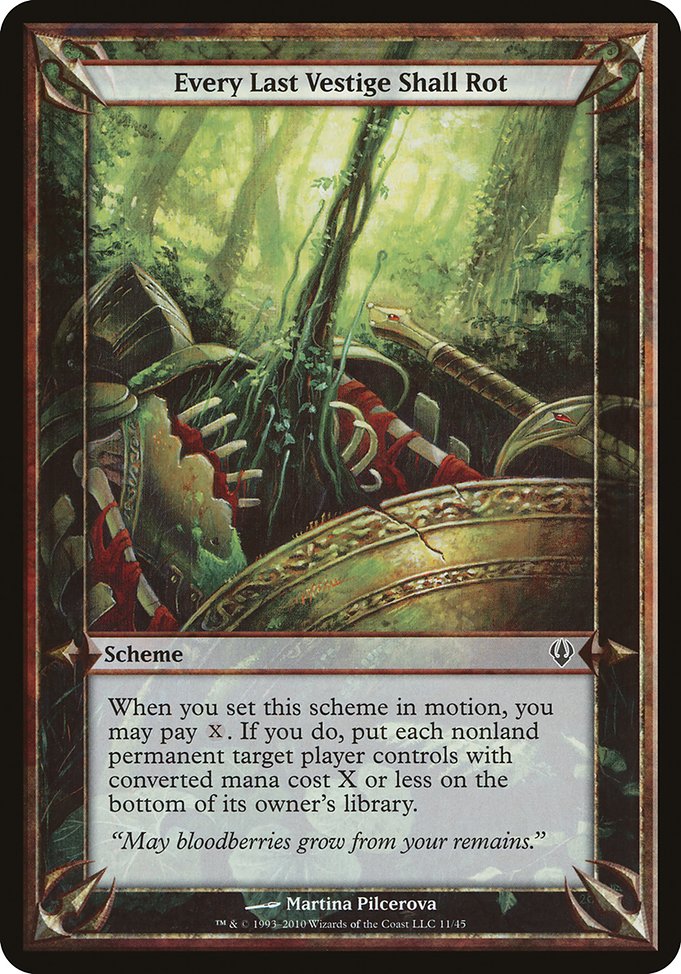
Magic: The Gathering has always teased the psychology of color, not just in gameplay but in the very mood and texture of its artwork 🧙♂️. When a card marches into the battlefield with a palette that refuses to shout color, it’s telling a story about absence as a force of influence. The artwork for Every Last Vestige Shall Rot—part of the Archenemy Schemes—leans into a colorless, almost archival vibe that hinges on neutral tones, decayed textures, and a quiet, inexorable sense of entropy 🔥. You don’t need red or blue to feel the dread; you feel it because rot doesn’t care about color. It cares about time, neglect, and the quiet tyranny of what’s left when all else is stripped away 💎⚔️.
The card is labeled a Scheme in the Archenemy line, a special multiplayer-focused subset that often invites players to think about long-form control and collective strategy. Its mana cost is empty (CMC 0), and it carries no color identity, which is itself a statement about psychology: colorless magic can be a vehicle for inevitability rather than overt aggression. In the image, you glimpse objects caught in the slow decay of some eerie, otherworldly garden—bloodberries mentioned in the flavor text—an eerie reminder that rot isn’t just a physical process; it’s a narrative device that punctures hubris and reshapes the board’s balance 🧙♂️🎨.
The Palette of Decay
Martina Pilcerova’s art for this scheme uses a restrained palette—earthy browns, slate grays, and muted greens—punctuated by the stark whiteness of bone-like textures and the occasional sickly hue. In color psychology, such a palette whispers of mortality, neglect, and the slow erosion of what players value most on the table. The absence of a bold color identity mirrors the card’s mechanical effect: X can be paid to move nonland permanents with mana value X or less to the bottom of their owner’s library. The act of forcing a shuffle that erases key threats is a quiet, surgical kind of control—less about flash and more about inevitability. It’s a lesson in how composition can evoke mood even before any rules interaction happens 🧠💎.
Color psychology isn’t just about the pretty art; it’s about how a card’s mechanics amplify that mood. This scheme’s activated effect—“When you set this scheme in motion, you may pay X. If you do, put each nonland permanent target player controls with mana value X or less on the bottom of its owner's library”—reads like a ruthless clearing in a neglected garden. It’s colorless by design, a blank slate that lets entropy do the talking. In practice, it creates a sense of looming collapse: you’re not smashing with a flamboyant spell; you’re orchestrating a moment where the board’s structure falters, and the rot spreads to the horizon 🧩⚔️.
The flavor text—“May bloodberries grow from your remains.”—couples macabre imagery with a hint of ecological horror. Color psychology in MTG often uses words and imagery to reinforce a card’s stance; here, the line evokes a dark, living garden where decay is almost a benevolent, if wicked, fertilizer. The art, the flavor, and the colorless identity combine to make rot feel like a natural law rather than a cruel trick. It’s a reminder that even in a game of color wars, there are forces that transcend color—entropy as a universal mechanic, a truth that resonates with players who remember old-school schemes and the thrill of a well-timed disruption 🧙♂️🎲.
In a multiplayer, arch-enemy context, this scheme is less about winning a single clash and more about tilting the entire game toward a slow, inevitable correction. The absence of color means it’s not about flashy combos but about tempo and board state control. A seasoned player can leverage the flexibility of paying X to tailor the disruption to the board’s composition—if a table is rich with low-cost tokens or utility permanents, a well-chosen X can nudge the game toward a more favorable trajectory for the caster’s side. It’s the kind of card that invites slow, philosophical debates about what “value” means when permanence is a moving target. And yes, it’s a great talking point for fans who love the idea that rot reshapes strategy as much as any direct damage or counterspell ever could 🧙♂️🔥.
As a common rarity from Archenemy Schemes, the card sits in the broader collector conversation about the set’s experimental approach to multiplayer play. The art is a strong selling point, especially for players who enjoy the “rot as story” vibe and the quiet menace of colorless design. The card’s printing status—nonfoil, oversize in its scheme context—adds a tactile layer to the nostalgia: a reminder that 2010-era design often prioritized story moments and theme over sheer combat power. The market price tends to bob around a few dollars, reflecting both its collectibility and its place as a quirky, thematically rich piece in a larger narrative arc 🧙♂️💎.
For fans who love blending lore with color theory, this scheme is a case study in how a single image and a few lines of rules text can conjure a mood that transcends color boundaries. It invites us to ask: what does rot say about a player’s plan? How does a colorless approach translate into a psychological edge in the heat of play? And how does art, with its careful shade and texture choices, help us feel the creeping inevitability before the grave consequences arrive? The answer, as with any great MTG artwork, sits at the intersection of design, storytelling, and the simple, gleeful joy of a well-timed strategic twist 🧙♂️🎨.
Clear Silicone Phone Case — Slim, Durable Open Port DesignMore from our network
- https://blog.zero-static.xyz/blog/post/dig-up-design-chaos-and-mtg-player-psychology/
- https://articles.zero-static.xyz/blog/post/torchlight-infinite-hidden-details-that-reward-exploration/
- https://wiki.digital-vault.xyz/wiki/post/pokemon-tcg-stats-pecharunt-card-id-svp-149/
- https://wiki.digital-vault.xyz/wiki/post/pokemon-tcg-stats-seel-card-id-swsh125-029/
- https://blog.crypto-articles.xyz/blog/post/nft-data-flopper-1091-from-flopper-collection-on-magiceden/
Every Last Vestige Shall Rot
When you set this scheme in motion, you may pay {X}. If you do, put each nonland permanent target player controls with mana value X or less on the bottom of its owner's library.
ID: c6f67230-8208-4a77-af66-661de044e188
Oracle ID: 4f7600d8-53f8-463b-82a8-bda483f0b41b
Multiverse IDs: 212655
TCGPlayer ID: 37126
Cardmarket ID: 240568
Colors:
Color Identity:
Keywords:
Rarity: Common
Released: 2010-06-18
Artist: Martina Pilcerova
Frame: 2003
Border: black
Set: Archenemy Schemes (oarc)
Collector #: 11★
Legalities
- Standard — not_legal
- Future — not_legal
- Historic — not_legal
- Timeless — not_legal
- Gladiator — not_legal
- Pioneer — not_legal
- Modern — not_legal
- Legacy — not_legal
- Pauper — not_legal
- Vintage — not_legal
- Penny — not_legal
- Commander — not_legal
- Oathbreaker — not_legal
- Standardbrawl — not_legal
- Brawl — not_legal
- Alchemy — not_legal
- Paupercommander — not_legal
- Duel — not_legal
- Oldschool — not_legal
- Premodern — not_legal
- Predh — not_legal
Prices
- USD: 2.90
- EUR: 0.76
More from our network
- https://crypto-acolytes.xyz/blog/post/nft-stats-bitcreep-5-from-the-bitcreeps-collection/
- https://blog.digital-vault.xyz/blog/post/ai-driven-steelform-sliver-synergy-predictions-for-decks/
- https://crypto-acolytes.xyz/blog/post/minecraft-best-weapons-for-a-players-essential-arsenal/
- https://crypto-acolytes.xyz/blog/post/nft-stats-meta-betties-2369-from-meta-betties-collection/
- https://wiki.digital-vault.xyz/wiki/post/pokemon-tcg-stats-kahili-card-id-sm8-179/