
Image courtesy of TCGdex.net
How Attack Costs Shape Balance in the Pokémon TCG: A Close Look at Chikorita
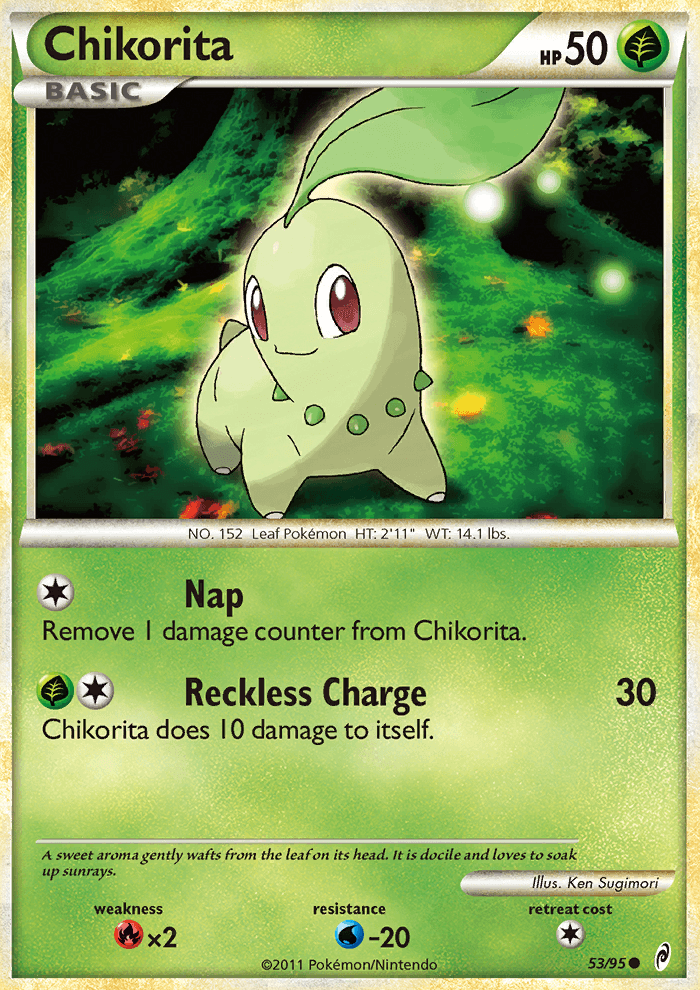
In the Pokémon Trading Card Game, every gasping breath of strategy is tied to energy costs—the invisible currency that decides what an attacker can do and when it’s safe to press the advantage. The Call of Legends era gave us a wonderfully compact microcosm of this balance in a single, unassuming Grass-classic: Chikorita. With a modest 50 HP, a basic attack kit, and an artful illustration by Ken Sugimori, this common Basic Pokémon invites players to think beyond raw numbers and consider how cost, risk, and reward mingle to shape deck viability across formats and eras. ⚡🔥
Attack costs as a balance dial
Chikorita’s two attacks demonstrate a deliberate balance through cost and effect. Its first move, Nap, costs a single Colorless energy and simply removes 1 damage counter from Chikorita. That minimal cost opens opportunities for stall tactics and powder-dry healing in the early turns, letting a player recycle the little HP they have left into a more stubborn board presence. The second attack, Reckless Charge, raises the stakes: it costs Grass + Colorless and deals 30 damage to the opponent while inflicting 30 damage to Chikorita itself. The self-inflicted recoil is not an afterthought; it’s the balancing instrument that keeps such a powerful punt in check. The cost combination—Grass for growth and Colorless for flexibility—pushes players to invest in both board presence and energy diversity to leverage the payoff safely.
What does this tell us about balance decisions more broadly? Attack costs are a designer’s lever to calibrate risk vs. reward. A low-cost, high-margin move is only as threatening as its impact, while a higher-cost attack can deliver meaningful pressure but invites careful energy planning and protective play. In Chikorita’s case, the second attack’s power is intentionally tempered by self-damage, ensuring it isn’t a runaway win condition against a wider pool of opponents. The grass-typing and the cost structure also align with typical Grass deck archetypes of the era, encouraging energy diversity without rendering the card overpowered in any single match-up. The result is a teaching card for new players and a reminder to veteran players that every energy counted—and miscounted—can swing the tempo of a match. 🎴💎
Chikorita in context: the Call of Legends ecosystem
Chikorita hails from Call of Legends, a set that catalogues a broad swath of classic Pokémon from the early days of the TCG. The card’s basic stage and common rarity make it a reliable entry point for new players while still offering enough nuance for collectors and experimenters. The illustration by Ken Sugimori anchors the card in nostalgic lore, bridging the gap between the Kanto nostalgia and the strategic modern lens. The set itself packs 95 official Call of Legends cards within its official card count, contributing to a vibrant secondary market where even common cards can become beloved mementos for fans. The holo and reverse-holo variants add a shimmering layer of collectibility to an otherwise modest package, reinforcing the idea that balance isn’t just about gameplay—it’s about how a card ages in the minds of players and collectors alike. 🔥🎨
Gameplay strategies: maximizing Nap and Reckless Charge
- Nap as a tempo tool: Use Nap to reset damage on Chikorita, buying you turns to set up additional damage counters elsewhere or to stall until you can safely retreat or heal. Because it costs nothing more than a single Colorless energy, it’s a reliable maintenance move in longer stalemates.
- Reckless Charge timing: The 30-for-30 exchange is a bold commitment. You’ll want to deploy Reckless Charge when you’ve got a clear plan to weather the recoil—perhaps with a healing support or a deck that can quickly press a second wave of pressure. The grass energy requirement nudges you toward multi-energy lines but still rewards patient play rather than reckless aggression.
- Weakness & resistance awareness: Fire types hit Chikorita for double damage, which punishes a naive leap into aggressive matchups, while Water resistance softens some hits. Smart players will weigh matchups and energy placement before committing to the attack chain, preserving board value rather than chasing a reckless finish.
- Deck-building implications: Because of the cheap colorless cost, Chikorita can slot into mixed-energy decks without demanding perfect color alignment on every turn. This flexibility echoes the broader design philosophy of balance: cards provide meaningful options, but only when energy resources and board state permit them to coexist with other threats. ⚡🎮
For collectors who also enjoy competitive play, the card’s mechanical simplicity is a canvas for teaching moments. The presence of a bright holo variant invites discussion about rarity differentials, while the base stats remind players that a card’s power curve isn’t solely about raw damage—it’s about how costs constrain or enable deployment in real games. The narrative under the surface is as important as the numbers on the card: a classic starter Pokémon, balanced by costs that encourage thoughtful resource management rather than brute force. 💎
Market value and collector insights
From a collector’s perspective, Call of Legends Chikorita sits in an interesting cross-section of accessibility and aspirational value. The standard (non-holo) common version tends to hover in the sub-dollar range, with Cardmarket reporting an average around 0.39 EUR and occasional dips as low as 0.02 EUR. The footprint of holo and reverse-holo variants, however, tells a different story: holo copies often command a premium in the market, with reverse-holo examples trending higher and occasionally reaching the mid-to-high euro range in well-preserved conditions. For dedicated collectors, the allure lies not only in the card’s place in the TCG history but also in its role as a tangible artifact of energy economics in action—the thing that makes a fragile 50 HP Grass starter feel like a strategic heavyweight in the right deck. On U.S. market data, non-foil prints show low price points (around 0.5 USD market price in some lists), while reverse holo and holo copies capture the imagination and the wallets of collectors who crave nostalgia with a side of sparkle. In short: value here isn’t just about power; it’s about stories, sets, and the enduring charm of Sugimori’s art. 💎🧭
A closer look at the set and the art
The Call of Legends identity—logo, card-count realities, and the dense mix of reprinted and original art—gives Chikorita a special place in the fan ledger. Ken Sugimori’s line work remains a touchstone for many players who grew up collecting and battling with these cards. The card’s design harmonizes with the broader green-phased questions of balance: how to give Grass-type creatures a voice without overshadowing Fire or Water, how to keep early-stage Pokémon relevant as a player’s toolkit expands. For players who love the lore, there’s a quiet thrill in seeing a simple, reliable starter evolve into a strategic piece of a larger puzzle—one that invites experimentation with attack costs, timing, and retreat decisions. 🎴🎨
As you explore this card and others from the same era, you’ll notice a recurring theme: the cost is never just a line on a card. It’s a promise about what your deck can do, when it can do it, and how long it can stay in the fight. That’s the essence of balance in the Pokémon TCG—and it’s precisely why Chikorita remains a thoughtful case study for players who love to dissect the math behind the move choices. ⚡🔥
Phone Click-On Grip Portable Phone Holder KickstandMore from our network
Chikorita
Set: Call of Legends | Card ID: col1-53
Card Overview
- Category: Pokemon
- HP: 50
- Type: Grass
- Stage: Basic
- Dex ID: 152
- Rarity: Common
- Regulation Mark: —
- Retreat Cost: 1
- Legal (Standard): No
- Legal (Expanded): No
Description
Attacks
| Name | Cost | Damage |
|---|---|---|
| Nap | Colorless | |
| Reckless Charge | Grass, Colorless | 30 |
Pricing (Cardmarket)
- Average: €0.39
- Low: €0.02
- Trend: €0.43
- 7-Day Avg: €0.24
- 30-Day Avg: €0.39
Support Our Decentralized Network
Donate 💠More from our network
- https://wiki.digital-vault.xyz/wiki/post/pokemon-tcg-stats-gengar-card-id-ecard3-10/
- https://blog.zero-static.xyz/blog/post/brisela-voice-of-nightmares-top-mtg-reddit-threads-explored/
- https://wiki.digital-vault.xyz/wiki/post/pokemon-tcg-stats-mistys-seadra-card-id-gym1-9/
- https://transparent-paper.shop/blog/post/stable-diffusion-xl-prompt-pop-art-synthwave-halftone-retro-futurism-rust-texture-neon-glow/
- https://crypto-acolytes.xyz/blog/post/nft-stats-hiney-kin-3767-from-hiney-kin-collection/