
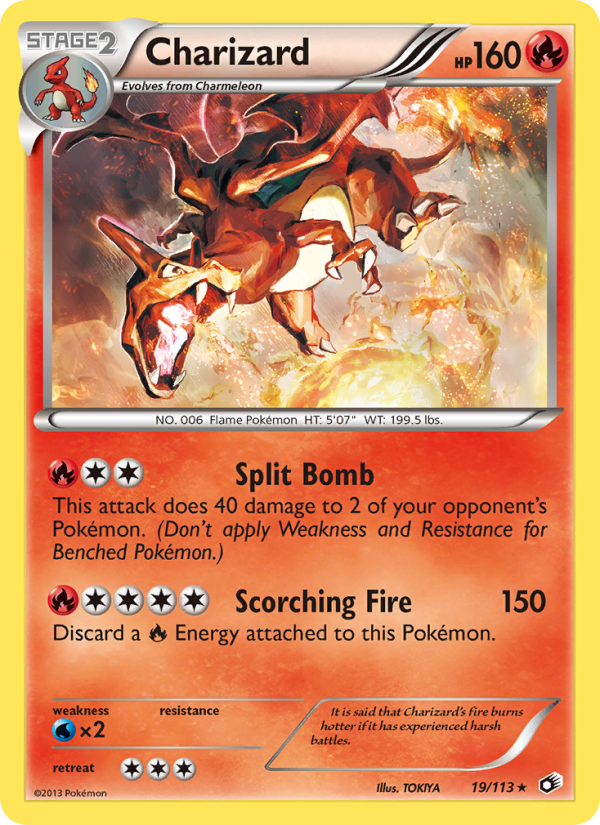
Image courtesy of TCGdex.net
Charizard’s TCG mechanics: constraints that shaped its design
Few Pokémon spark as much nostalgia as the blazing red dragon that so often stood between players and victory. The Charizard card from the Legendary Treasures set (bw11-19) is a masterclass in how a product designer navigates a web of constraints to create something that feels both thrilling to play and faithful to the character’s identity. With a towering 160 HP and Fire type power, this Stage 2 evolution—evolving from Charmeleon—had to ride the tightrope between being a formidable threat and a card that could be built around without breaking game balance. The deliberate choices behind its two distinct attacks, its energy economy, and its interaction with bench play reveal a design ethos that valued strategic depth as much as fan-favorite appeal.
Legendary Treasures sits in a period of the TCG where card viability often hinged on energy costs, bench interaction, and how a single card could drive deck archetypes. Charizard’s attacks embody those constraints in vivid form. The first attack, Split Bomb, costs Fire + Colorless + Colorless and delivers 40 damage to two of the opponent’s Pokémon. The constraint here is clear: you’re encouraged to spread pressure across the opponent’s board rather than crush a single target, a deliberate nudge toward controlling the late-game tempo through bench management. An additional twist—“Don’t apply Weakness and Resistance for Benched Pokémon”—manifests a thoughtful boundary: the card can pressure multiple targets without amplifying its own raw power unfairly against the bench. In a meta where bench exposure could become a liability, this rule preserves strategic nuance while keeping the play space clear and fair for both sides.
The second attack, Scorching Fire, costs Fire + Colorless + Colorless + Colorless + Colorless and deals 150 damage, with the caveat that you must discard a Fire Energy attached to Charizard. This is a striking constraint: a punishing finish that rewards thoughtful energy budgeting but demands a significant energy commitment and a willingness to part with a key resource. Designers recognized that big-damage finishes need to be balanced by costs that prevent reckless spamming, especially for a Stage 2 with a high HP pool. The five-energy requirement ensures players plan for a sustained burn, leaning on their broader deck to accelerate Fire Energy and set up the late-game knockout without sacrificing resilience on the front end.
Several other constraints shape Charizard’s design. HP 160 is not accidental; it places Charizard in a tier where it’s durable enough to survive meaningful returns from opposing attacks, yet not so overpowered that it tanks standard matchups on turn one. The Fire weakness to Water ×2 is a classic trade-off—Charizard is potent yet inherently vulnerable to a common counter. Retreat cost of 3 reinforces the idea that Charizard is a big, hard-hitting finish piece—powerful, but not easily pulled away from the battlefield when you need it most. The card’s rarity—Rare in a set whose card count spans 113 official cards (with 140 total in the BW11 era)—and its holo/normal/reverse variants underscore a collector-facing constraint: the card’s desirability is amplified by scarcity and the tactile thrill of a holo Charizard in a Legendary Treasures sleeve.
From a layout and aesthetics perspective, TOKIYA’s illustration anchors the card in a lore-friendly moment—Charizard blazing with intensity, yet framed by the era’s stylization. The card’s evolution line—Charmeleon to Charizard—reflects the game’s longstanding design discipline: stage-based progression that rewards evolving your board state while preserving a fair power curve. The Legendary Treasures set’s mechanics often leaned into elemental flavors and dramatic on-attribute interactions, making Charizard a natural centerpiece that showcases how a single card can embody both story and strategy under a defined constraint set.
Key constraints that guided gameplay design
- Energy economy: The second attack’s heavy energy cost compels players to invest in energy acceleration and resource management. You’re rewarded for sustained play rather than punchy single-turn bursts, which aligns with Charizard’s identity as a dramatic mid-to-late game finisher.
- Bench engagement: Split Bomb’s multi-target damage, paired with the rule about bench weaknesses and resistances, nudges players toward board control rather than a blunt, single-target KO strategy. This fosters decision-making about which threats to pressure and when to pivot to the late-game finish.
- Stage 2 design philosophy: Evolving from Charmeleon encourages players to invest in a longer-term plan. Charizard’s presence as a formidable Stage 2 aligns with a tempo curve where players set up early threats and then capitalize as the opponent stabilizes their board.
- Rarity and set distribution: As a Rare card in Legendary Treasures—within a set that includes 113 official cards and 140 total—Charizard was positioned to be a sought-after collectable that players chase for both function and display value. The holo, normal, and reverse variants widen the collectible appeal without diluting balance on the table.
- Rotations and legality: The card’s standard-rotation status (Standard vs Expanded) reflects a broader constraint: designers must anticipate how a card will age within the evolving rules, preserving Expanded playability while acknowledging Standard’s periodic reshaping.
- Illustration and identity: TOKIYA’s artwork anchors Charizard in a recognizable aesthetic that fans trust, reinforcing narrative continuity across the card’s life in print and digital reprints without stepping into AI-generated territory.
Gameplay strategy and collector insights
In a practical build, players lean into the card’s dual identity: a sturdy, reliable frontline with a punishing finisher. Early game looks to establish Field presence and begin applying pressure with Split Bomb, forcing the opponent to protect multiple threats. By the mid to late game, Scorching Fire—when energy acceleration lines up and the discard cost can be absorbed—becomes the decisive blow. The card’s Water weakness remains a natural counter in the meta, so successful Charizard decks often incorporate tools or support to mitigate the risk of a fast Water-type counter sweep.
Collectors value this Charizard not only for its playability but for its place in Legend-laden lore. Market indicators show a healthy range: CardMarket lists an average around 33 EUR with a low end around 13 EUR and a positive trend; holo variants fetch higher figures, with a notable market price around 39.99 EUR and a trend above 50 EUR. On TCGPlayer, holo prices can spike toward the upper hundreds, reflecting both nostalgia and demand among high-end collectors. This dynamic makes the bw11-19 Charizard a standout piece for both competitive players and gallery-worthy displays in a collection led by iconic Fire-type champions.
For fans who adore the synergy of art, lore, and strategy, the Legendary Treasures Charizard remains a beacon. Its design constraints—carefully balanced HP, multi-target pressure, and a high-cost burn that rewards board control—offer a enduring lesson in how to craft cards that are both playable and collectible. The card’s bold illustration, its evolving lineage from Charmeleon, and its place within a set that celebrated legendary creatures all contribute to a story as fiery as its flame-based attacks. ⚡🔥💎
Phone Grip Click-On Personal Phone Holder KickstandMore from our network
- https://crypto-acolytes.xyz/blog/post/hero-1425-soul-gate-heroes-nft-stats/
- https://transparent-paper.shop/blog/post/stable-diffusion-xl-prompt-cyberpunk-neural-style-transfer-jungle-ruins-coral-texture-glacier-teal-sandstone-texture/
- https://blog.crypto-articles.xyz/blog/post/liverpool-blip-deepens-into-a-long-term-trend/
- https://blog.crypto-articles.xyz/blog/post/nft-data-gor-capsule-3158-from-gorex-capsules-collection-on-magiceden/
- https://blog.crypto-articles.xyz/blog/post/nft-data-jellylore-club610-from-jellylore-club-collection-on-magiceden/
Charizard
Set: Legendary Treasures | Card ID: bw11-19
Card Overview
- Category: Pokemon
- HP: 160
- Type: Fire
- Stage: Stage2
- Evolves From: Charmeleon
- Dex ID: 6
- Rarity: Rare
- Regulation Mark: —
- Retreat Cost: 3
- Legal (Standard): No
- Legal (Expanded): Yes
Description
Attacks
| Name | Cost | Damage |
|---|---|---|
| Split Bomb | Fire, Colorless, Colorless | |
| Scorching Fire | Fire, Colorless, Colorless, Colorless, Colorless | 150 |
Pricing (Cardmarket)
- Average: €33.15
- Low: €12.99
- Trend: €43.57
- 7-Day Avg: €31.56
- 30-Day Avg: €42.31
Support Our Decentralized Network
Donate 💠More from our network
- https://crypto-acolytes.xyz/blog/post/hero-1425-soul-gate-heroes-nft-stats/
- https://transparent-paper.shop/blog/post/stable-diffusion-xl-prompt-cyberpunk-neural-style-transfer-jungle-ruins-coral-texture-glacier-teal-sandstone-texture/
- https://blog.crypto-articles.xyz/blog/post/liverpool-blip-deepens-into-a-long-term-trend/
- https://blog.crypto-articles.xyz/blog/post/nft-data-gor-capsule-3158-from-gorex-capsules-collection-on-magiceden/
- https://blog.crypto-articles.xyz/blog/post/nft-data-jellylore-club610-from-jellylore-club-collection-on-magiceden/