

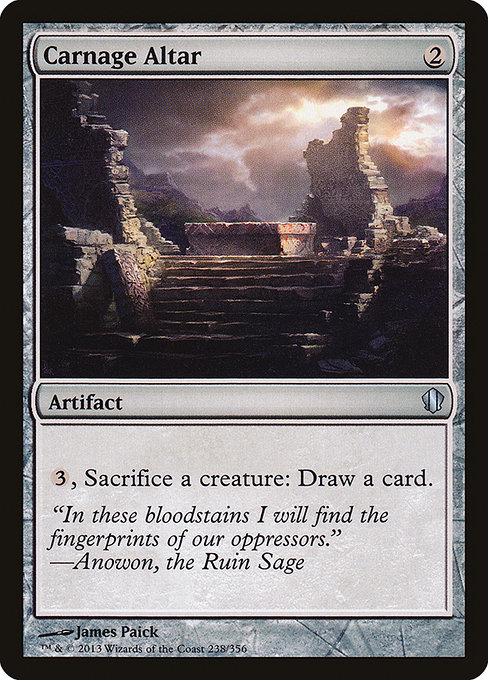
Image courtesy of Scryfall.com
Carnage Altar and Color Interaction: Multicolor Mechanics Deep Dive
In the vibrant kaleidoscope of multicolor Magic: The Gathering decks, a colorless artifact can feel like a quiet maestro conducting a symphony. Carnage Altar, from Commander 2013, is a perfect case study. With a modest mana cost of {2} and the ability text "{3}, Sacrifice a creature: Draw a card," it doesn’t sing in a particular color, but it harmonizes beautifully with every color you might wield. The artifact’s colorless nature means it slips into red-white, black-green Aristocrats, blue-black control, or green ramp with equal ease. You’re not chasing a color-based payoff; you’re chasing resource efficiency and tempo—exactly the kind of engine that shines brighter when your deck spans multiple colors 🧙♂️🔥.
Colorless tools in a colorful world
Color identity in Commander is all about mana sources and spells that define a commander’s color wheel. Carnage Altar doesn’t contribute to a color’s identity, so it never forces you into a single color strategy. That makes it an ideal companion for multicolor lines where you want reliable card draw without locking yourself into a specific color’s mana requirements. In practice, the Altar acts as a universal refill button: invest a creature, pay three mana, and you replace the one you sacrificed with a fresh draw. In decks that teem with creatures—token swarms, aristocrat synergies, or graveyard shenanigans—the Altar becomes a steady drip of gas. It’s the sort of card that plays nicely with both heavy-hitting black sac outlets and blue-control tempo, all without forcing you to contort your mana base to meet a color’s demands 🎲⚔️.
Strategies to weave Carnage Altar into multicolor flow
- Synergy with sacrifice engines: Carnage Altar wants creatures on the battlefield and a way to spare one for the cost. In a multicolor shell, you can pair it with generic sac outlets or ETB-triggered creatures that give you value when they die. The result is a loop where you trade a creature for a card, then recur or re-summon that creature to sac again later in the game—perfect for late-game pressure and long, droning games where every draw pushes you closer to a win condition 💎.
- Reanimation and recursion: If your deck leans on reanimation spells or graveyard recursion, Carnage Altar feeds the engine by turning a sacrificed creature into immediate card draw. In color combinations that push graveyard strategies—black’s natural affinity for sacrifice and blue’s permission to draw—this artifact quietly becomes a powerhouse, keeping your hand full while you churn through threats.
- Token and populating boards: Multicolor builds that generate tokens or use wide boards can feed Carnage Altar consistently. Sacrificing a token or a persist creature to draw a card helps you maintain pressure while you lean into the “board state” you’re constructing in colors like green and white, where tokens and value engines thrive. The art and text pair nicely with themes of harvest and consequence, which fits the flavor of a well-tuned aristocrat or token strategy 🧙♂️.
- Colorless reliability in manabases: Since the Altar is colorless, it isn’t picky about your mana sources. It works with shock lands, fetches, and mana rocks from any color combo, ensuring you don’t miss a draw just because your mana base is a little wonky. In a world where a single color can overperform or underperform, Carnage Altar keeps a predictable beat to lean on as you plan for the long game 🎨.
Flavor, lore, and the design philosophy
The flavor text—"In these bloodstains I will find the fingerprints of our oppressors." — Anowon, the Ruin Sage—echoes the card’s core theme: sacrifice as a path to knowledge and advantage. James Paick’s art work, with its stark lines and shadowed composition, captures a moment where grisly ritual and strategic thinking collide. This design is a quiet celebration of efficiency: not flashy, not color-bound, but precisely the kind of engine that empowers a wide swath of multicolor decks to function more smoothly yet with impactful payoff when drawn at the right moment 🔥. The rarity—uncommon—and its presence in Commander 2013 reflect a time when Wizards of the Coast leaned into accessible, interactive artifacts that rewarded intelligent resource management across a variety of color identities 🧙♂️.
Crafting around the card in real-world tabletop play
For players juggling a busy mana base across several colors, Carnage Altar is a reliable “gas source” you can count on in many game states. It’s not a slam-dunk combo piece that ends games immediately, but it delivers real, steady value. If you’re piloting a multicolor Commander who wants to balance aggression with card advantage, consider how the Altar can become a recurring draw engine alongside other value-adding elements. It also serves as a neat talking point at the table: a colorless artifact that thrives in a color-rich environment, proving once again that color doesn’t always determine usefulness—context and synergy do 🧭.
From card data to table talk
As a product of Commander 2013, Carnage Altar sits within a lineage of reprints that made the format accessible and flexible. Its {2} mana cost remains friendly in multiplayer settings, and its uncommon rarity keeps it approachable without being ubiquitous. In terms of design, the card exemplifies how a modest ability can become a backbone with the right support—an emblem of multicolor strategy where the sum is greater than its parts. And if you enjoy the tactile thrill of discovery, the Altar’s flavor-text and artwork provide a nice thematic anchor for players who love the darker, ritualistic side of magic’s lore 💎.
Whether you’re brewing a new deck or revisiting a beloved aristocrat or control shell, Carnage Altar invites you to explore how colorless engines can power multicolor strategies. It’s a reminder that in the multiverse of colors, sometimes the most understated tools shine brightest when you let them dance with your entire color palette 🧙♂️🎨.
More from our network
- https://wiki.digital-vault.xyz/wiki/post/pokemon-tcg-stats-marill-card-id-ecard1-120/
- https://wiki.digital-vault.xyz/wiki/post/pokemon-tcg-stats-palossand-card-id-a3-082/
- https://wiki.digital-vault.xyz/wiki/post/pokemon-tcg-stats-palossand-card-id-sm3-62/
- https://crypto-acolytes.xyz/blog/post/nft-stats-george-plays-clash-royale-817-from-gpcr-nft-collection-collection/
- https://wiki.digital-vault.xyz/wiki/post/pokemon-tcg-stats-suicune-card-id-pop2-4/
Carnage Altar
{3}, Sacrifice a creature: Draw a card.
ID: c08486d3-3d94-49c7-b8c9-61eb8a3e6428
Oracle ID: aa05900f-0f04-407e-931c-fea8f91e78e3
Multiverse IDs: 376277
TCGPlayer ID: 72065
Cardmarket ID: 264959
Colors:
Color Identity:
Keywords:
Rarity: Uncommon
Released: 2013-11-01
Artist: James Paick
Frame: 2003
Border: black
EDHRec Rank: 14723
Penny Rank: 12961
Set: Commander 2013 (c13)
Collector #: 238
Legalities
- Standard — not_legal
- Future — not_legal
- Historic — not_legal
- Timeless — not_legal
- Gladiator — not_legal
- Pioneer — not_legal
- Modern — legal
- Legacy — legal
- Pauper — not_legal
- Vintage — legal
- Penny — legal
- Commander — legal
- Oathbreaker — legal
- Standardbrawl — not_legal
- Brawl — not_legal
- Alchemy — not_legal
- Paupercommander — not_legal
- Duel — legal
- Oldschool — not_legal
- Premodern — not_legal
- Predh — legal
Prices
- USD: 0.14
- EUR: 0.14
- TIX: 0.04
More from our network
- https://blog.crypto-articles.xyz/blog/post/spoink-design-parallels-across-physical-and-digital-pokemon-tcg/
- https://blog.crypto-articles.xyz/blog/post/nft-data-b283-from-b33-collection-on-magiceden/
- https://crypto-acolytes.xyz/blog/post/nft-stats-zmb3y-1909-from-zmb3ys-collection/
- https://blog.crypto-articles.xyz/blog/post/nft-data-493-from-bitasuar-collection-on-magiceden/
- https://articles.zero-static.xyz/blog/post/devil-may-cry-5-memes-the-top-community-moments-revealed/