
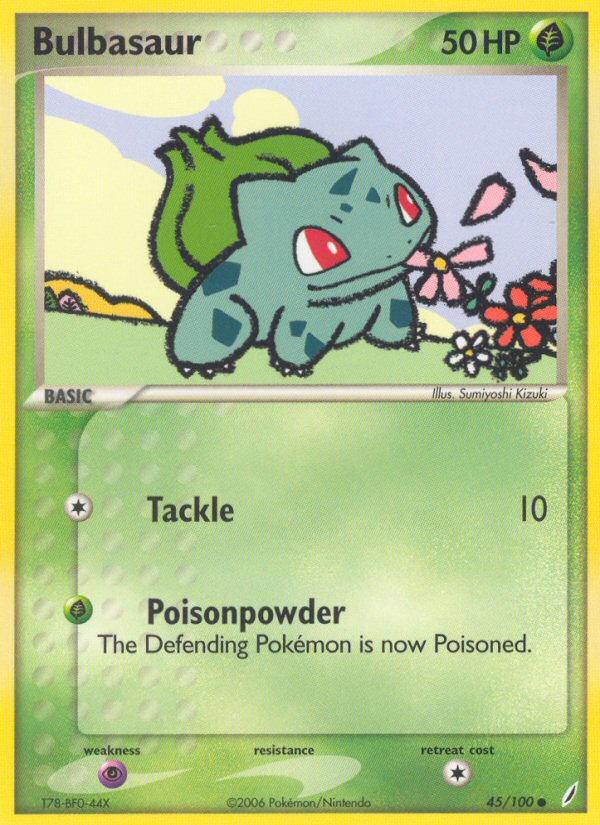
Image courtesy of TCGdex.net
Bulbasaur Evolution: How the TCG Mirrors Game Mechanics
For fans of both the video games and the trading card game, Bulbasaur stands as a small, sturdy lighthouse illustrating how evolution works in the Pokémon TCG. This particular card, Bulbasaur from Crystal Guardians (ex14), is a humble Basic Grass-type with 50 HP and two distinct attacks that hint at the path ahead: Tackle and Poisonpowder. The journey from Bulbasaur to Ivysaur and then Venusaur mirrors the familiar progression in the games, but with the tactile excitement that only a card-based mechanic can provide. ⚡
Card snapshot: what you’re holding in your hand
- Card name: Bulbasaur
- Set: Crystal Guardians (ex14)
- Rarity: Common
- Stage: Basic
- HP: 50
- Type: Grass
- Attacks:
- Tackle — Cost: Colorless; Damage: 10
- Poisonpowder — Cost: Grass; Effect: The Defending Pokémon is now Poisoned.
- Weakness: Psychic ×2
- Illustrator: Sumiyoshi Kizuki
- Evolution: Evolves to Ivysaur (Stage 1) and later Venusaur (Stage 2)
- Legal in formats: Not current Standard/Expanded formats, representative of classic-era play
The card’s artwork by Sumiyoshi Kizuki captures Bulbasaur’s iconic innocence, a design cue echoed across the Crystal Guardians set. While the card itself is not a holo or first edition, its plain-but-memorable frame invites players to focus on gameplay and the evolution narrative rather than glare-worthy rarity. Collectors love Bulbasaur as a cornerstone of early Grass decks, and the card’s 50 HP reminds us that strategy often beats raw numbers—evolving at the right moment is the real power play. 🎨
The evolution mechanic in the TCG vs. the games
In the Pokémon video games, Bulbasaur follows a straightforward path: Bulbasaur → Ivysaur → Venusaur, with levels of strength and access to stronger moves as you progress. The TCG translates this lineage into a crisp, turn-based mechanic. A Bulbasaur player must:
- Place Bulbasaur on the Bench on a turn, then
- On a later turn, play Ivysaur from the hand to evolve Bulbasaur, placing Ivysaur on top of the Basic card, thus upgrading its HP and attacks.
Key nuance: you can only evolve a Pokémon on your turn, and you cannot evolve the same Pokémon on the same turn that it was put onto the field. This creates rhythm in the game—the tempo of setting up a stage 1 Pokémon and then securing a stage 2 upgrade—mirroring the game’s sense of progression while requiring careful timing and energy management. Bulbasaur’s transition to Ivysaur unlocks stronger options and better survivability, just as in the RPGs where Ivysaur presents improved stats and more powerful moves. The TCG achieves this growth through stacked Attack costs and improved HP on Ivysaur and Venusaur, reinforcing the theme that evolution is a strategic pivot point in every deck. 💪
Gameplay strategy: leveraging Bulbasaur’s kit
- Energy planning: Tackle uses Colorless energy while Poisonpowder needs Grass energy. A well-timed energy setup means you can threaten with Poisonpowder to apply a persistent condition while you prepare the evolution path to Ivysaur for more potent attacks.
- Poison as tempo: Poisonpowder isn’t a one-shot finisher, but it buys you time. Poison status affects the Defending Pokémon across turns, pressuring your opponent to draw into healing or switching options. In combination with Grass-energy support cards, you can snowball pressure as you evolve.
- Evolution timing: Early on, Bulbasaur serves as a sturdy stall turn, buying you the turns needed to draw Ivysaur. Pacing matters: evolving too soon may deprive you of the defense needed to withstand a quick counterattack; delaying evolution risks giving up momentum if your opponent accelerates their own growth.
- Bench economy: Running Bulbasaur means you’ll be building a two-stage ladder in play—Ivysaur then Venusaur—so you’ll want reliable draw and search to fetch the evolutions when the moment is right. The overarching strategy is to keep your options flexible while you pressure with a Poisonpowder-supported front line.
Art, lore, and the collector’s eye
Sumiyoshi Kizuki’s Bulbasaur embodies the warmth of the early 2000s Pokémon TCG era. The Crystal Guardians set, with its clean lines and playful palettes, invites a nostalgic gaze that fans often pair with modern collecting practices. This Bulbasaur is a reminder that even “Common” cards can anchor a strong deck strategy, especially when the evolution line remains intact in your binder and your gameplay.
“Evolving on the right turn is the moment where strategy meets growth—exactly what makes the TCG feel like a living, breathing game.”
From a collector’s standpoint, the card’s value has an interesting spread. Price data across markets show that non-holo Bulbasaur ex14-45 sits in the modest-but-collectible range, while the holo or reverse-holo variants—where they exist—tend to command higher prices. Cardmarket data from early 2025 indicates a typical non-holo Bulbasaur in the single-digit to low double-digit euro range, whereas holo and reverse-holo copies can leap into the tens, depending on condition and edition. In modern terms, the value lies not only in the card itself but in the lineage it represents and the evolution mechanics it demonstrates so clearly. 🛒
As a piece of playable history, Bulbasaur’s evolution line remains a blueprint for deck-building: you begin with a sturdy, affordable base, then gradually upgrade to a powerhouse with Ivysaur and Venusaur, all while timing your Poisonpowder to maximize disruption. The card’s 50 HP and its two attacks—one quick and one strategic—create a microcosm of the long arc of a Pokémon TCG match: set up, pressure, evolve, and strike with a bigger threat when your opponent is least prepared. 🔥
Gaming Neon Mouse Pad 9x7 Personalized NeopreneMore from our network
- https://crypto-acolytes.xyz/blog/post/klout-genesis-hashtag-1200-klout-genesis-hashtags-nft-stats/
- https://blog.crypto-articles.xyz/blog/post/poliwrath-ex-limited-edition-vs-pre-release-card-value/
- https://wiki.digital-vault.xyz/wiki/post/pokemon-tcg-stats-grimer-card-id-base5-57/
- https://blog.digital-vault.xyz/blog/post/shivan-reef-tales-fanfiction-meets-mtg-dual-land-lore/
- https://crypto-acolytes.xyz/blog/post/nft-stats-bagtardio-1396-from-bagtardio-collection/
Bulbasaur
Set: Crystal Guardians | Card ID: ex14-45
Card Overview
- Category: Pokemon
- HP: 50
- Type: Grass
- Stage: Basic
- Dex ID: 1
- Rarity: Common
- Regulation Mark: —
- Retreat Cost:
- Legal (Standard): No
- Legal (Expanded): No
Description
Attacks
| Name | Cost | Damage |
|---|---|---|
| Tackle | Colorless | 10 |
| Poisonpowder | Grass |
Pricing (Cardmarket)
- Average: €1.2
- Low: €0.08
- Trend: €1.42
- 7-Day Avg: €1.27
- 30-Day Avg: €1.13
Support Our Decentralized Network
Donate 💠More from our network
- https://crypto-acolytes.xyz/blog/post/klout-genesis-hashtag-1200-klout-genesis-hashtags-nft-stats/
- https://blog.crypto-articles.xyz/blog/post/poliwrath-ex-limited-edition-vs-pre-release-card-value/
- https://wiki.digital-vault.xyz/wiki/post/pokemon-tcg-stats-grimer-card-id-base5-57/
- https://blog.digital-vault.xyz/blog/post/shivan-reef-tales-fanfiction-meets-mtg-dual-land-lore/
- https://crypto-acolytes.xyz/blog/post/nft-stats-bagtardio-1396-from-bagtardio-collection/