

Image courtesy of Scryfall.com
Edition differences and how to read print runs for Blade Splicer
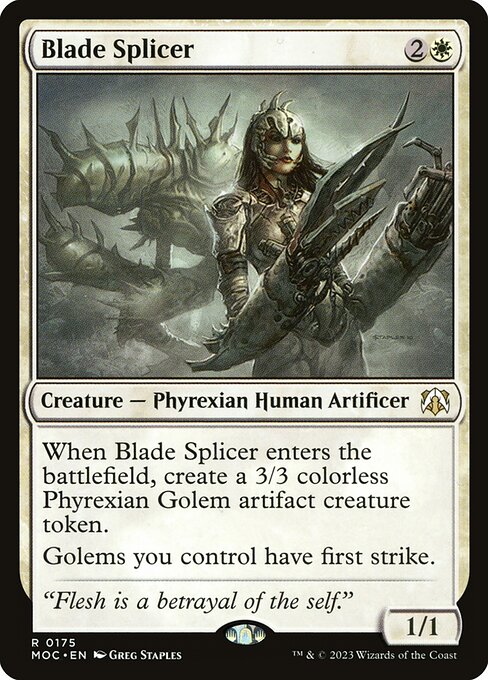
For players and collectors, Blade Splicer is a perfect case study in how print runs feel in your binder. This white mana creature from the Phyrexian-tinged design space enters the battlefield and immediately plants a 3/3 colorless Phyrexian Golem token that the spell’s controller owns. On top of that, all Golems you control gain first strike, turning a modest block into a surprising board presence. The mana cost is friendly for aggressive or midrange white builds: a clean 2 and W—enough to splash in token-oriented strategies or artifact synergies without overtaxing your mana base. In the current data snapshot, we see a modern reprint in March of the Machine Commander with the collector text aligned to modern printing standards: rarity marked as rare, and a non-foil finish. This combination isn’t random; it reflects Wizards’ approach to Commander reprints: broad accessibility with clear, modernized presentation. 🧙♂️🔥
Print run differences matter most when you’re chasing specific editions for value, display, or even binder completeness. Blade Splicer’s original appearance came in New Phyrexia (2011). The later Commander-focused reprint in March of the Machine Commander (set type: Commander) showcases a different printing window, tooling, and stock notes—most notably the nonfoil finish that dominates this particular print. The Scryfall data confirms the MOC print is nonfoil, which aligns with many Commander reprints that prioritize accessibility over high-end foil runs for widespread play. When you flip through price histories, you’ll see the nonfoil version typically easier to find in bulk, though foil variants exist in other sets. This dynamic shapes not just collector value but also casual market behavior among players who want a dependable copy for EDH tables. 💎⚔️
“Flesh is a betrayal of the self.” — flavor text of Blade Splicer, a line that perfectly captures the Phyrexian zeal for perfection through synthesis.
What does that mean in practice? If you’re chasing print-run differences, you’re tracking more than just whether a card exists in foil or nonfoil. You’re looking at stock quality, border treatment, and subtle typography shifts that accompany reprints. The MOC Commander edition uses a 2015-era frame with a black border and the oval security stamp, a hallmark of many print runs around that era. The card’s overall presentation—art, borders, and font—helps you spot a reprint at a glance, even if you’re browsing through a messy binder or a dealer’s table. In other words, the difference between a handful of copies can feel like comparing two close cousins: familiar, but with distinct personality. 🧭🎨
From a collector’s lens, Blade Splicer’s price thread mirrors its print-availability reality. In the current data snapshot, USD prices sit around pennies, with EUR quotes hovering slightly higher, and a nonzero TIX value for the odd collector’s pinch. The rarity remains rare, which historically nudges it into “sleeve-ready” territory for EDH players who want a reliable, budget-friendly entrant into Golem-swarm strategies. Meanwhile, the card’s reprint status signals a broad distribution—helpful for players who want a competitive white creature with a built-in win condition via token generation without chasing a hard-to-find original print. 🧲
For deck builders, Blade Splicer unlocks a few sweet lines. In artifact-heavy or golem-friendly shells, you can deploy it early to spawn a 3/3 golem that immediately benefits your board state. The first-strike aura on your golems adds a layer of protection as you establish a thicker board presence. In Commander games, where sweepers are common and Board Wipes abound, that first strike becomes a meaningful tempo engine—enabling you to pressure opponents while you assemble your artifact-creation engine. The card’s white mana identity also leaves room for multicolor splashes, especially in artifact-centric strategies that lean on colorless support. 🧙♂️⚔️
Reading the prints page: practical tips for collectors
When you’re evaluating different editions, lean on credible sources like Scryfall’s prints data. Blade Splicer’s entry shows a set name of March of the Machine Commander and a rarity tag of rare, with a nonfoil finish, part of the Commander product line. If you’re comparing to earlier prints, note differences in frame design, border color, and watermark eras—each tells a story about production runs and market demand at the time of printing. The card’s legality, too, shifts with format: modern, legacy, and commander players see this card legally in a broad swath of environments, while vintage and older formats handle the card within their own historical contexts. For the value-minded, a quick check of EDHREC and TCGPlayer can reveal where copy scarcity meets playability, which in turn informs how you price or trade for a specific edition. 🧲🎲
In the end, print-run differences are less about one card’s power and more about the environment in which it lives: a Commander table, a bustling market, or a casual weekend trade night. Blade Splicer offers a vivid vignette of this phenomenon: a modest three-mana body that can catalyze into a swarm of metallic allies, with the elegance of a well-timed token engine and the resilience of a celebrated white artifact synergy. If you’re cataloging your collection, or simply curating a deck that leans into golems and artifacts, this card remains a productive, cost-effective pivot—the kind of staple that makes EDH feel like a living museum of Magic’s print-history. 🧙♂️💎
Phone Case with Card Holder MagSafeMore from our network
- https://donation.digital-vault.xyz/donation/post/support-ethical-education-projects-that-teach-not-exploit/
- https://blog.crypto-articles.xyz/blog/post/malamar-evolution-line-across-archetypes-frequency-analysis/
- https://blog.digital-vault.xyz/blog/post/how-shaders-transform-kelp-plant-appearance-in-minecraft/
- https://crypto-acolytes.xyz/blog/post/nft-stats-midevil-4728-from-midevils-collection/
- https://crypto-acolytes.xyz/blog/post/cozy-classics-best-retro-couch-co-op-games/
Blade Splicer
When this creature enters, create a 3/3 colorless Phyrexian Golem artifact creature token.
Golems you control have first strike.
ID: 3dac9526-388d-487e-a790-066f83050794
Oracle ID: 194166ad-0179-42a3-86b9-ba7f322ec576
Multiverse IDs: 612423
TCGPlayer ID: 491309
Cardmarket ID: 705563
Colors: W
Color Identity: W
Keywords:
Rarity: Rare
Released: 2023-04-21
Artist: Greg Staples
Frame: 2015
Border: black
EDHRec Rank: 4117
Penny Rank: 1100
Set: March of the Machine Commander (moc)
Collector #: 175
Legalities
- Standard — not_legal
- Future — not_legal
- Historic — legal
- Timeless — legal
- Gladiator — legal
- Pioneer — not_legal
- Modern — legal
- Legacy — legal
- Pauper — not_legal
- Vintage — legal
- Penny — legal
- Commander — legal
- Oathbreaker — legal
- Standardbrawl — not_legal
- Brawl — legal
- Alchemy — not_legal
- Paupercommander — not_legal
- Duel — legal
- Oldschool — not_legal
- Premodern — not_legal
- Predh — legal
Prices
- USD: 0.14
- EUR: 0.24
- TIX: 0.38
More from our network
- https://crypto-acolytes.xyz/blog/post/nft-stats-gib-4160-from-gib-collection/
- https://crypto-acolytes.xyz/blog/post/nft-stats-quant-60-from-quantardios-collection/
- https://wiki.digital-vault.xyz/wiki/post/pokemon-tcg-stats-heliolisk-card-id-a1-111/
- https://wiki.digital-vault.xyz/wiki/post/pokemon-tcg-stats-dreepy-card-id-swsh8-128/
- https://blog.digital-vault.xyz/blog/post/ai-driven-synergy-forecast-for-mtgs-respite/