
Image courtesy of TCGdex.net
Larvitar in Obsidian Flames: Combos for the Scarlet & Violet Meta
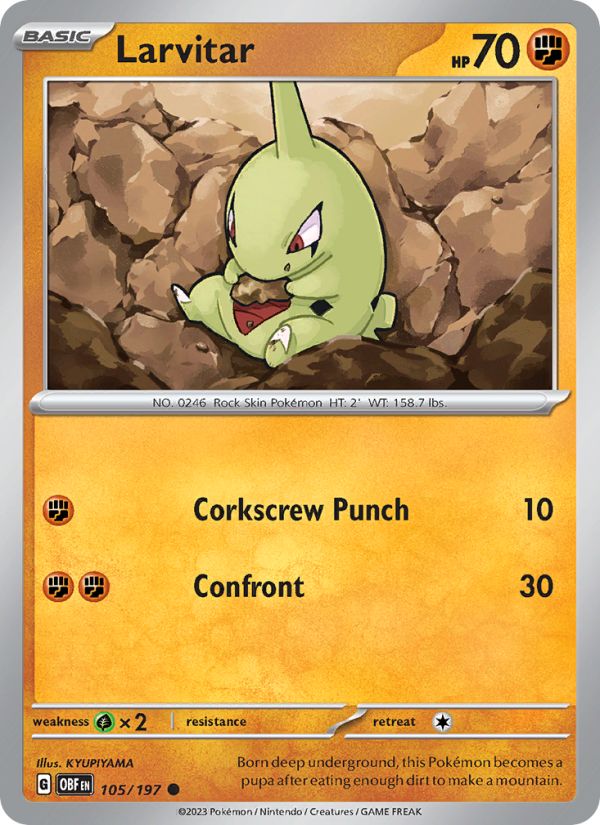
In the sprawling landscape of the Scarlet & Violet era, this humble Basic Fighting-type from the Obsidian Flames subset brings more than just cute artwork to the table ⚡. With a sturdy 70 HP and two accessible attacks, Larvitar invites players to build tempo through careful energy management and smart evolution planning. Its common rarity makes it an enticing option for budget-conscious builders who still want competitive edge, especially when paired with a patient midgame plan that crescendos into a Tyranitar-powered late game. The illustrator behind this piece, KYUPIYAMA, crafts a scene that feels as playful as it is purposeful, a reminder that TCGs blend art with strategy in equal measure 🎨.
Card at a glance: Larvitar is a Basic Fighting-type with two straightforward attacks. Corkscrew Punch costs a single Fighting energy and deals a modest 10 damage, ideal for early chip and for setting up subsequent plays. Confront costs two Fighting energies and delivers 30 damage, making Larvitar a patient accelerant—you’re not crushing your opponent in a single swing, but you’re steadily building pressure while you set up the next phase of your board.
Core mechanics and early tempo
- Corkscrew Punch — Cost: Fighting. A reliable opener that helps you establish your board presence without overcommitting resources.
- Confront — Cost: Fighting, Fighting. The skillful follow-up that rewards you for investing energy across turns, creating a smooth ramp toward stronger family members on the bench.
In a Scarlet & Violet meta where speed and disruption often decide the match, Larvitar’s value lies in how well you can chain it into a stronger attacker. Think of it as the first rung in a ladder: you place Larvitar, attach energy, and sail into the next step with Pupitar and, eventually, Tyranitar. The basic line also gives you room to incorporate supportive draw and search elements that keep your hand full while your board evolves. And yes, the cute-but-crucial role of your "setup turns" should not be underestimated—the moment you can safely evolve, your options multiply considerably ⚡.
Evolving strategy: Pupitar and Tyranitar as the power curve
Larvitar shines when you plan the evolution path. The typical engine is a steady 2-3 Larvitar on the bench, with a Pupitar to begin buffering the energy you’re about to invest, and a Tyranitar to land the heavy blows that swing prize density in your favor. The two-attacks structure of Larvitar ensures you’re not fighting alone; you’re building a tempo machine that scales as you draw into your evolutions. In practice, you want to accelerate energy onto Larvitar early, then transition to Pupitar for midgame board presence, finally deploying Tyranitar to answer the highest-value threats on the opponent’s side. It’s a classic layering of tempo and payoff, and when executed cleanly, it can outpace faster, one-shot-oriented strategies common in the current format 🎴.
“The magic of this line is not a single explosive swing, but a disciplined crescendo: deny early aggression, then unleash a bigger threat when your opponent is least prepared.”
To support this curve, include standard deck-building tools for energy acceleration and consistency. Rare Candy remains a practical choice to speed through the evolutions, and search tools that fetch Larvitar, Pupitar, and basic Trainers/cards keep your lines open. In Scarlet & Violet, balancing draw with just enough disruption is essential—your aim is to reach Tyranitar with a full hand ready to push through multi-pronged attacks while maintaining board control.
Matchups, bench resilience, and adaptability
Facing Grass-leaning decks or spread-focused strategies, Larvitar’s durability on the bench becomes a strategic asset. Its HP and evolving line give you a built-in resilience that you can leverage to weather early exchanges. The key is to time your Evolutions so Tyranitar can respond to the threats your opponent presents in their active and on the bench. If your meta leans on a lot of aggressive single-prize pushes, you’ll want to prioritize card draw and energy search to keep your engine flowing, so your Tyranitar can land the decisive, heavier blows when the window opens. And while the exact weaknesses of a given matchup can shift with set rotations, the general rule remains: pressure with your early Larvitar while you assemble the midgame evolution chain, then punish with your late-game attacker when your opponent commits resources to answer the line you’ve established 🔥.
Collector insights and market vibes
As a Common rarity card in the Obsidian Flames set, Larvitar is accessible for most collectors and players building around a tight budget. CardMarket data from late 2025 shows a gentle price curve for non-holo copies, with averages around €0.03 and lows near €0.02. Holo variants, while rarer, hover around €0.11 on average, with potential upticks depending on demand and the broader meta shift. For players chasing a reliable core engine, Larvitar’s low entry point makes it a smart starting point for a Lynx-line of evolutions that can scale with board development—and a fun curiosity for hobbyists who appreciate the Obsidian Flames aesthetic and KYUPIYAMA’s expressive art 💎.
Practical deck concepts and a starter skeleton
Here’s a flexible, high-clarity concept you can adapt to your local meta. Think of this as a framework rather than a rigid list, designed to emphasize tempo, evolution, and scalable power:
- Pupitar — 2 copies to begin pressuring the board while you ramp to Tyranitar.
- Tyranitar — 2 copies (or adjust based on local availability) to deliver heavy-hitting, late-game blows that swing prizes in your favor.
- Energy and draw — a healthy mix of Fighting Energy with draw Supporters (e.g., Professor’s Research-like effects) to keep the engine moving.
- Consistency pieces — Rare Candy or other evolution accelerants to smooth transitions between Larvitar, Pupitar, and Tyranitar.
Incorporate trainers and tools that help you search and attach energy efficiently, because tempo is king here. The goal is not just to hit hard; it’s to maintain pressure while you climb the evolution ladder and prevent your opponent from stabilizing their own board. And with the Obsidian Flames aesthetic as your backdrop, every match feels as much like a narrative as a duel ⚡🎮.
Whether you’re a veteran builder or a curious collector, the Larvitar line in this set offers a clear path to a midrange, scalable strategy. Its approachable power curve makes it accessible, while the potential for a strong Tyranitar payoff keeps the deck tantalizingly competitive in a Scarlet & Violet meta that rewards thoughtful tempo and patient evolution. The combination of art, playstyle, and market accessibility makes this little Fighting-type a delightful addition to many decks—so grab a few Larvitar, start plotting your Pupitar path, and brace for Tyranitar-level payoff when the timing is right 🔥.
Interested in more practical picks for your collection? Check out our network’s other deep dives and stay ahead of the curve with ongoing strategy discussions and market chatter.
phone case with card holder glossy matte polycarbonateMore from our network
- https://crypto-acolytes.xyz/blog/post/solana-sombrero-meme-coin-sees-downward-on-chain-momentum/
- https://transparent-paper.shop/blog/post/designing-etsy-ready-logo-templates-for-your-business/
- https://blog.crypto-articles.xyz/blog/post/nft-data-325-from-pumppets-collection-on-magiceden/
- https://crypto-acolytes.xyz/blog/post/midevil-319-midevils-nft-stats/
- https://donation.digital-vault.xyz/donation/post/fund-transparent-analytics-and-metrics-for-open-data/
Larvitar
Set: Obsidian Flames | Card ID: sv03-105
Card Overview
- Category: Pokemon
- HP: 70
- Type: Fighting
- Stage: Basic
- Dex ID: 246
- Rarity: Common
- Regulation Mark: G
- Retreat Cost: 1
- Legal (Standard): Yes
- Legal (Expanded): Yes
Description
Attacks
| Name | Cost | Damage |
|---|---|---|
| Corkscrew Punch | Fighting | 10 |
| Confront | Fighting, Fighting | 30 |
Pricing (Cardmarket)
- Average: €0.03
- Low: €0.02
- Trend: €0.04
- 7-Day Avg: €0.02
- 30-Day Avg: €0.03
Support Our Decentralized Network
Donate 💠More from our network
- https://crypto-acolytes.xyz/blog/post/solana-sombrero-meme-coin-sees-downward-on-chain-momentum/
- https://transparent-paper.shop/blog/post/designing-etsy-ready-logo-templates-for-your-business/
- https://blog.crypto-articles.xyz/blog/post/nft-data-325-from-pumppets-collection-on-magiceden/
- https://crypto-acolytes.xyz/blog/post/midevil-319-midevils-nft-stats/
- https://donation.digital-vault.xyz/donation/post/fund-transparent-analytics-and-metrics-for-open-data/