
Image courtesy of TCGdex.net
Best Energy Types for Technical Machine: Devolution in Pokémon TCG
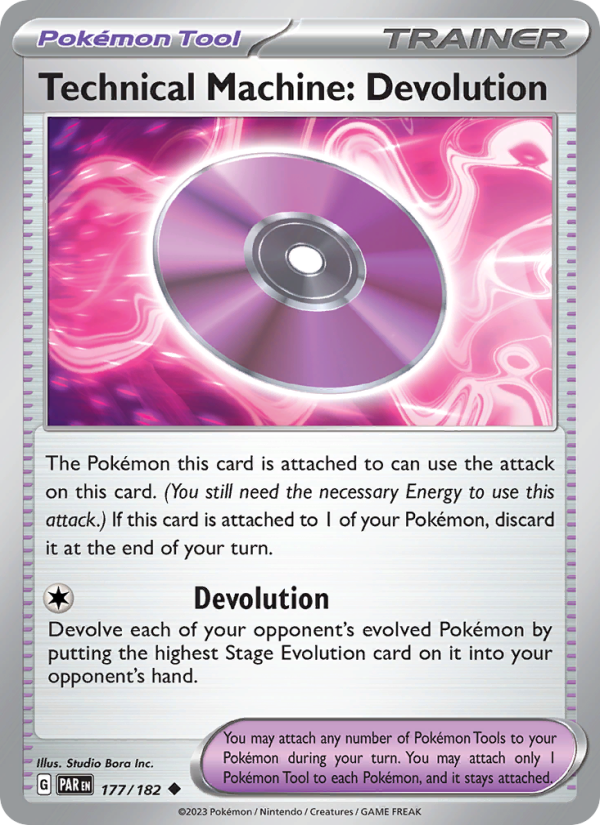
In the ever-shifting meta of the Pokémon Trading Card Game, support items that bend the flow of a match after just a single turn can tilt the balance decisively. Technical Machine: Devolution is one such tool. A Trainer — Tool from the Paradox Rift set (sv04), this uncommon gem bears the weight of clever disruption. Illustrated by Studio Bora Inc., Devolution is not your typical supplement card; it tucks into your active strategy, offering a direct way to unsettle an opponent who relies on evolving threats. The attack is simple in cost—Colorless—but its impact is anything but. When attached to one of your Pokémon, it allows that Pokémon to execute the Devolution attack, devolving each of your opponent’s evolved Pokémon by placing the highest Stage Evolution card from that Pokémon into your rival’s hand. Then, the Tool itself disappears at the end of your turn if you keep it attached to your Pokémon. This is a strategic blip in the clock, a moment of disruption you can leverage with the right energy support.
Because the attack cost is Colorless, the type of energy you attach to your Pokémon is flexible. In practical terms, that means you’re free to design your deck around your preferred energy economy without worrying about mismatch penalties when you want to pop Devolution on the battlefield. Still, the question remains: which energy types synergize best with this card to maximize its disruption while keeping your engine humming? Below, we break down practical approaches for building around this tool in both casual and more committed builds.
Why Colorless Cost Opens the Door to Flexible Energy Strategy
- Universal activation: Since Devolution’s cost is Colorless, any basic energy can power the attack. That makes it an ideal fit for decks that already run a mix of types or that want to hedge against energy droughts in mid- to late-game turns.
- Rhythms of evolution: The heart of Devolution is punishing an opponent’s evolutions. In decks that hinge on evolving into stronger attackers—think lines with Stage 1s or even Stage 2s—this Tool creates a tactical tempo swing. When you devolve a powerful evolved Pokémon back to a less threatening form (or even a basic), you strip away a key source of damage and ability access for a turn or two.
- Energy economy considerations: If your deck already leans on high-volume energy throughput (to fuel big attacks or to sustain long sequences of plays), you want energy that won’t clog your hand or respiration. Colorless-compatible energy supports that flow, letting you keep your energy mix varied without sacrificing the ability to trigger Devolution on demand.
Practical Energy Profiles to Consider
- Colorless-focused builds: This is the cleanest route. Put Devolution onto a sturdy Basic or an Evolution-stage Pokémon that already has reliable attack options. Pair with basic Colorless Energy or Rainbow Energy (if your local ruleset allows its classic behavior) to ensure you can always pay the price for Devolution, even in mixed-energy decks. The advantage is predictability: you can deploy Devolution across multiple matchups without having to reconfigure your energy lineup mid-game.
- Rainbow or multi-type supplementation: If your deck benefits from branching into multiple types (for attackers or for synergy with other Tools and Supporter cards), Rainbow Energy-type options can be appealing. They provide energy flexibility, letting you field a more diverse offensive plan while keeping the Colorless cost satisfied. Just be mindful of any drawbacks that come with Rainbow or similar energies in your chosen playgroup.
- Energy acceleration partners: Cards that accelerate energy attachment or that recycle Energy from the discard pile help keep Devolution usable in longer games. In practice, you’ll want to keep a steady supply of energy to the bench and active, so you can switch to Devolution plays when your opponent’s Evolutions become threatening again.
Strategic Tips for Using Devolution Effectively
- Target opportunistically: Devolve the most threatening evolved Pokémon your opponent has on board at the moment—typically high-HP Stage 2s or boss attackers. Turning a budding threat back into a less dangerous basic can buy you cycles to set up your own board state.
- Attach and forget… or re-attach: Since the Tool is discarded at the end of your turn if attached, you’ll look to reattach as soon as possible in subsequent turns. This makes your energy line-up and bench management crucial—without a strong reattachment plan, the disruption potential fades fast.
- Decks that benefit from disruption: Decks that stall opponents with evolving lines or that rely on specific evolutions (to unlock powerful attacks or abilities) gain outsized value from Devolution. It’s less about destroying your opponent’s board and more about forcing them to redraw, rethink, and retool on the fly.
- Compatibility with other Tools and Supporters: Use Devolution alongside other disruption-oriented cards, like those that shuffle, discard, or reconfigure the opponent’s hand and bench. The goal is to push your opponent into making suboptimal plays while you advance your own plan.
A Quick Scout on the Card Itself
- Set Paradox Rift (sv04)
- Rarity Uncommon
- Illustrator Studio Bora Inc.
- Type Trainer — Tool
- Attack Devolution (Colorless) — Devolve each of your opponent’s evolved Pokémon by putting the highest Stage Evolution card on it into your opponent’s hand.
- Effect The Pokémon this card is attached to can use the attack on this card. You still need the necessary Energy to use this attack. If this card is attached to 1 of your Pokémon, discard it at the end of your turn.
- Legal Standard & Expanded
From a collector’s lens, Paradox Rift brings a wealth of flavor and function. While Devolution sits at Uncommon, its practical impact on a match—especially when paired with a thoughtful energy plan—can feel legendary in the moment. The card’s roster status, combined with its illustration credits to Studio Bora Inc., makes it a neat intersection of playability and artful design. For players who savor the lore of evolution and the art of disruption, Devolution is a reminder that sometimes the best offense is a well-timed reset.
To players envisioning a balanced, energetic approach, pairing Devolution with a flexible energy strategy keeps your options open. It’s not just about watering a single attack—it's about shaping the tempo of the game, forcing your opponent into difficult choices, and quietly building a winning path while they struggle with devolved, devolving momentum ⚡🔥.
Neon Clear Silicone Phone Case — Slim, Flexible ProtectionMore from our network
- https://blog.crypto-articles.xyz/blog/post/nft-data-pfp-855-from-pumpfun-pepe-collection-on-magiceden/
- https://transparent-paper.shop/blog/post/stable-diffusion-xl-prompt-samurai-cinema-neon-noir-aztec-gold-palette-space-market-concrete-cracked-texture-cyberpunk/
- https://transparent-paper.shop/blog/post/stable-diffusion-xl-prompt-expressionism-ink-wash-texture-calligraphy-brushwork-neo-feudal-cyberpunk-fortress-silhouette-high-contrast-lighting/
- https://wiki.digital-vault.xyz/wiki/post/pokemon-tcg-stats-beedrill-card-id-lc-20/
- https://blog.crypto-articles.xyz/blog/post/nft-data-pumpixels-255-from-pumpixels-collection-on-magiceden/
Technical Machine: Devolution
Set: Paradox Rift | Card ID: sv04-177
Card Overview
- Category: Trainer
- HP:
- Type:
- Stage:
- Dex ID:
- Rarity: Uncommon
- Regulation Mark: G
- Retreat Cost:
- Legal (Standard): Yes
- Legal (Expanded): Yes
Description
Attacks
| Name | Cost | Damage |
|---|---|---|
| Devolution | Colorless |
Pricing (Cardmarket)
- Average: €0.16
- Low: €0.02
- Trend: €0.16
- 7-Day Avg: €0.16
- 30-Day Avg: €0.16
Support Our Decentralized Network
Donate 💠More from our network
- https://blog.crypto-articles.xyz/blog/post/nft-data-pfp-855-from-pumpfun-pepe-collection-on-magiceden/
- https://transparent-paper.shop/blog/post/stable-diffusion-xl-prompt-samurai-cinema-neon-noir-aztec-gold-palette-space-market-concrete-cracked-texture-cyberpunk/
- https://transparent-paper.shop/blog/post/stable-diffusion-xl-prompt-expressionism-ink-wash-texture-calligraphy-brushwork-neo-feudal-cyberpunk-fortress-silhouette-high-contrast-lighting/
- https://wiki.digital-vault.xyz/wiki/post/pokemon-tcg-stats-beedrill-card-id-lc-20/
- https://blog.crypto-articles.xyz/blog/post/nft-data-pumpixels-255-from-pumpixels-collection-on-magiceden/