

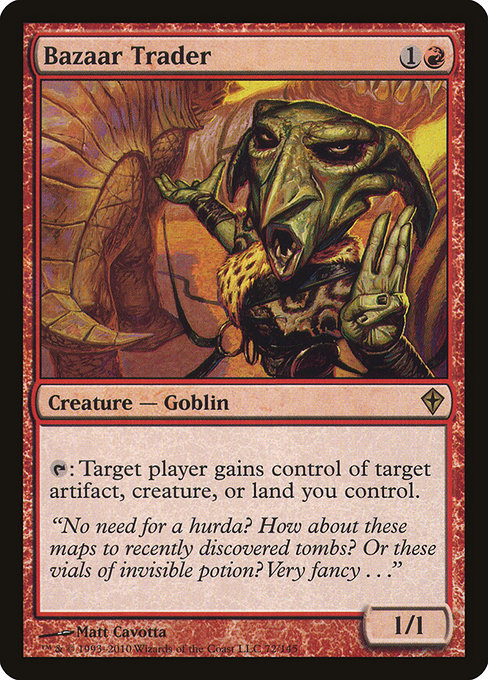
Image courtesy of Scryfall.com
AI-generated art trends flow through the Multiverse: a look from Bazaar Trader to today
When you scan the flame-lit alleys of Worldwake’s Bazaar Trader, you’re not just seeing a goblin peddler with a mischievous glint—you're witnessing a snapshot of early 2010s MTG art that sits at the crossroads of classic fantasy illustration and emerging digital experimentation. Today, AI-generated art trends have exploded into the MTG ecosystem, reshaping everything from card commissions to fan art and beyond. The question on many players’ minds: how does artificial intelligence influence the way we visualize whatever lies within the mana curve? 🚀🔥
A quick refresher on Bazaar Trader
Bazaar Trader is a red Goblin from the Worldwake set, an uncommon rarity that sits at a modest 2 mana, specifically one red and one colorless ({1}{R}). It is a 1/1 creature whose notable line in the oracle text reads: “T: Target player gains control of target artifact, creature, or land you control.” That tiny tap ability is a playful and compact nod to barter, deception, and a pinch of chaos—perfectly aligning with red’s impulsive, chaotic nature. The card’s flavor text—"No need for a hurda? How about these maps to recently discovered tombs? Or these vials of invisible potion? Very fancy . . ."—invites players into a world where trade, mischief, and treasure are everyday currency. 🧭💎
The artwork, created with a high-res scan process and illustrated by Matt Cavotta, captures a bustling, tactile moment: goblin trade, glinting wares, and a sense of movement that makes the bazaar feel alive. This is where AI-driven art begins to flex its wings in MTG spaces—by interpreting a vibe, a composition, or a mood and translating it into expressive, sometimes surreal visuals. The Worldwake frame, black border, and the non-foil charm of the card anchor the piece in a tactile era while hinting at the bold experiments that would follow in later sets. 🧙♂️🎨
“No need for a hurda? How about these maps to recently discovered tombs? Or these vials of invisible potion? Very fancy . . .”
In the early 2010s, the industry began experimenting with digital workflows, but the modern AI era accelerates that experimentation into an ever-changing creative frontier. AI tools can study the kinds of motifs that define worlds like Tarkir’s martial pacts, Innistrad’s gothic hush, or the riotous bazaars of a Worldwake-like setting, and then spin variants that explore lighting, texture, and composition you might not see in a traditional pencil-and-ink workflow. The result? More vibrant color palettes, swirls of motion around creatures, and nuanced textures—think metallic glints, glassy liquids, or dreamlike skies—that feel both fresh and nostalgically MTG. 🧪🔮
Why AI-generated art resonates with modern MTG design
- Color and mood exploration: AI can rapidly prototype multiple palettes for a single concept, helping artists and designers lock in the right emotional tone for a card’s identity—whether that’s the hot glare of red-hot chaos or the sharper edges of a treacherous market scene.
- Texture and detail breakthroughs: The tactile feel of Bazaar Trader’s wares—silks, coins, maps, and curious gadgets—can be rendered with surprising richness, closer to collectible prints than ever before.
- Iterative storytelling: As stories evolve around a set, AI can riff on existing lore, offering alternate takes that explore what-if scenarios—what if the trader’s wares included artifacts from a parallel plane? AI art can help visualize those “what ifs” without waiting for a new commission slot.
- Accessibility and speed: For independent creators and fan communities, AI-generated iterations can broaden participation, inviting everyone to contribute to the evolving visual language of a set without prohibitive costs.
- Collector-culture synergies: As card prices and print runs scale, AI-assisted art experiments catch the eye of collectors who crave novelty while still cherishing the classic ether of early world-building art.
From a gameplay perspective, the visual design also matters. Red cards like Bazaar Trader often lean into bold, kinetic imagery—flashing reds, molten textures, and bustling marketplaces—that communicate urgency and opportunity. When AI-assisted artists study these cues, they can produce pieces that capture the same adrenaline surge players feel when a critical attack or a surprise steal swings momentum. In effect, AI art becomes a tool for aligning aesthetic intention with mechanical function, a marriage that can deepen immersion without sacrificing clarity on the battlefield. ⚔️🔥
Design, rarity, and the value of a moment in time
Bazaar Trader’s status as a rare from Worldwake—set in 2010—sits at a fascinating intersection of purchase power and nostalgia. With market prices around USD 3–4 for non-foil and higher for foil, the card isn’t the most expensive on the shelf, but it carries a collectible charm that resonates with players who remember the early days of online decks and trading communities. The art, meanwhile, has aged with a certain retro-sheen that AI-assisted reimaginings are increasingly teasing out in fan art and alt-art projects. As AI tools become more integrated into design workflows, you may see more MTG cards that balance fidelity to classic interpretations with bold experiments in texture, lighting, and composition. The result is a visual continuum—where old-world inkline meets new-world algorithms—that mirrors the very essence of Bazaar Trader: a constant exchange of ideas, styles, and possibilities. 🧩💠
For collectors and players who appreciate the artistry as much as the mechanics, these shifts offer a fresh lens through which to view familiar cards. The art becomes a conversation starter, a collectible in its own right, and a bridge between the tactile charm of vintage frames and the infinitely variable outcomes of digital artistry. It’s a reminder that MTG’s multiverse is not only about what happens on the battlefield but also about how we see it, imagine it, and trade it in our imaginations. 💎🎲
Neoprene Mouse Pad Round or Rectangular, Non-Slip, PersonalizedMore from our network
- https://crypto-articles.xyz/tmpdy61lf0n/81b421fe.html
- https://articles.zero-static.xyz/blog/post/un-sets-color-balance-metrics-for-golgothian-sylex/
- https://crypto-acolytes.xyz/blog/post/nft-stats-dgcc-1202-from-degenerate-golfers-country-club-collection/
- https://crypto-acolytes.xyz/blog/post/unlock-immersive-pc-gaming-with-a-triple-monitor-setup/
- https://blog.crypto-articles.xyz/blog/post/nft-data-bagtardio-65-from-bagtardio-collection-on-magiceden/
Bazaar Trader
{T}: Target player gains control of target artifact, creature, or land you control.
ID: 9235ef13-a363-4cab-b69d-39093a621a5c
Oracle ID: 21ad7067-3210-42d6-9009-0784b2834227
Multiverse IDs: 198364
TCGPlayer ID: 34336
Cardmarket ID: 22163
Colors: R
Color Identity: R
Keywords:
Rarity: Rare
Released: 2010-02-05
Artist: Matt Cavotta
Frame: 2003
Border: black
EDHRec Rank: 7263
Penny Rank: 9195
Set: Worldwake (wwk)
Collector #: 72
Legalities
- Standard — not_legal
- Future — not_legal
- Historic — not_legal
- Timeless — not_legal
- Gladiator — not_legal
- Pioneer — not_legal
- Modern — legal
- Legacy — legal
- Pauper — not_legal
- Vintage — legal
- Penny — legal
- Commander — legal
- Oathbreaker — legal
- Standardbrawl — not_legal
- Brawl — not_legal
- Alchemy — not_legal
- Paupercommander — not_legal
- Duel — legal
- Oldschool — not_legal
- Premodern — not_legal
- Predh — legal
Prices
- USD: 3.82
- USD_FOIL: 8.87
- EUR: 2.35
- EUR_FOIL: 4.81
- TIX: 0.02
More from our network
- https://wiki.digital-vault.xyz/wiki/post/pokemon-tcg-stats-reuniclus-card-id-sv05-072/
- https://crypto-acolytes.xyz/blog/post/nft-stats-pi-pyramid-17-from-pi-pyramide-collection/
- https://wiki.digital-vault.xyz/wiki/post/pokemon-tcg-stats-passimian-card-id-a3a-034/
- https://rusty-articles.xyz/tmp6xvrqzx4/6dfeba20.html
- https://blog.digital-vault.xyz/blog/post/rarity-scaling-and-set-balance-sunstar-lightsmith-in-mtg/