

Image courtesy of Scryfall.com
Decades of Darkness: How MTG Art Evolved Across the Eras
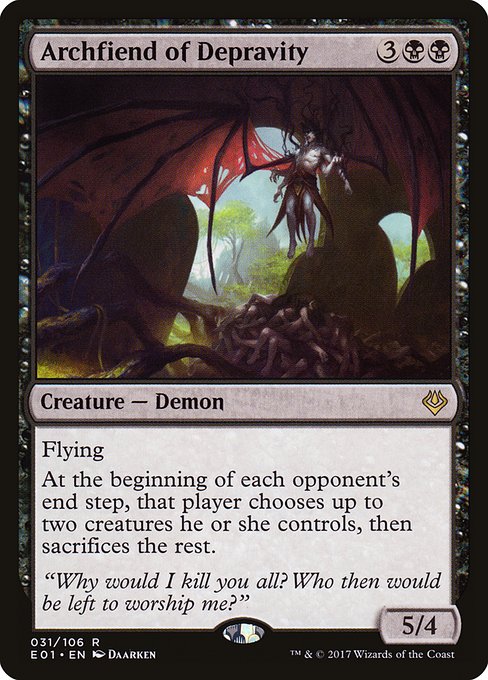
Magic: The Gathering has always been a visual menu as much as a mechanical one. From the early days of the have-you-seen-this-foretelling-demon to the modern, cinema-grade posters that sit on our walls, the art of MTG tracks a cultural arc: how we see fantasy, fear, and power rendered on a single card. 🧙♂️🔥 Each generation of cards has tugged the medium forward—painterly realism, digital bravado, and a renewed appetite for narrative depth. The Archfiend of Depravity provides a perfect case study: a demon who wears the weight of five mana, a 5/4 body that sprints past the pure stat line into a moment of mood, menace, and story. 💎⚔️
A Case Study in a Modern Demon: Archfiend of Depravity
Released on June 16, 2017, Archfiend of Depravity sits within the unusual Archenemy: Nicol Bolas set (print name e01), a bold collaboration that fused a dramatic narrative backdrop with a premium showcase of creature design. This black mana creature—a rare from a special-issue deck—asks opponents to consider more than their board presence. Its Flying keyword is a familiar whisper of menace, but the real trick lies in its static ability: at the beginning of each opponent’s end step, that player chooses up to two creatures they control, then sacrifices the rest. In gameplay terms, Archfiend nudges a control dynamic—punishing wide boards and turning the tide with a single, oppressive reminder that every creature on the battlefield comes with a cost. 🧙♂️
The art, painted by Daarken, anchors that mechanical feel in a moment of atmospheric dread. The demon is rendered with the confidence of modern digital painting—sharp contrast, deep blacks, and a selected palette that carves light from shadow. The image breathes with a weighty presence: every horn, every sinewy curve, and every glimmer of red in the eyes signals the creature’s ancient hunger for worship and warfare. It’s a testament to how contemporary MTG art can balance narrative storytelling with aesthetic spectacle. 🎨
“Why would I kill you all? Who then would be left to worship me?”
The piece sits squarely in the 2015 frame era’s sensibilities—where art directors leaned toward cinematic composition, dynamic lighting, and a sense of sculptural form that reads clearly even at card-size. Archfiend’s stance is both regal and predatory, perched atop a throne of shadowy menace that mirrors the flavor text’s chilling ambition. The result is art that isn’t just decorative; it actively communicates the card’s role within the game’s demon-filled lore. The demon’s five-mana cost and its five-power silhouette aren’t merely numbers—they’re a visual promise: power comes with a price, and the price is sometimes your own board state. 🔥
Tracing the Threads: How Art Styles Shifted Over the Decades
To appreciate Archfiend’s place in art history, let’s outline a broader arc of MTG illustration across decades, with a focus on black mana and its iconic fiends:
- 1990s – Golden Age of Illustration: Cards were often painterly, with lush fantasy detail and painterly textures. Artists like Jeff A. and Rob Alexander built lush, otherworldly atmospheres that screamed epic quest rather than a single mechanical moment. The cards felt like windows into a different universe, and demon lords loomed large with dramatic, almost stained-glass color schemes.
- 2000s – The Digital Dawn: As digital painting matured, artists began experimenting with bolder lighting, sharper edges, and more dynamic action. Black creatures darkened the frame with high-contrast shading, and the sense of scale grew more cinematic. The demon archetype found itself balancing menace with movement, trading some of the old painterly softness for a crisp, almost poster-like readability on a compact card face.
- 2010s – The Modern Painter-Designer Synthesis: The mid-2010s brought a fusion of traditional technique and digital polish. The Archfiend we see here is a product of this era: a commanding silhouette, layered textures, and careful color grading that ensures the creature remains legible against busy battlefield backgrounds. The art communicates story and tone at a glance, essential for a game where a single card may shift a duel’s momentum in a few turns.
- 2020s – Cinematic Realism and Identity: Recent pieces push narrative depth and emotional resonance. We see more environmental storytelling—thrones, ruins, ominous skies, and the evidence of a world that responds to a demon’s presence. Yet even as the palette broadens, black-mana images persist in a distinctive language: high contrast, razor-thin whites, and a focus on the demon’s gaze as a narrative engine. Archfiend’s bold features and the sense of looming doom align with this modern lens. 🎲
Art direction isn’t just about pretty pictures; it’s about fidelity to gameplay identity. Archfiend’s design reinforces its role as a control-oriented behemoth, a classic-black strategy piece that punishes board presence while offering a dramatic focal point on the battlefield. The demon’s visual impact enhances the listening-to-your-opponent feel of the card—knowing that every end step is a ritual, a ritual that might shrink their side of the board to nearly nothing. ⚔️
Beyond the knife-edge of gameplay, collectors also weigh the tactile details: rarity, foil availability, and the lore surrounding its printing. Archfiend of Depravity is a rare in its original printing, with a robust flavor text that hints at divine arrogance and annihilative appetite. Its value on the table and in collections is partially a reflection of its art’s power as a storytelling instrument—and that power has grown as the decades have evolved from painterly wonders to cinematic, digitally refined scenes. 💎
As fans, we’re witnessing a conversation across time: how artists respond to the same core motifs—power, chaos, and dark beauty—while adopting the tools and tastes of their era. The Archfiend’s era is our era’s mirror: bold, brutal, and beautiful, a reminder that magic thrives not only in the cards we play but in the images that frame our battles. 🧙♂️
Clear Silicone Phone Case - Slim, Durable ProtectionMore from our network
- https://wiki.digital-vault.xyz/wiki/post/pokemon-tcg-stats-torchic-card-id-ex9-69/
- https://crypto-acolytes.xyz/blog/post/nft-stats-buly-615-from-buly-collection/
- https://articles.digital-vault.xyz/blog/post/persona-5-royal-development-budget-and-scale-explained/
- https://blog.crypto-articles.xyz/blog/post/nft-data-xp-1022-from-xp-collection-on-magiceden/
- https://blog.crypto-articles.xyz/blog/post/chansey-and-stadium-cards-perfecting-tcg-deck-builds/
Archfiend of Depravity
Flying
At the beginning of each opponent's end step, that player chooses up to two creatures they control, then sacrifices the rest.
ID: 0ec85db7-c8ec-4730-b692-c140977436aa
Oracle ID: af247e2f-b271-4f5b-ab98-4579d2c17c21
Multiverse IDs: 430570
TCGPlayer ID: 132250
Cardmarket ID: 298351
Colors: B
Color Identity: B
Keywords: Flying
Rarity: Rare
Released: 2017-06-16
Artist: Daarken
Frame: 2015
Border: black
EDHRec Rank: 1649
Penny Rank: 10985
Set: Archenemy: Nicol Bolas (e01)
Collector #: 31
Legalities
- Standard — not_legal
- Future — not_legal
- Historic — not_legal
- Timeless — not_legal
- Gladiator — not_legal
- Pioneer — legal
- Modern — legal
- Legacy — legal
- Pauper — not_legal
- Vintage — legal
- Penny — legal
- Commander — legal
- Oathbreaker — legal
- Standardbrawl — not_legal
- Brawl — not_legal
- Alchemy — not_legal
- Paupercommander — not_legal
- Duel — legal
- Oldschool — not_legal
- Premodern — not_legal
- Predh — not_legal
Prices
- USD: 5.49
- EUR: 2.34
More from our network
- https://crypto-acolytes.xyz/blog/post/nft-stats-george-plays-clash-royale-798-from-gpcr-nft-collection-collection/
- https://wiki.digital-vault.xyz/wiki/post/pokemon-tcg-stats-pidove-card-id-bw4-83/
- https://blog.rusty-articles.xyz/blog/post/spider-man-miles-morales-best-settings-for-smooth-gameplay/
- https://blog.digital-vault.xyz/blog/post/aettir-and-priwen-joke-cards-shape-mtg-culture/
- https://wiki.digital-vault.xyz/wiki/post/pokemon-tcg-stats-gastrodon-card-id-sv08-107/