
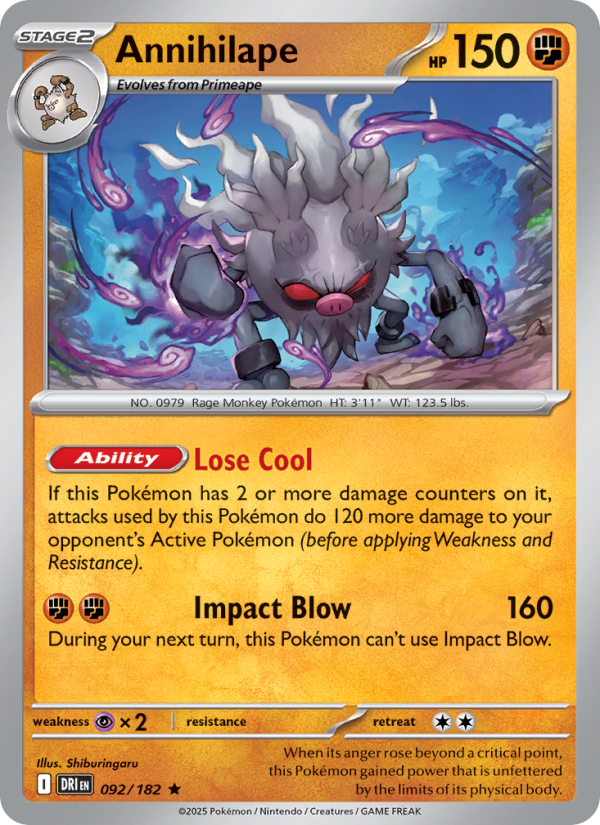
Image courtesy of TCGdex.net
Analyzing Annihilape's Meta Footprint in the Pokémon TCG
In the evolving landscape of the Pokémon Trading Card Game, certain cards become yardsticks for what “big-game” pressure looks like in practice. Annihilape, a rare fighter from the Destined Rivals set (sv10), is one of those cards that fans and competitors watch when it surfaces in a decklist. With 150 HP, a dynamic two-part toolkit, and a storyline-laden evolution from Primeape, this Stage 2 behemoth has the potential to swing games—if you navigate its risks with precision. ⚡🔥
Snapshot: the card at a glance
- Name: Annihilape
- Set: Destined Rivals (sv10)
- Rarity: Rare
- Stage: Stage 2 (evolves from Primeape)
- HP: 150
- Type: Fighting
- Ability: Lose Cool — If this Pokémon has 2 or more damage counters on it, attacks used by this Pokémon do 120 more damage to your opponent's Active Pokémon (before applying Weakness and Resistance).
- Attack: Impact Blow — 160 damage costing Fighting, Fighting; During your next turn, this Pokémon can't use Impact Blow.
- Retreat: 2
- Regulation: Standard and Expanded legal
“Lose Cool” changes the math: once Annihilape carries two or more damage counters, every hit from this fighter is a 120-damage amplifier on the way to KOing the opponent’s Active Pokémon—before weakness and resistance apply. In other words, your single big hit can become a late-game knockout factory if you survive to the right moment.
In practice, Annihilape’s big draw is how its ability incentivizes a deliberate mid-to-late-game setup. The base Attack, Impact Blow, already clocks in at 160 damage for two Fighting energy—a respectable number that puts pressure on the opponent's actively defended Pokémon. But the moment Annihilape is battered enough to sit with two counters, its burden becomes twofold: you’re rewarded for stalling and trading until you can unleash an amplified offense, while also accepting a one-turn delay after Impact Blow due to the attack-imposed cooldown. The tension between offense and sustainability defines Annihilape’s win-rate swings in most decks using it. 🎴🎨
How the math breaks in your favor (and how it can bite back)
Let’s walk through a representative scenario to illustrate the strategic torque behind the card. Suppose Annihilape has two damage counters placed on it across a couple of exchanges. From there, its Attacks start adding 120 extra damage to every strike against the opponent’s Active Pokémon. That means:
- Impact Blow’s base 160 becomes 280 total damage (before any weaknesses or resistances are applied).
- Other attacks, if you have them in your move-set or if you couple Annihilape with supportive partner Pokémon, also gain a +120 modifier, creating the potential for multiple KO turns if the opponent’s Active is already damaged or weak.
- However, you must endure a cooldown: after you use Impact Blow, you can’t use it again on the very next turn. This forces a careful timing dance—you leverage the burst when the cost is highest, then reconstitute momentum with supportive plays (like retreating to a fresh attacker or stacking damage counters elsewhere) so you’re not stranded.
From a matchmaking perspective, Annihilape tends toward midrange to aggressive lines. Its 150 HP is sturdy enough to weather several early trades in the average metagame, yet it’s not invulnerable to quick two-hit knockouts from other big threats, especially in formats where two-energy attackers are common. As a Stage 2 with a defined evolution path, it also invites a lane-filling build: a Primeape-centered line that accelerates your setup while maintaining pressure on the bench’s positioning. The key question in any meta is whether an opponent can impose enough early damage to threaten a two-counter threshold before you reach the “cooling period” window for your big hit. ⚡🔥
Deck-building angles: maximizing reliability while managing risk
Any Annihilape deck needs a plan to deliver two counters and preserve snowball momentum. Here are practical considerations for builders aiming to maximize win-rate potential:
- : Look for ways to place counters on Annihilape without exposing it to instant KO threats. This might involve strategic bench pressure or other Pokémon that can chip away at the opponent’s board while you build toward the counter threshold.
- : Because Impact Blow locks you out for a turn, you’ll often want a supplementary attacker or a retreat plan to keep applying pressure during that downtime. Consider partners that maintain board presence without requiring the same energy investment.
- : The two Fighting-energy cost for Impact Blow means you’ll typically want strong energy acceleration and resource pacing. A slower opening can still pay off once Lose Cool activates, but you’ll want to avoid stalling too long in the early game.
- : In matchups where your opponent can punish your setup with heavy disruption, you may need to pivot—preserving Annihilape for a late-game finish while your bench remains healthy and ready to strike.
Collectors will notice the Destined Rivals holo variant of Annihilape, along with its reverse foil, as a reminder of the set’s thematic arc and the competitive narrative it fed into for that era. While the card’s price on non-holo prints is currently accessible—often measured in fractions of a euro—the holo version tends to carry a… sparkle premium, reflecting both rarity and collector demand. The real value here isn’t just monetary; it’s a moment in a tournament where two counters on Annihilape unlocks dramatic damage, turning a tense board state into a dramatic finish. 💎🎴
Market pulse and collector value
Current pricing data shows Annihilape’s non-holo print averaging around a few euro-cents, with holo variants climbing higher due to rarity and aesthetic appeal. This balance makes Annihilape an attractive pick for budget-friendly competitive lists and for collectors seeking a glossy, high-visibility card from a notable storyline. Regulation-wise, the card remains legal in Standard and Expanded formats (Regulation Mark I), ensuring it can appear in a broad array of tournament-poised decks. This flexibility often translates to steady demand across both casual players and serious contenders. 📈
The art, lore, and the player experience
Destined Rivals frames a clash of rival legacies, and Annihilape sits at the heart of that tension. As the evolution from Primeape, this Pokémon embodies a blend of ferocity and resilience—a mirror to how many players approach the game: you’ll get tested, you’ll adapt, and you’ll push through to a hard-hitting payoff. In casual play, the card’s dramatic burst on the right turn provides memorable moments that keep the table buzzing long after the match ends. The holo treatment amplifies that moment, giving fans something tangible to admire at the table while you strategize your next move. 🎨🎮
Non-Slip Gaming Mouse Pad - Neon Vibrant Polyester SurfaceMore from our network
- https://crypto-acolytes.xyz/blog/post/nft-stats-tardio-957-from-tardio-collection/
- https://blog.crypto-articles.xyz/blog/post/nft-data-391-from-katyo-collection-on-magiceden/
- https://crypto-acolytes.xyz/blog/post/bmb-community-season-2-5042-bmb-community-airdrop-season-2-nft-stats/
- https://articles.zero-static.xyz/blog/post/unlock-card-draw-engines-with-serras-liturgy/
- https://blog.crypto-articles.xyz/blog/post/nft-data-lighthouse-477-from-lighthouses-collection-on-magiceden/
Annihilape
Set: Destined Rivals | Card ID: sv10-092
Card Overview
- Category: Pokemon
- HP: 150
- Type: Fighting
- Stage: Stage2
- Evolves From: Primeape
- Dex ID: 979
- Rarity: Rare
- Regulation Mark: I
- Retreat Cost: 2
- Legal (Standard): Yes
- Legal (Expanded): Yes
Description
Abilities
-
Lose Cool — Ability
If this Pokémon has 2 or more damage counters on it, attacks used by this Pokémon do 120 more damage to your opponent's Active Pokémon (before applying Weakness and Resistance).
Attacks
| Name | Cost | Damage |
|---|---|---|
| Impact Blow | Fighting, Fighting | 160 |
Pricing (Cardmarket)
- Average: €0.06
- Low: €0.02
- Trend: €0.04
- 7-Day Avg: €0.05
- 30-Day Avg: €0.06
Support Our Decentralized Network
Donate 💠More from our network
- https://crypto-acolytes.xyz/blog/post/nft-stats-tardio-957-from-tardio-collection/
- https://blog.crypto-articles.xyz/blog/post/nft-data-391-from-katyo-collection-on-magiceden/
- https://crypto-acolytes.xyz/blog/post/bmb-community-season-2-5042-bmb-community-airdrop-season-2-nft-stats/
- https://articles.zero-static.xyz/blog/post/unlock-card-draw-engines-with-serras-liturgy/
- https://blog.crypto-articles.xyz/blog/post/nft-data-lighthouse-477-from-lighthouses-collection-on-magiceden/