

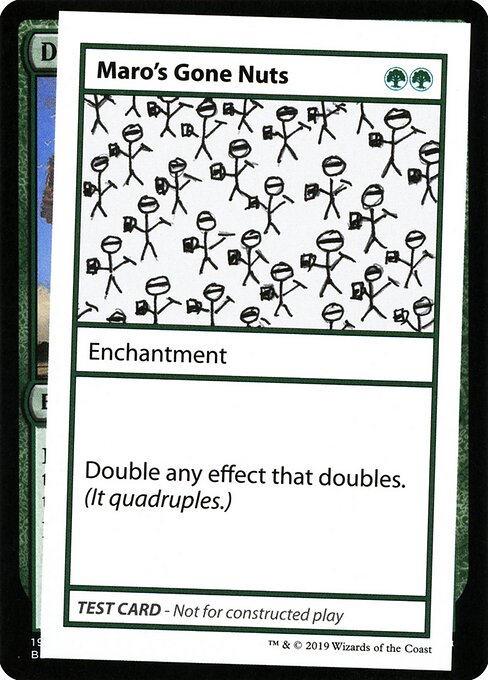
Image courtesy of Scryfall.com
Analyzing Player Engagement Across MTG Archetypes with Maro's Gone Nuts
Magic: The Gathering isn’t merely a game of who draws the best lands or lands the biggest haymaker—it’s a long-running experiment in player engagement. Different archetypes evoke different kinds of thrill: the tempo snap of an aggressive rush, the slow-burning satisfaction of a value engine, the cinematic crescendo of a combo finish, and the ritual of a well-timed wipe of the board. When you drop a card like Maro’s Gone Nuts into the conversation, you get a lens into how players across archetypes react to multiplier-rich effects 🧙♂️🔥. This offbeat enchantment costs {G}{G} and reads, quite simply, “Double any effect that doubles. (It quadruples.)” It’s a rare playtest oddity from the Mystery Booster era, a wink to the designer Mark Rosewater, and a reminder that sometimes the most engaging moments come from the playful edge of design 💎⚔️.
The card sits in a curiosities corner: green, poly-mythic in flavor, and not a standard-legal mainstay. It’s part of Mystery Booster Playtest Cards 2021 (cmb2), stamped as a rare with the artful signature of Mark Rosewater, and it teases players with the meta-idea of multiplying multipliers—an idea that invites us to imagine how an entire deck could pivot when every doubling effect compounds. In practical terms, Maro’s Gone Nuts isn’t about raw power in a vacuum; it’s about the narrative and engagement curve you get when your board state can swing wildly with the right setup 🧙♂️🎨. The line between “fun” and “frustrating” narrows here, and that makes for memorable games at the kitchen table or in casual circles.
The mechanic as a mirror: how archetypes respond
What makes this card a joy for some and a curious challenge for others is the way it amplifies existing archetype tendencies. Consider a few archetypal responses, taken as thought experiments for engagement rather than a deck-building guide to victory:
- Aggro and tempo: In fast-paced strategies that rely on efficient combat and explosive turns, doubling an already potent pump or combat trick can compress clock speed in delightful fashion. A single spell or pump effect could cascade into two or four more threats, reshaping how quickly an opponent must pivot to answer threats ⚔️.
- Ramp and big-mana engines: Green’s natural affinity for acceleration meets Maro’s Gone Nuts with a theoretical appetite for bigger, louder turns. If you have ways to double mana or accelerate draw, the multiplier effect could push you into an overwhelming late-game showpiece—think colossal krakens or stomping giants bursting into the scene with renewed vigor 💥💎.
- Value engines and card advantage: Midrange and control players value incremental gains, but a quadrupled doubling mechanic can bend the curve toward a dramatic crescendo—draws becoming even more flavorful, mana rocks producing extra value, and answers multiplying in lockstep with threats 🧩.
- Combo and copy/synergy decks (casual by design): The real “wow” is here. Decks built around copying spells, copying permanents, or engineering intricate loops can feel like watching a stage magician’s finale—the multiplier on a multiplier can yield fireworks that are equal parts comedy and awe 🧙♂️🎭.
In practice, this thought experiment also reveals an important truth about player engagement: anticipation matters. The moment a player recognizes that everything that doubles might now be doubled again, their decisions carry more weight. The table leans into timing, plays around potential stacks, and the social dynamic—who hits the big turn first, who sets up the next chain, who holds back—is where the magic happens 🧙♂️🔥.
Practical takeaways for deck builders and playgrounds
Even when a card exists primarily as a playful nod to design, it teaches a set of useful ideas for understanding engagement density across archetypes. Here are a few lessons that feel especially relevant to the MTG community’s culture of experimentation:
- Balance multiplier potential with tempo: If every doubling effect becomes a vehicle for domination, you risk the table’s energy leveling into fatigue. Healthy engagement thrives when there’s room for dramatic turns but also space for polite tempo losses and creative answers 🧠.
- Cultivate thematic targets: Tokens, +1/+1 counters, and card draw can be fertile ground for multiplier interactions. A deck that leans into those lanes will feel the most alive when played with a card that magnifies their impact 🔁.
- Celebrate the narrative: The joy of MTG often comes from storytelling around a match. A multiplier on a multiplier invites players to craft a micro-story of escalation—an “epic comeback” arc that fuels laughter and shared memory 🎲.
“A multiplier on a multiplier is a rollercoaster built by design and chance—perfect for a table that loves long games and loud laughter.”
For collectors and casual players alike, Maro’s Gone Nuts is also a reminder of the quirky corners of Magic’s history. While its market footprint is modest—about 0.23 USD in the USD catalog and a similar euro footprint—the card’s charm lies in its playful provenance and the conversations it sparks at the table. It’s the sort of piece that belongs on a shelf next to other designer gems, a conversation starter about what magic could be when a designer’s sense of humor takes the wheel 🧪💎.
Non-Slip Gaming Mouse Pad 9.5x8in Anti-Fray Rubber BaseMore from our network
- https://articles.zero-static.xyz/blog/post/pokemon-go-most-satisfying-achievements-and-how-to-earn/
- https://articles.zero-static.xyz/blog/post/minecraft-community-creations-spotlight-epic-builds-revealed/
- https://blog.crypto-articles.xyz/blog/post/nft-data-cnp-red-kakera-05407-from-cnp-red-kakera-collection-on-magiceden/
- https://wiki.digital-vault.xyz/wiki/post/pokemon-tcg-stats-feraligatr-card-id-xy4-17/
- https://wiki.digital-vault.xyz/wiki/post/pokemon-tcg-stats-yamask-card-id-sv07-062/
Maro's Gone Nuts
Double any effect that doubles. (It quadruples.)
ID: 4762ac9c-665a-4a22-8702-e883b97f1d5f
Oracle ID: 8b72aca0-69b6-4829-b3cd-0f8713b7303f
TCGPlayer ID: 247008
Cardmarket ID: 415064
Colors: G
Color Identity: G
Keywords:
Rarity: Rare
Released: 2021-08-20
Artist: Mark Rosewater
Frame: 2015
Border: black
Set: Mystery Booster Playtest Cards 2021 (cmb2)
Collector #: 81
Legalities
- Standard — not_legal
- Future — not_legal
- Historic — not_legal
- Timeless — not_legal
- Gladiator — not_legal
- Pioneer — not_legal
- Modern — not_legal
- Legacy — not_legal
- Pauper — not_legal
- Vintage — not_legal
- Penny — not_legal
- Commander — not_legal
- Oathbreaker — not_legal
- Standardbrawl — not_legal
- Brawl — not_legal
- Alchemy — not_legal
- Paupercommander — not_legal
- Duel — not_legal
- Oldschool — not_legal
- Premodern — not_legal
- Predh — not_legal
Prices
- USD: 0.23
- EUR: 0.77
More from our network
- https://crypto-acolytes.xyz/blog/post/nft-stats-dapper-doggos-28-from-dapper-doggos-collection/
- https://blog.crypto-articles.xyz/blog/post/nft-data-bbc-1905-from-battle-bros-club-collection-on-magiceden/
- https://articles.zero-static.xyz/blog/post/cuphead-best-weapons-and-upgrades-guide-for-boss-fights/
- https://wiki.digital-vault.xyz/wiki/post/pokemon-tcg-stats-gogoat-card-id-sm8-36/
- https://crypto-acolytes.xyz/blog/post/nft-stats-non-fungible-token-8-from-non-fungible-tokens-collection/