

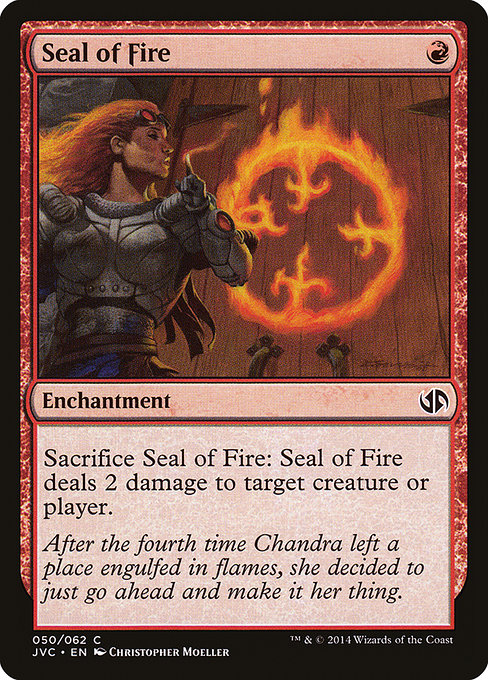
Image courtesy of Scryfall.com
Engagement in Red: Reading Archetypes Through Seal of Fire
Magic: The Gathering thrives on the dance between archetypes: aggressive starts, patient control, or cunning combo endings all vying for a moment of dominance. When we zoom in on red's playbook, a tiny, red-hot instrument often reveals how players stay engaged across different styles. Enter Seal of Fire, a one-mana enchantment from the Duel Decks Anthology set that rewards quick decisions with direct pressure. Its ability—sacrifice this enchantment to deal 2 damage to any target—feels almost blunt, but the implications for player engagement run surprisingly deep 🧙♂️🔥. It becomes a lens for how players pace themselves, pivot on a threat, and choose when to commit resources to the exact spark that ends a game.
Seal of Fire is a simple card on the surface: mana cost {R}, color identity red, enchantment. But its true power lies in the timing and the context you bring to the board. For an aggressive red archetype, the card can act as a finishing touch or as a way to push damage through a stalemate. In a burn-focused strategy, sacrificing the enchantment to ping a stubborn blocker or a planeswalker can be the final nudge that converts a narrow victory into a decisive finish. For tempo or midrange red builds, it’s a flexible tool—trade value with a creature now, then cash in the enchantment later to hit harder where it counts. The choice to sac is a microcosm of how players stay engaged: you’re constantly weighing board presence, resource density, and the fragile math of “can I win next turn?” ⚔️💥
“After the fourth time Chandra left a place engulfed in flames, she decided to just go ahead and make it her thing.”
The flavor text gives Seal of Fire a personality: red’s signature aura of impulsive power, tempered by a strategic mind that knows when to ignite and when to economize. The art by Christopher Moeller captures that moment of decision—the spark before the spark. In practice, Seal of Fire’s common rarity and 1-mana cost make it accessible enough to slot into budget red shells, while its reprint history from a notable dual deck keeps it relevant for players building casual or Commander-style experiences. As a nonfoil card in print, it’s a familiar sight at game nights, inviting both nostalgia and modern curiosity 💎🎨.
From a collection perspective, Seal of Fire sits in a sweet spot for enthusiasts who want a piece of red’s history without breaking the bank. The card’s price sits modestly in the dollar range, reflecting its common rarity and broad availability. Yet that accessibility doesn’t diminish its strategic utility; in the right deck, it can turn a single decision into a game-changing moment. It’s the kind of card that invites analysis: when to sac, what to target, and how to leverage the damage into a broader plan. That dynamic—the push-pull between sacrifice and payoff—keeps engagement high across playgroups that favor different archetypes 🔥🎲.
How to read engagement across archetypes with Seal of Fire
- Aggro and Burn: Use Seal of Fire to maintain pressure when tempo is slipping. Sacrifice it to remove a blocker or to finish off a wounded opponent—every choice compounds into tempo swings that players remember and discuss later.
- Control and Midrange: In slower shells, the enchantment serves as a proactive reach option. It’s a deliberate decision to spend a mana on threat denial and direct damage, which can bait opponents into misreading your late-game burn plan.
- Commander and Casual: In singleton formats, the card scales with the table’s pace. Sacrificing the enchantment can deny an opposing synergy piece or punish a fragile board state, creating memorable moments that fuel talk and theorycrafting online and at the local store.
- Sacrifice-Outlets and Synergy: The real thrill comes from playing with a sacrifice outlet—the card rewards you for finding the right moment to cash in. It’s a crisp, satisfying loop that rewards players who track life totals and available targets with the precision of a meta call 🧙♂️.
- Value vs. Risk: The engagement curve hinges on risk assessment. You trade a stable enchantment for two damage; if the board stays tight, that distinction matters. If it doesn’t, you still have a tool that can shift a game’s momentum in a heartbeat.
Design-wise, Seal of Fire offers a clean, deliberate mechanic that resonates with red’s ethos: short-term commitment, explosive payoff, and a dash of risk. It’s a micro-lesson in how a single card can influence decision-making at every stage of the game, from opening turns to adrenaline-fueled finishes 🧭⚔️.
For players who love digging into data, this enchantment is a gentle reminder that engagement isn’t just about big spells or flashy finishes. It’s about the cadence of play: the choice to sac, the timing of the ping, and the way those moments accumulate into a thousands-of-turns-long conversation about what red can do when the table keeps its eyes on the prize. That’s where the magic happens—where strategy meets storytelling and players find reasons to come back to the table again and again 🔥💎.
Practical takeaways for builders
- Reserve Seal of Fire for moments where it can threaten lethal damage or remove a troublesome blocker—don’t waste the sac on low-value targets.
- Pair with cheap removal or reach spells to maximize the burn payoff without overcommitting your board.
- Consider its inclusion in budget-friendly red shells or Commander decks that prize speed and precision over sheer volume of spells.
- Keep an eye on the meta: in environments where aggro is dominant, the card shines as a reliable add-on; in slower metas, it’s the surprise finisher that catches opponents off guard.
As a touchstone of red’s engagement style, Seal of Fire reminds us that every card choice—no matter how small—can shape how players experience the game. Its crisp, high-tempo personality invites ongoing play, discussion, and, yes, the occasional reckless bluff that makes MTG nights worth staying up for 🧙♂️🎨.
Neoprene Mouse Pad - Round/Rectangular Non-SlipMore from our network
- https://articles.zero-static.xyz/blog/post/henge-guardian-unraveling-stone-circles-in-mtg-lore/
- https://transparent-paper.shop/blog/post/reconstructing-stellar-motion-with-pmra-and-pmdec-in-scorpius-blue-white-giant/
- https://blog.crypto-articles.xyz/blog/post/nft-data-mafiabits-1406-from-mafiabits-collection-on-magiceden/
- https://wiki.digital-vault.xyz/wiki/post/pokemon-tcg-stats-lycanroc-ex-card-id-b1-323/
- https://wiki.digital-vault.xyz/wiki/post/pokemon-tcg-stats-entei-card-id-ecard2-10/
Seal of Fire
Sacrifice this enchantment: It deals 2 damage to any target.
ID: 210f4f5a-4a36-4f2f-8821-d04f3f52c8db
Oracle ID: 348a345e-4639-41ca-b015-a5d43459eb64
Multiverse IDs: 393869
TCGPlayer ID: 93811
Cardmarket ID: 270091
Colors: R
Color Identity: R
Keywords:
Rarity: Common
Released: 2014-12-05
Artist: Christopher Moeller
Frame: 2015
Border: black
EDHRec Rank: 16810
Penny Rank: 1478
Set: Duel Decks Anthology: Jace vs. Chandra (jvc)
Collector #: 50
Legalities
- Standard — not_legal
- Future — not_legal
- Historic — not_legal
- Timeless — not_legal
- Gladiator — not_legal
- Pioneer — not_legal
- Modern — legal
- Legacy — legal
- Pauper — legal
- Vintage — legal
- Penny — not_legal
- Commander — legal
- Oathbreaker — legal
- Standardbrawl — not_legal
- Brawl — not_legal
- Alchemy — not_legal
- Paupercommander — legal
- Duel — legal
- Oldschool — not_legal
- Premodern — legal
- Predh — legal
Prices
- USD: 0.90
- EUR: 0.99
More from our network
- https://blog.crypto-articles.xyz/blog/post/nft-data-479-from-light-seekers-collection-on-magiceden/
- https://articles.zero-static.xyz/blog/post/how-pillars-of-eternity-ii-patches-could-transform-deadfire/
- https://blog.digital-vault.xyz/blog/post/blue-white-giant-illuminates-masstemperature-connection/
- https://articles.zero-static.xyz/blog/post/peach-garden-oath-prices-regional-gaps-and-collector-behavior/
- https://crypto-acolytes.xyz/blog/post/nft-stats-pullo-913-from-pullo-collection/