

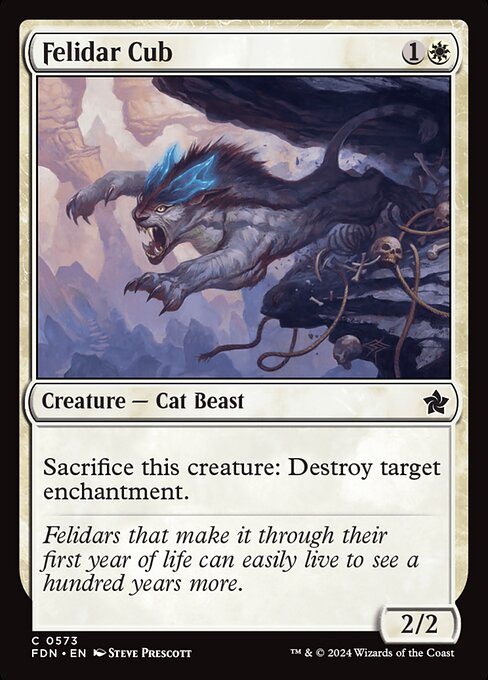
Image courtesy of Scryfall.com
The Allure of Collectible Rarity in MTG: Felidar Cub as a Case Study
Rarity isn’t just a label on a card; it’s a carefully engineered psychological trigger 🧠✨. In the vast multiverse of Magic: The Gathering, rarity shapes how we perceive a card’s value, how we collect, and how we build our decks. Felidar Cub, a modest white creature from Foundations’ Foundations set, is a prime example of how a seemingly simple card can illuminate the intricate dance between power, scarcity, and narrative allure. This little 2/2 Cat Beast with a practical but unflashy ability—sacrifice it to destroy target enchantment—goes beyond raw stats to tap into a deeper human instinct: the thrill of pursuit and the satisfaction of seeing a plan come together 🔥💎.
First, there’s price psychology. Felidar Cub is a common rarity in a core set print that dates back to older printing cycles, now re-released in Foundations. Its market price — roughly a few tenths of a dollar in USD terms — sits at a paradoxical crossroads: low enough to be approachable for new players, but not so cheap that it’s instantly disposable from a collector’s mindset. This imbalance is precisely where rarity psychology thrives. When you see a card labeled common, you might dismiss it at a glance. Yet the same card can become a focal point for a player chasing “complete sets,” or for those who prize evergreen designs that show up in multiple formats. The subtle thrill is knowing you can actually pull a solid contributor without emptying your wallet 🧙♂️🎲.
Felidar Cub also embodies the narrative of white mana’s practical, protection-oriented identity. For a color that prizes answering threats and stabilizing the board, a small creature with a targeted disenchantment-destroying effect touches the heart of what many players crave: a clean, reliable answer that doesn’t demand a lot of mana or a high-risk combo. The card’s mana cost of {1}{W} keeps it accessible in early-game turns, and its 2/2 body provides solid creature presence without demanding heroic tempo to justify its inclusion. The rarity tag—common—doesn’t promise legendary status; rather, it promises ubiquity, which paradoxically can increase your attachment. The more you see a card in your drafts, the more it becomes a familiar companion on your journey through a set or across formats.
“Sometimes the most satisfying win is the one that quietly hums along—consistently, predictably, and with a touch of clever utility.” 🧙♂️
Another facet of rarity psychology is the sense of discovery and the power of storytelling in design. Felidar Cub’s flavor text—“Felidars that make it through their first year of life can easily live to see a hundred years more”—adds a gentle, enduring mythos about resilience and community. It’s a reminder that these creatures aren’t just stats on a sheet; they’re part of a living world with culture, history, and legends. The card’s lore, coupled with Steve Prescott’s art, creates a vivid image that fans want to collect, frame, and discuss, even if the card remains a common pick in most decks. That blend of art, flavor, and function is a cornerstone of rarity’s allure 🖼️🎨.
From a game design perspective, Felidar Cub demonstrates how a card can be both functional and thematically resonant without tipping into “overpowered.” Its sacrifice-to-destroy-enchantment ability offers a reliable answer to a broad category of threats—enchantments—without creating a broken engine. In Limited formats, this is especially valuable: you’re not chasing a once-per-game tutor; you’re maintaining parity, keeping games honest, and rewarding players who plan ahead. The balancing act between power and rarity is precisely what fuels the long-term fascination with MTG’s rarity system. When a common card feels “worth keeping” because of timing and synergy, players experience a spark that rare cards sometimes fail to ignite—consistency can be its own form of scarcity, especially in chaotic board states ⚔️🔥.
Felidar Cub also offers a mini-case study in market dynamics. Reprints, set type, and foil availability shape how collectors perceive a card’s value. This particular listing shows nonfoil versions priced in the low coins range, while foil variants (where they exist) often command a premium in the hands of glossy aesthetic enthusiasts. The dynamic between mass production and the dream of rarity keeps the conversation lively in online communities, shop shelves, and draft tables. When a card sits at the intersection of a solid in-game role and a modest price, it becomes a gateway drug for casual collectors who want a tangible piece of the MTG ecosystem without over-committing to a single archetype 🎲💎.
Rarity in Practice: Building with Commons
For players who love to tinker, the foundations of a strong deck often rest on a sprinkling of dependable commons. Felidar Cub isn’t flashy, but its ability continues to invite creative line-ups—think of it as a miniature utility piece that interacts with enchantments in ways that can swing a midrange game. In the broader tapestry of MTG, you’ll see players mixing commons like Felidar Cub with unassuming removal, light strategies, and clever sacrifice synergies to create resilient boards that outlast bigger, flashier threats. That philosophy—maximizing value from staple, widely available cards—helps explain why many players adore the “common” tier: it’s the sandbox where experimentation thrives, and the thrill of discovery becomes a repeatable ritual 🧙♂️🎲.
And yes, the art and flavor contribute to the compound interest of collecting. The Foundations set’s classic, no-frills aesthetic—paired with a modern illustration that captures a feline grace—helps keep Felidar Cub memorable long after it leaves the battlefield. The emotional resonance of a well-drawn creature and a thoughtful flavor text will often outlast any price tag, making this little cub a cherished memory for fans who like to build personal narratives around their card collections 💎🎨.
If you’re a reader who loves the intersection of psychology, design, and gameplay, Felidar Cub is a neat microcosm of MTG’s enduring appeal. It’s a reminder that rarity isn’t just about scarcity or price; it’s about the stories we tell, the strategies we test, and the little moments when a card quietly proves its worth over a long arc of play and collection 🧙♂️🔥.
Neon Gaming Mouse Pad 9x7 Custom Neoprene Stitched EdgesMore from our network
- https://blog.crypto-articles.xyz/blog/post/nft-data-geek-3194-from-geeks-collection-on-magiceden/
- https://transparent-paper.shop/blog/post/lean-digital-business-plan-a-practical-startup-blueprint/
- https://wiki.digital-vault.xyz/wiki/post/pokemon-tcg-stats-poke-maniac-card-id-sm11-204/
- https://blog.rusty-articles.xyz/blog/post/explores-escavalier-promo-vs-pack-versions-in-pokemon-tcg/
- https://blog.zero-static.xyz/blog/post/how-buyouts-impact-small-set-mtg-creature-cards-in-early-winter/
Felidar Cub
Sacrifice this creature: Destroy target enchantment.
ID: 0d61d50b-7ab6-45a9-b207-31d87aa2e555
Oracle ID: cae60cf8-cd64-4595-a4dd-946694cf2bb1
Multiverse IDs: 680712
TCGPlayer ID: 590973
Cardmarket ID: 795771
Colors: W
Color Identity: W
Keywords:
Rarity: Common
Released: 2024-11-15
Artist: Steve Prescott
Frame: 2015
Border: black
EDHRec Rank: 9327
Penny Rank: 7063
Set: Foundations (fdn)
Collector #: 573
Legalities
- Standard — legal
- Future — legal
- Historic — legal
- Timeless — legal
- Gladiator — legal
- Pioneer — legal
- Modern — legal
- Legacy — legal
- Pauper — legal
- Vintage — legal
- Penny — not_legal
- Commander — legal
- Oathbreaker — legal
- Standardbrawl — legal
- Brawl — legal
- Alchemy — legal
- Paupercommander — legal
- Duel — legal
- Oldschool — not_legal
- Premodern — not_legal
- Predh — not_legal
Prices
- USD: 0.13
- EUR: 0.19
- TIX: 0.03
More from our network
- https://articles.digital-vault.xyz/blog/post/top-fallout-4-community-memes-that-define-the-wasteland/
- https://blog.rusty-articles.xyz/blog/post/kindlespark-duo-in-commander-a-top-deck-frequency-analysis/
- https://blog.zero-static.xyz/blog/post/how-mimikyu-v-art-communicates-power-in-pokemon-tcg/
- https://wiki.digital-vault.xyz/wiki/post/pokemon-tcg-stats-charizard-ex-card-id-g1-11/
- https://wiki.digital-vault.xyz/wiki/post/pokemon-tcg-stats-porygon-card-id-swsh11-140/