

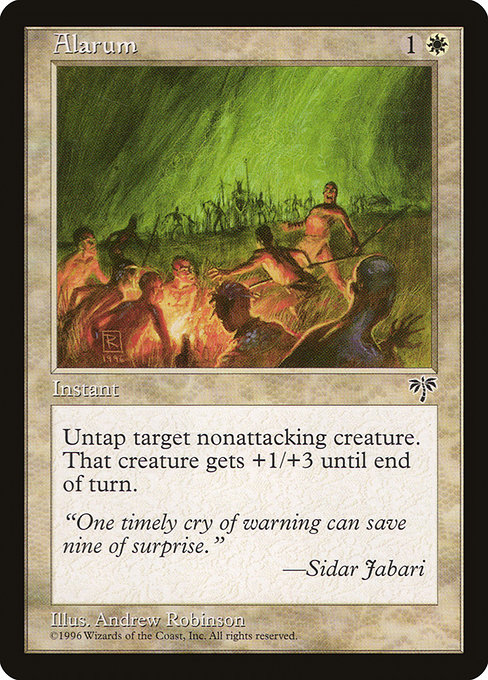
Image courtesy of Scryfall.com
Signed Alarum: Mirage Auction Landscape
In the wild world of MTG collecting, signed copies can turn humble cards into coveted artifacts 🧙♂️🔥. Alarum, a white instant from the Mirage era released on 1996-10-08, is a perfect case study. With a modest mana cost of {1}{W}, it untaps a target nonattacking creature and grants it +1/+3 until end of turn. It’s not flashy by modern standards, but that simple, well-timed effect embodies the elegance of white tempo in a pre-2000s toolkit. When a creator’s signature finds its way onto a Mirage common, the conversation shifts from strictly playable value to collectible provenance—and that shift can drive some surprising auction heat 🧭💎.
“One timely cry of warning can save nine of surprise.” — Sidar Jabari
For collectors, signed copies are less about raw power and more about narrative. A signed Alarum carries a whisper of the Mirage print run, the artist’s engraving on a card that once rode booster packs and shop shelves across the globe. It’s a tactile link to a time when flexible, clever spells shaped games the way a good card sleeve shapes a deck: with character, not just numbers. The result at auction is often a blend of nostalgia, authenticity, and the overall condition of the card—all factors that can push a common from “worth a few cents” to “worth a small but meaningful premium.” 🪙🎨
Gameplay snapshot: why Alarum keeps a special place in tempo-minded decks
Alarum’s cavity of utility sits in its instant-speed, noncombat nature. Untapping a nonattacking creature can open the door to a surprise block or set up a two-step aggression that catches an opponent off guard. The +1/+3 boost for that turn adds a meaningful punch for a single swing, turning even a small body into a credible threat. In Mirage-era strategies, where players built around clever combat tricks and efficient spells, Alarum fits neatly into white-based tempo or control-forward lineups. It’s not a mythic, but it’s exactly the sort of red thread that weaves nostalgia into a collector’s story—especially when a card bears an artist’s autograph and a handwritten note of provenance 🧷⚔️.
Art, lore, and the collector’s eye
The Mirage set—one of MTG’s classic expansions—presents a distinct aesthetic: bold lines, moody atmospherics, and a taste for graspable magic in black-bordered frames. Andrew Robinson’s artwork for Alarum anchors the card in a moment of quiet urgency, while the flavor text gives it a dose of storytelling charm. The rarity is listed as common, but a signed copy can depart from the crowd, especially if the signature is authenticated and tied to a known collector’s signature series. In markets where authentic autographs are verified, these copies often command premiums over their unsigned cousins, even for a card with a low base price. It’s the allure of the signed artifact meeting a card with real vintage pedigree 🧙♂️💎.
Mirage’s place in MTG history is also about accessibility—the nonfoil print exists in abundance relative to modern foils, yet a signed piece remains scarce. For auctioneers and buyers, this dynamic creates a bid landscape that rewards patience, authentication, and careful grading. A near-mint signed Alarum can become a talking point in a display case, a reminder of the era when simple spells could turn the tide of a match with precision and timing ⚔️🎲.
Auction dynamics for signed copies: what to watch out for
- Signature authenticity: Look for clear provenance, a certificate of authenticity, or a reputable signatory source. A loose signature on a card market from the 1990s may require extra vetting.
- Condition matters: For signed copies, the balance of autograph condition and card condition is key. A pristine signature on a slightly worn card is often preferable to a flawless card with a smudged autograph.
- Signature location: Signatures placed on the card edge or margins can affect readability and display value; some collectors prefer signatures in specific spots where grading and displays stay clean.
- Framing and display: Proper framing that protects the autograph without obscuring the card’s art helps maintain long-term value.
- Market context: The overall interest in Mirage-era signed cards, plus the presence of a sought-after signature, can push Alarum’s value beyond its base price, which sits modestly around typical Mirage commons. Expect variability depending on the signing artist and the auction house’s audience 🧭🎨.
For those curious about current baseline values, Scryfall lists Alarum’s nonfoil print within Mirage with a baseline price in the teens of cents to dollars, depending on market fluctuations. Signed copies, though, live in a different tier—often driven by authentication and collector demand. The story here mirrors the broader trend: as digital markets surge and collectors hunt for tangible connections to the past, signed physical cards find audience at auction houses and online marketplaces, bridging nostalgia with real-world value 🧙♂️💎.
Tips for new collectors chasing signed Mirage commons
- Seek authenticated signatures from recognized artists or signatories associated with the card’s era.
- Confirm card grade and autograph condition before bidding; grading can materially affect value.
- Compare multiple listings to gauge whether an autograph is being offered with a premium or if the price reflects genuine scarcity.
- Pair a signed Alarum with a display frame that protects both card and signature for long-term enjoyment.
- Keep an eye on cross-market chatter—sometimes a cross-pollination with digital NFT-like collecting trends can buoy interest in vintage autographs, even for common cards 🧲🎲.
As you explore auction catalogs and shop listings, Alarum stands as a reminder that even modest spells from Mirage carry stories worth retelling. The card’s clean white mana identity, its crisp instant-speed effect, and the human touch of a signature all combine to offer a compelling glimpse into MTG’s evolving collector culture. It’s a small piece of magic that travels across time—a testament to how a single, well-timed cry can echo through decades of gameplay and collecting 🧙♂️🔥.
Phone Case with Card Holder Slim Impact ResistantMore from our network
Alarum
Untap target nonattacking creature. It gets +1/+3 until end of turn.
ID: 155f2aa6-6c47-4a06-b0ef-2d9205cd133e
Oracle ID: 18e96674-6fd8-4046-a3fe-7ba80138d85d
Multiverse IDs: 3477
TCGPlayer ID: 4963
Cardmarket ID: 8257
Colors: W
Color Identity: W
Keywords:
Rarity: Common
Released: 1996-10-08
Artist: Andrew Robinson
Frame: 1997
Border: black
EDHRec Rank: 24644
Set: Mirage (mir)
Collector #: 2
Legalities
- Standard — not_legal
- Future — not_legal
- Historic — not_legal
- Timeless — not_legal
- Gladiator — not_legal
- Pioneer — not_legal
- Modern — not_legal
- Legacy — legal
- Pauper — legal
- Vintage — legal
- Penny — not_legal
- Commander — legal
- Oathbreaker — legal
- Standardbrawl — not_legal
- Brawl — not_legal
- Alchemy — not_legal
- Paupercommander — legal
- Duel — legal
- Oldschool — not_legal
- Premodern — legal
- Predh — legal
Prices
- USD: 0.11
- EUR: 0.05
- TIX: 0.09
More from our network
- https://articles.digital-vault.xyz/blog/post/how-wolfenstein-ii-the-new-colossus-defines-an-era-in-gaming/
- https://blog.crypto-articles.xyz/blog/post/rillaboom-deck-guide-crafting-a-powerful-grass-strategy/
- https://crypto-acolytes.xyz/blog/post/nft-stats-nft-419-from-deb00tyclub-ii-collection/
- https://donation.digital-vault.xyz/donation/post/support-diversity-in-open-source-technology-projects/
- https://wiki.digital-vault.xyz/wiki/post/pokemon-tcg-stats-fraxure-card-id-sv105b-146/