
Image courtesy of TCGdex.net
Alakazam: Mastering Ability Sequencing in the Pokémon TCG
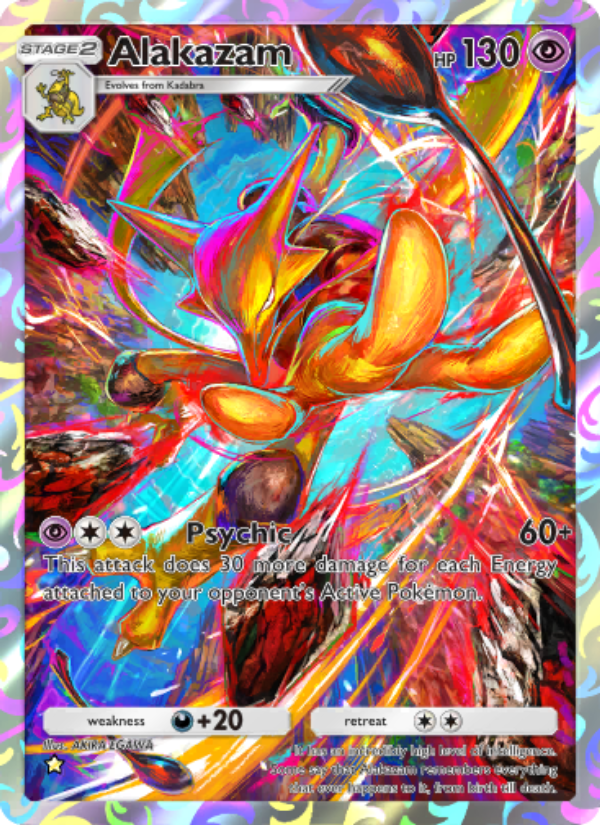
In the Genetic Apex era, Alakazam stands out as a mental marvel on the battlefield. With an impressive 130 HP and a Psychic typing, this Stage 2 powerhouse—evolving from Kadabra—invites players to choreograph a sequence of moves that feel almost like telekinesis in action. The illustration by AKIRA EGAWA captures the card’s poised focus, hinting at the precision you’ll need to wield its abilities effectively. The card’s flavor text — “It has an incredibly high level of intelligence. Some say that Alakazam remembers everything that ever happens to it, from birth till death.” — isn’t just lore; it mirrors the strategic memory you’ll apply to every decision across a match. ⚡🔥
At a glance, Alakazam’s kit is a study in tempo. It’s a Stage 2 Pokemon with a single, high-stakes attack that scales with the state of your opponent’s board. The card’s rarity is One Star, and within the Genetic Apex set (A1), you’ll find holo, reverse, and normal variants, all of which collectors chase for display cases as well as decks. How you sequence its abilities—how you time its evolution, energy attachment, and attack timing—can swing matchups from a grindy stalemate into a single, decisive moment. 💎🎴
Card snapshot
- Stage: Stage 2 (evolves from Kadabra)
- HP: 130
- Type: Psychic
- Rarity: One Star
- Set: Genetic Apex (A1)
- Illustrator: AKIRA EGAWA
- Weakness: Darkness (+20)
- Retreat: 2
- Attack: Psychic — Costs Psychic + Colorless + Colorless; 60+ base damage, plus 30 more damage for each Energy attached to your opponent’s Active Pokémon
- Evolution: Evolves from Kadabra
- Flavor: “It has an incredibly high level of intelligence... remembers everything that ever happens.”
Indeed, the key to leveraging Alakazam lies in sequencing the moves that set up its high-damage output. The attack’s base 60 damage is respectable on its own, but the real payoff comes from matching your opponent’s energy state. If their Active Pokémon has several Energy cards attached, Alakazam’s Psychic attack can explode in one shot, turning a cautious midgame into a dramatic finish. This makes planning ahead about energy placement, board state, and timing essential—so you’re ready to unleash the maximal 60+ damage when the stars align. ⚡🎮
Sequencing Alakazam’s abilities: a practical playbook
- Turn 1–2: Establish board presence — Quick early pressure usually means getting Kadabra onto the bench and setting up a draw engine. If you can, have a plan to accelerate into Alakazam by Turn 2 or 3. Use draw-supporting Trainers to refill your hand while you look for the rare Candy or an evolution item that lets you advance Kadabra to Alakazam efficiently. The goal is a smooth transition from bench to active, with Alakazam ready to unleash late-game thunder when your opponent is most vulnerable.
- Turn 2–3: Prepare the big swing — The practical bottleneck in this deck is energy. Alakazam’s attack costs 1 Psychic and 2 Colorless energies, which, under standard rules, means you’ll need to accumulate energy across turns or leverage cards that allow multiple attachments. If you’re fortunate enough to have a way to attach energy to Alakazam while it’s benched, start loading it up so that you can pivot to the attacker role when you’re ready. The moment you have the required energy on Alakazam in-hand or on the field, you can threaten the 60+ damage with a clean line of play. Remember that the Total Energy in your hands or on the field also informs your decision to retreat or switch in a follow-up attacker to maintain pressure. 🧠💥
- Turn(s) when you attack: read and exploit the field — The damage punchline is the energy on your opponent’s Active Pokémon. If their Active has two or more Energy attached, your 60+ attack can reach 120, 150, or more, depending on how many Energies you see. The sequencing trick is to time the Alakazam attack for a moment when your opponent’s board state is most vulnerable—perhaps after a forced attacker swap or just after you’ve whittled down their front line with other attackers. This is where the “memory” of the card—counting what has happened in the match—becomes critical. Plan for a big finish when you’ve locked in enough Energy on the field to maximize the 60+ calculation. 🔥🎯
- Defense-in-depth: manage threats and retreat — Alakazam’s retreat cost is 2, which means you’ll want to consider a clean pivot if a Dark-type threat targets your prized psychic. If a heavy Darkness counter-move appears, don’t be afraid to rotate into a sturdier ally or to swap Alakazam out to preserve its value for the late game. The sequencing here is about preserving tempo: keep the pressure, but don’t overextend into a dead-end exchange that leaves your prize vulnerable to a single big hit.
- Endgame and prize balance — In a matchup where you’re racing to take Prizes, Alakazam can finance a decisive swing by harnessing the right energy count and a timely retreat. When you land that big 60+ hit, you may stretch through a couple more turns by keeping Alakazam active, handling draws, and leveraging supportive tools from your deck. The endgame is often a battle of who can more cleanly execute the energy sequence and read the opponent’s board state first. 🏁
Beyond gameplay, Alakazam’s artistry and rarity also hold collector appeal. The holo variant from Genetic Apex, illustrated by AKIRA EGAWA, tends to attract attention for display and nostalgia alike. With a base HP of 130 and a compelling evolving line from Kadabra, this card reminds players that clever sequencing can be as elegant as a well-timed reveal. The card’s description about memory adds a thematic layer to the tactics: you’re not just swinging for damage, you’re orchestrating a memory-packed sequence of plays that feels almost like a mental duel. 🎨💎
This synergy of strategy and story makes Alakazam a favorite for both players building competitive lists and collectors chasing the most expressive holo prints. In sets like Genetic Apex, a One Star rarity card can be one of the more accessible ways to experience a memorable psychic threat on the tabletop while still offering meaningful strategic depth.
Neon Gaming Rectangular Mouse Pad Non-Slip 1/16 in ThickMore from our network
- https://articles.digital-vault.xyz/blog/post/what-to-expect-from-future-prey-updates-and-patches/
- https://crypto-acolytes.xyz/blog/post/pfp-670-pumpfun-pepe-nft-stats/
- https://crypto-acolytes.xyz/blog/post/nft-stats-gib-928-from-gib-collection/
- https://crypto-acolytes.xyz/blog/post/nft-stats-non-fungible-token-677-from-non-fungible-tokens-collection/
- https://wiki.digital-vault.xyz/wiki/post/pokemon-tcg-stats-toxel-card-id-swshp-swsh209/
Alakazam
Set: Genetic Apex | Card ID: A1-236
Card Overview
- Category: Pokemon
- HP: 130
- Type: Psychic
- Stage: Stage2
- Evolves From: Kadabra
- Dex ID:
- Rarity: One Star
- Regulation Mark: —
- Retreat Cost: 2
- Legal (Standard): No
- Legal (Expanded): No
Description
It has an incredibly high level of intelligence. Some say that Alakazam remembers everything that ever happens to it, from birth till death.
Attacks
| Name | Cost | Damage |
|---|---|---|
| Psychic | Psychic, Colorless, Colorless | 60+ |
Support Our Decentralized Network
Donate 💠More from our network
- https://articles.digital-vault.xyz/blog/post/what-to-expect-from-future-prey-updates-and-patches/
- https://crypto-acolytes.xyz/blog/post/pfp-670-pumpfun-pepe-nft-stats/
- https://crypto-acolytes.xyz/blog/post/nft-stats-gib-928-from-gib-collection/
- https://crypto-acolytes.xyz/blog/post/nft-stats-non-fungible-token-677-from-non-fungible-tokens-collection/
- https://wiki.digital-vault.xyz/wiki/post/pokemon-tcg-stats-toxel-card-id-swshp-swsh209/