

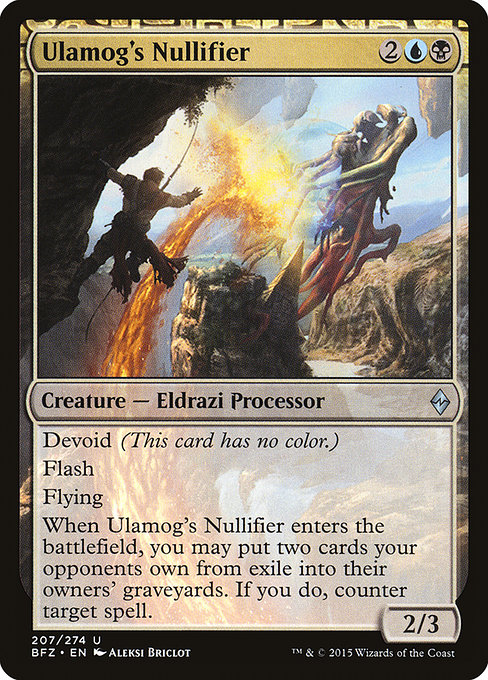
Image courtesy of Scryfall.com
AI-Driven Ulamog's Nullifier: Smart Combos for MTG Strategy
Artificial intelligence isn’t here to steal the game—it’s here to level up how we think about it. When we apply AI-style analysis to a card like Ulamog's Nullifier, we’re not chasing random synergies; we’re hunting for actionable, repeatable lines of play that exploit the card’s unique blend of colorless presence and two-for-one disruption. From the Battle for Zendikar era, this uncommon Eldrazi Processor brings a weirdly efficient toolkit: Devoid, Flash, Flying, and a powerful ETB line that can swing a match in a single moment if used deftly. 🧙♂️🔥
Ulamog's Nullifier costs {2}{U}{B}, a tidy four-mana commitment that fits well in Esper and其他 U/B or colorless-heavy shells. Its surface reads as a resilient defensive beater, but the real juice lies in its triggered ability: when it enters the battlefield, you may put two cards your opponents own from exile into their owners' graveyards. If you choose to do so, you get to counter target spell. That “two-for-one plus counterspell” package in one card is the kind of design that invites AI-style optimization: which two exile-owned cards should we move, and when is the optimal moment to cash in the counterspell window? ⚔️
What makes the engine sing: core mechanics in play
Let’s unpack the card’s anatomy and why it invites AI-driven optimization. Devoid means it’s colorless in practice, which lets it slide into colorless and multi-color builds without adding mana-screws. The Flash and Flying keywords give it tempo-friendly options—you can drop it on opponent-focused turns, threaten a surprise block, or slam in for value while your mana base remains flexible. The ETB effect hinges on exile and graveyard interaction: you must move two of your opponents’ exiled cards into their graveyards to unlock the counter. This creates a dual-layered decision: do we commit to pruning their exile zone now, or hold the moment for a later spell we need countered? AI tools excel at weighing these trade-offs across multiple adversaries and turns. 🧩
In practical terms, the most compelling AI-guided paths involve creating a predictable cadence: set up a control frame, then flip the switch on Nullifier to apply pressure at a moment when your counter-spell is most valuable. The card’s rarity (uncommon) and its set placement in Battle for Zendikar also spark EDH and casual-Commander discussions, where players embrace the architecture of a two-color identity with a colorless shell. The art by Aleksi Briclot anchors the card in lore, and the creature’s 2/3 body gives you a reasonable board presence while you assemble the lock pieces. EDHREC data hints at its offbeat but persistent niche in longer games where graveyard dynamics matter. 💎
AI-fueled combos: five lines that shine in practice
- Double-entry disruption with a flicker engine — Pair Ulamog's Nullifier with a flicker effect (for example, a recursion or blink engine) so that every re-entry triggers the exile-to-graveyard option again. If you run a card like Panharmonicon, the ETB trigger is doubled for each entry, letting you exile four cards per entry and still counter a spell. This creates a rhythm: cast, blink, re-enter, exile two more, counter the next spell. The AI looks for the best timing to flicker, ensuring you maximize the two-for-one without tipping your own resources. 🧙♂️
- Blink-and-molt with a midgame counter window — Use a one-card flicker like Ghostly Flicker or Ephemerate to re-enter Ulamog's Nullifier, stacking additional opportunities to exile opponent-owned cards and trigger the counter. AI analysis helps identify when an opponent is about to cast a game-changing spell, so you can blink just in time to keep their critical actions in check while you push the graveyard tempo. ⚔️
- Targeted exile-into-graveyard pruning — On entry, choose two exile-owned cards that would most hinder the opposing strategy if they hit the graveyard (think planeswalkers sitting in exile, or key combo pieces your foe relies on). The AI can simulate dozens of permutations across opponents’ decks to surface choices that maximize disruption while minimizing self-harm. The result is a consistently hostile answer that also preserves your counter opportunity for the right moment. 🔥
- Counterpressure via colorless resilience — Because Ulamog’s Nullifier is color-devoid in practice, it slots into a broad range of boards. When AI helps build around it with a flexible mana base and a few counter-target spells, you’re not just removing a threat—you’re constructing a tempo net that both exiles and counters, forcing opponents to play under a widening spectrum of limitations. The endgame is a resilient plan that leans on tempo, permission, and a well-timed graveyard lockdown. 💎
- Commander-friendly shell (Esper/UB). — Laying the groundwork for a resilient control deck in a Commander table means balancing removal, counterspells, and the occasional card draw. Ulamog's Nullifier’s color identity (B/U) helps you pull in efficient disruption and resilient card advantage in a long game. AI-assisted tuning helps you pick the exact mix of fetches, tutors, and blink effects to ensure you reach the critical turn where Nullifier shows its true value. 🎨
Strategic tips from the AI notebook
- Timing is everything. The AI perspective emphasizes setting up a safe window to trigger the exile-to-graveyard sequence—after you’ve secured a couple of low-variance spells that opponents rely on, or just before you intend to counter a pivotal move. 🧭
- Think in layers. Don’t commit to exiling two cards too early if you’re likely to need the counter spell next. AI-assisted play looks ahead a few moves to align both the exile-gaining and the countering into a single, coherent plan. 🧠
- Acknowledge the table. In multiplayer formats, AI models keep track of how many exile cards remain and adjust the two-for-two calculus to preserve options for later opponents as needed. It’s not about annihilating everyone at once; it’s about maintaining pressure while avoiding predictable plays. 🎲
What to watch for in art, lore, and value
The enigmatic presence of the Eldrazi Processor in BFZ is what makes Ulamog's Nullifier feel larger than life. The card’s fleeting colorlessness, its Flash and Flying mobility, and the jaw-drop moment when a spell is countered create a memorable narrative of inevitability—an AI-driven rhythm that fans recognize in the broader lore of Zendikar. For collectors, the foil versions and near-term availability matter, but the real magic lies in the engineering of synergy—the way a single card can catalyze a spectrum of creative strategies. 🖌️
Phone Grip Click-on Reusable Adhesive Holder KickstandMore from our network
- https://crypto-acolytes.xyz/blog/post/nft-stats-pfp-745-from-pumpfun-pepe-collection/
- https://cryptoacolytes.zero-static.xyz/30da4002.html
- https://blog.zero-static.xyz/blog/post/mtg-artist-spotlight-rubblebelt-raiders-career-highlights/
- https://wiki.digital-vault.xyz/wiki/post/pokemon-tcg-stats-leavanny-card-id-bw11-12/
- https://wiki.digital-vault.xyz/wiki/post/pokemon-tcg-stats-spinda-card-id-sm1-102/
Ulamog's Nullifier
Devoid (This card has no color.)
Flash
Flying
When this creature enters, you may put two cards your opponents own from exile into their owners' graveyards. If you do, counter target spell.
ID: acd482ad-ca4a-470f-8a76-14ec7b58316a
Oracle ID: bd213210-42d1-49af-9959-08188abe692a
Multiverse IDs: 402081
TCGPlayer ID: 104876
Cardmarket ID: 284454
Colors:
Color Identity: B, U
Keywords: Flying, Devoid, Flash
Rarity: Uncommon
Released: 2015-10-02
Artist: Aleksi Briclot
Frame: 2015
Border: black
EDHRec Rank: 12631
Penny Rank: 6170
Set: Battle for Zendikar (bfz)
Collector #: 207
Legalities
- Standard — not_legal
- Future — not_legal
- Historic — not_legal
- Timeless — not_legal
- Gladiator — not_legal
- Pioneer — legal
- Modern — legal
- Legacy — legal
- Pauper — not_legal
- Vintage — legal
- Penny — not_legal
- Commander — legal
- Oathbreaker — legal
- Standardbrawl — not_legal
- Brawl — not_legal
- Alchemy — not_legal
- Paupercommander — not_legal
- Duel — legal
- Oldschool — not_legal
- Premodern — not_legal
- Predh — not_legal
Prices
- USD: 0.09
- USD_FOIL: 0.27
- EUR: 0.06
- EUR_FOIL: 0.36
- TIX: 0.03
More from our network
- https://blog.digital-vault.xyz/blog/post/mangara-the-diplomat-enchantment-driven-tempo-control-guide/
- https://crypto-acolytes.xyz/blog/post/nft-stats-meta-betties-2369-from-meta-betties-collection/
- https://crypto-acolytes.xyz/blog/post/nft-stats-george-plays-clash-royale-epic-159-from-gpcr-nft-collection-collection/
- https://wiki.digital-vault.xyz/wiki/post/pokemon-tcg-stats-radiant-blastoise-card-id-swsh105-018/
- https://wiki.digital-vault.xyz/wiki/post/pokemon-tcg-stats-chinchou-card-id-sm8-73/