
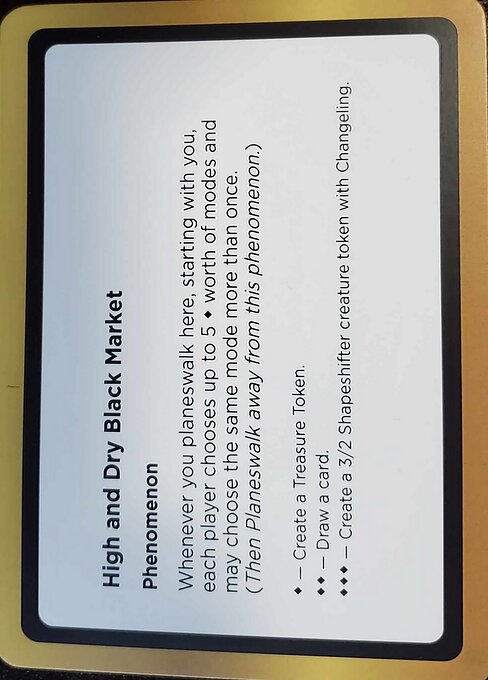
Image courtesy of Scryfall.com
AI-Driven Synergy Analytics for High and Dry Black Market
If you’ve ever watched a Commander table melt into a gleeful flurry of untaps, treasures, and shapeshifting mayhem, you know the thrill of synergy in MTG. Modern AI-assisted models aim to quantify that thrill, translating wild human decisions into predictable patterns. When we look at a planar phenomenon like High and Dry Black Market, the AI challenge becomes even juicier: a blank mana cost, a text-rich event loop, and a menu of modes that each player can bend to their own strategy. 🧙♂️🔥 This card’s Oracle text reads like a micro-game: as soon as you planeswalk here, every player selects up to five diamond-equivalent modes and may repeat the same choice; then the plane walks away. The modes offer a Treasure token, a card draw, or a 3/2 Changeling creature token. It’s a microcosm of decision trees, probability, and ramp all folded into one dramatic moment. 🎲
What makes this card a perfect proving ground for AI synergy models
First, consider the mechanics in plain terms. This is a zero-mana, zero-color-cost Phenomenon with multiple payoff lines—Treasure generation, card draw, and a shapeshifter token with Changeling. The “up to five modes” threshold creates a combinatorial explosion of potential choices, especially when five players with different deck archetypes are involved. An effective AI model must handle:
- Player heterogeneity: each participant’s deck aims for different payoffs—from mana acceleration to card advantage to flexible creatures for tribal synergies.
- Mode redundancy: the rule allows choosing the same mode more than once, which increases the probability mass for certain strategies in a crowded table.
- Temporal dynamics: the moment you planeswalk in is ephemeral; the AI must estimate the downstream impact of that one decision sketch across the rest of the game.
- Shapeshifter with Changeling: a wildcard token that can slot into any creature-based plan in a tribal-agnostic way, opening latent synergies wherever you look.
- Nerdy nuance: the “Treasure” token adds ramp that can power big plays, while drawing a card reshapes tempo and card selection for turns that follow.
In practice, a robust model would blend a few approaches: a Bayesian belief model to capture player intent, a sparse decision tree for the modes, and a Monte Carlo tree search to simulate the ripple effects across several turns. The reward signal isn’t just “did I get a Treasure?” or “did I draw a card?”—it’s, “did this choice unlock a winning line while keeping the table engaged and tempo-positive for my board state?” And yes, we’re talking about how to weigh chaos with calculation, all while keeping the fun of MTG intact. 🧠💎
How the card’s three payoff lines inform deck strategy
From a gameplay perspective, this card rewards a balance between ramp, consistency, and interaction. The Treasure mode interacts beautifully with any deck that leans on artifact acceleration or mana-fixing—think generic rocks, Talismans, and potential color fixing through Treasure shenanigans. The immediate card draw option reshapes pace and risk tolerance; in a game where early draw luck can snowball into late-game wins, the AI can model the expected value of that single draw against the cost of giving opponents a free ramp click. And the Changeling 3/2 token introduces a flexible threat that can seed aggro, be used as a chump blocker, or morph into any tribal requirement later in the game. The AI’s job is to predict which path yields the highest probability of a favorable outcome given current board state, hand size, and opponent tendencies. ⚔️
As a design note, the card sits in a playful, “funny” frame of reference—the Punk set's Black Lotus Unknown Planechase collection—where the rules edge toward whimsy rather than rigid balance. The rarity is common, yet the effect invites a depth of analysis that feels almost vintage in its complexity. The AI can learn from table results: when players lean into mode diversity, does the table fragment into parallel lines of play or converge toward a few dominant strategies? And does the Changeling token end up becoming a decoy that buys critical turns for a winning combo? These questions become testbeds for real-time, adaptive analytics that MTG players crave. 🎨
“In a world where decision points are as sharp as a Planeswalker’s spark, the best analytics don’t just predict what happens next—they illuminate the gentle, human thrill of choosing your path.”
For analysts and players alike, the allure lies in the synthesis: AI helps map the invisible threads between choices and outcomes, not by stealing the game’s flavor but by highlighting the hidden geometry of every decision. When you’re staring at a board that might produce a Treasure token, a fresh card, or a shapeshifter that could fit any scheme, you’re watching probability become play. 🧙♀️✨
Practical takeaways for builders and dreamers
- Embrace modes as a spectrum: model not just which modes to pick, but how the distribution of mode selections shifts with different table sizes and archetypes. Use that to forecast tempo curves and win conditions. 🔎
- Pair with ramp-rich or creature-heavy decks to maximize the value of Treasure and the Changeling token. The synergy isn’t only about immediate payoff—it’s about creating a flexible engine that adapts as the game unfolds. 💎
- Test with simulations across diverse opponents: AI shines when it can vary its opponent profiles, revealing how robust a plan is to different strategies. 🎲
- Remember the flavor: even as analytics illuminate the next best move, the joy of MTG lies in the unpredictable, chaotic magic that emerges from human decisions. Balance rigor with playfulness. 🎨
- Document insights for future models: track which modes most often drive winning lines, and which Deck Archetypes exploit or counter the resulting Treasure economy. This is where data meets deckbuilding artistry. 🧙♂️
More from our network
- https://blog.digital-vault.xyz/blog/post/hot-giant-in-sagittarius-maps-milky-way-radial-velocities/
- https://wiki.digital-vault.xyz/wiki/post/pokemon-tcg-stats-houndoom-ex-card-id-xy8-21/
- https://blog.crypto-articles.xyz/blog/post/best-metal-type-partners-for-genesect-in-pokemon-tcg/
- https://blog.zero-static.xyz/blog/post/call-of-duty-modern-warfare-iii-timeline-breakdown/
- https://crypto-acolytes.xyz/blog/post/gaming-and-parenting-practical-boundaries-for-kids/

High and Dry Black Market
Whenever you planeswalk here, starting with you, each player chooses up to 5 ♦ worth of modes and may choose the same mode more than once. (Then Planeswalk away from this phenomenon.)
♦ — Create a Treasure Token.
♦ ♦ — Draw a card.
♦ ♦ ♦ — Create a 3/2 colorless Shapeshifter creature token with Changeling.
ID: a422e17c-f0a3-48f4-ad55-1b78adc2ecf8
Oracle ID: 4b0e9c83-867a-4dc1-ac15-3b00952f75c7
Colors:
Color Identity:
Keywords: Treasure
Rarity: Common
Released: 2024-10-25
Artist:
Frame: 2015
Border: gold
Set: Black Lotus Unknown Planechase (punk)
Collector #: PLA028
Legalities
- Standard — not_legal
- Future — not_legal
- Historic — not_legal
- Timeless — not_legal
- Gladiator — not_legal
- Pioneer — not_legal
- Modern — not_legal
- Legacy — not_legal
- Pauper — not_legal
- Vintage — not_legal
- Penny — not_legal
- Commander — not_legal
- Oathbreaker — not_legal
- Standardbrawl — not_legal
- Brawl — not_legal
- Alchemy — not_legal
- Paupercommander — not_legal
- Duel — not_legal
- Oldschool — not_legal
- Premodern — not_legal
- Predh — not_legal
Prices
More from our network
- https://blog.digital-vault.xyz/blog/post/metal-fatigue-memes-the-mtg-community-reactions/
- https://blog.zero-static.xyz/blog/post/outsmarting-whitesuns-passage-practical-mtg-answers/
- https://blog.crypto-articles.xyz/blog/post/nft-data-midevil-4670-from-midevils-collection-on-magiceden/
- https://blog.digital-vault.xyz/blog/post/gixian-puppeteer-examining-rarity-versus-usability-in-mtg/
- https://wiki.digital-vault.xyz/wiki/post/pokemon-tcg-stats-gardevoir-card-id-dp3-7/