

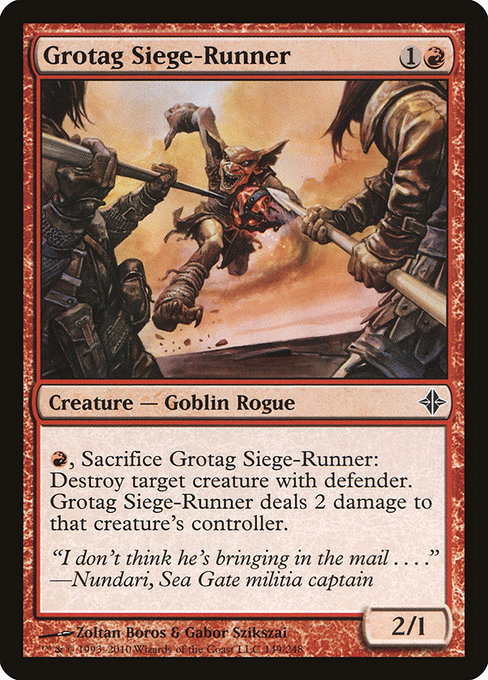
Image courtesy of Scryfall.com
AI-Driven Approaches to Deck Optimization with Grotag Siege-Runner
Deck-building in MTG has always been part art, part science, and part gut feel. When you add a card as compact and mischievous as Grotag Siege-Runner into the fold, the challenge—and the fun—ratchets up a notch 🧙♂️🔥. This Goblin Rogue costs a lean {R} and carries a two-power, one-toughness body whose true value is unlocked the moment you sac it: destroy target creature with defender, and ping its controller for 2. Rise of the Eldrazi minted this little gem in 2010 as a common rarity, but its potential in a well-tuned deck behaves like a secret weapon you pull out in the late game to swing tempo and pressure the opponent’s life total. The story behind the art—Zoltan Boros & Gabor Szikszai—delivers a flavor text that hints at the chaos and cunning of street-level goblin scheming: “I don't think he's bringing in the mail . . . .” ⚔️🎨
Machine learning offers a principled way to explore the vast space of possible decks that include Grotag Siege-Runner. Rather than relying on the memory of old peers or the latest gossip from the metagame, ML can evaluate thousands of possible 60-card lists, optimize for win rate against projected meta distributions, and adapt to format constraints. The key is to treat deck-building as a combinatorial optimization problem: choose the right balance of creatures, removal, burn, and mana sources so that the Siege-Runner can shine on turn 3 or turn 4, while still weaving in enough reach to finish games after the midgame skirmishes. This approach is especially appealing for red's notorious tempo arc, where a small error in curve or disruption can cost two critical turns 🧙♂️💎.
From a data perspective, we’d want to encode Grotag Siege-Runner with its concrete card data: mana cost {R}, type Creature — Goblin Rogue, power 2 / toughness 1, and its ability: {R}, Sacrifice this creature: Destroy target creature with defender. This creature deals 2 damage to that creature's controller. The card belongs to Rise of the Eldrazi (ROE), printed as a common with both foil and nonfoil finishes. Its color identity is red, and in formats where red is aggressive, it often serves as a pop when you need to remove a stubborn defender while pushing through for lethal damage. An ML-driven deck builder will weigh these attributes alongside more general features: mana curve, density of red sources, number of out-of-red removal spells, and cards that exploit the defender mechanic—both to break stalemates and maximize tempo. 🔥⚔️
What does an ML-guided deck look like in practice? Think of a red-leaning tempo shell where Grotag Siege-Runner acts as a compact removal engine and a quick threat. You want enough early plays to pressure while keeping the board from stalling behind large defenders. The ML model would consider recipe-like constraints: no more than four copies of any non-basic spell, a 60-card deck size, and a target mana curve that lands your first threatening play by turn 2 or 3 on average. It would score viability not only by raw damage but by interaction quality—how often does you-sacrifice line cleanly remove a defender that blocks your best evasive threats? And, crucially, how does that removal translate into incremental damage on the opponent: 2 damage from the sacrifice plus the tempo shift of having your other threats land untouched? 🎲
One attractive archetype emerges from this lens: a red tempo/sacrifice hybrid. In such a shell, Grotag Siege-Runner pairs with inexpensive red creatures and a handful of burn or efficient removal to disrupt blockers and defenders. The AI can tune how many two- or three-mana plays you can tolerate while keeping enough red mana sources to cast your threats and activate Siege-Runner’s cost on the same turn. The model learns thresholds—how many defender-typing blockers you can overcome before you need additional pressure or when you should pivot to becoming more resilient with burn and defensive plays. This is where machine learning shines: it can propose distribution patterns (land count, fetches, early removal density) that maximize win probability across simulated matchups, then iterate toward a near-optimal decklist with a level of nuance that’s hard to replicate by hand 🧙♂️🔎.
Beyond pure performance, there’s a design-and-culture angle that MTG fans love. Grotag Siege-Runner embodies the goblin archetype: fast, reckless, and delightfully tactical. The card’s ability nudges players toward a play style where every sacrifice is a calculated bet against the enemy’s defenses. Implementing ML-informed deck tuning invites players to think like strategists rather than scribes—what if your deck could learn to prefer crashing in with a Gian? Not quite—more like: your deck learns to prioritize the turns when it can convert a block into a two-for-one tempo swing. This is the fun intersection where computation meets chaos, and red’s color philosophy is on full display 🧙♂️🔥.
As you experiment, you’ll also discover the practicalities of building with restricted formats in mind. The card’s Modern and Legacy legality means it can slot into powerful red shells, but your ML-informed deck will align with the local meta: do defenders show up often enough to justify a repeated sacrificing engine, or should you diversify with additional removal and cheap threats? The beauty of AI-assisted deck design is that you can stress-test countless permutations, then narrow to the most robust configurations that survive a range of matchups, from early-game pressure to late-game gambits. It’s a playful, serious, and deeply MTG thing to do—merging data science with a love for the game 🧙🔥🎲.
And if you’re building a little while you think about your desk space between rounds, consider a practical companion: a neon mouse pad that keeps your desk looking as sharp as your strategy. If you’d like to snag a tactile, non-slip surface for long drafting sessions and tournament weekends, the Neon Gaming Mouse Pad Rectangular 1/16in Thick Non-Slip is a crisp, color-pop addition to your setup. It’s a fun nod to the same mind-body synergy that makes MTG so satisfying—your hands stay precise while your mind runs through the combinatorics of the next combat step.
Neon Gaming Mouse Pad Rectangular 1/16in Thick Non-SlipMore from our network
- https://wiki.digital-vault.xyz/wiki/post/pokemon-tcg-stats-suicune-ex-card-id-ex4-94/
- https://blog.crypto-articles.xyz/blog/post/nft-data-debros-197-from-debros-collection-on-magiceden/
- https://crypto-acolytes.xyz/blog/post/nft-stats-lil-chiller-2070-from-lil-chillers-collection/
- https://blog.digital-vault.xyz/blog/post/azor-the-lawbringer-tracking-price-volatility-in-silver-border-sets/
- https://wiki.digital-vault.xyz/wiki/post/pokemon-tcg-stats-steenee-card-id-sv04-009/
Grotag Siege-Runner
{R}, Sacrifice this creature: Destroy target creature with defender. This creature deals 2 damage to that creature's controller.
ID: 01c1a241-38ad-453e-b6c2-a79006031e2d
Oracle ID: f76969e7-b075-417c-bc15-1b94a17fef54
Multiverse IDs: 193496
TCGPlayer ID: 34843
Cardmarket ID: 22640
Colors: R
Color Identity: R
Keywords:
Rarity: Common
Released: 2010-04-23
Artist: Zoltan Boros & Gabor Szikszai
Frame: 2003
Border: black
EDHRec Rank: 28683
Penny Rank: 16046
Set: Rise of the Eldrazi (roe)
Collector #: 149
Legalities
- Standard — not_legal
- Future — not_legal
- Historic — not_legal
- Timeless — not_legal
- Gladiator — not_legal
- Pioneer — not_legal
- Modern — legal
- Legacy — legal
- Pauper — legal
- Vintage — legal
- Penny — legal
- Commander — legal
- Oathbreaker — legal
- Standardbrawl — not_legal
- Brawl — not_legal
- Alchemy — not_legal
- Paupercommander — legal
- Duel — legal
- Oldschool — not_legal
- Premodern — not_legal
- Predh — legal
Prices
- USD: 0.11
- EUR: 0.04
- EUR_FOIL: 0.19
- TIX: 0.03
More from our network
- https://wiki.digital-vault.xyz/wiki/post/pokemon-tcg-stats-clamperl-card-id-ex5-58/
- https://blog.digital-vault.xyz/blog/post/lineprancers-vs-control-key-tech-for-narrow-matchups/
- https://wiki.digital-vault.xyz/wiki/post/pokemon-tcg-stats-applin-card-id-a3b-006/
- https://wiki.digital-vault.xyz/wiki/post/pokemon-tcg-stats-hops-snorlax-card-id-svp-184/
- https://wiki.digital-vault.xyz/wiki/post/pokemon-tcg-stats-blastoise-piplup-gx-card-id-sm12-215/