
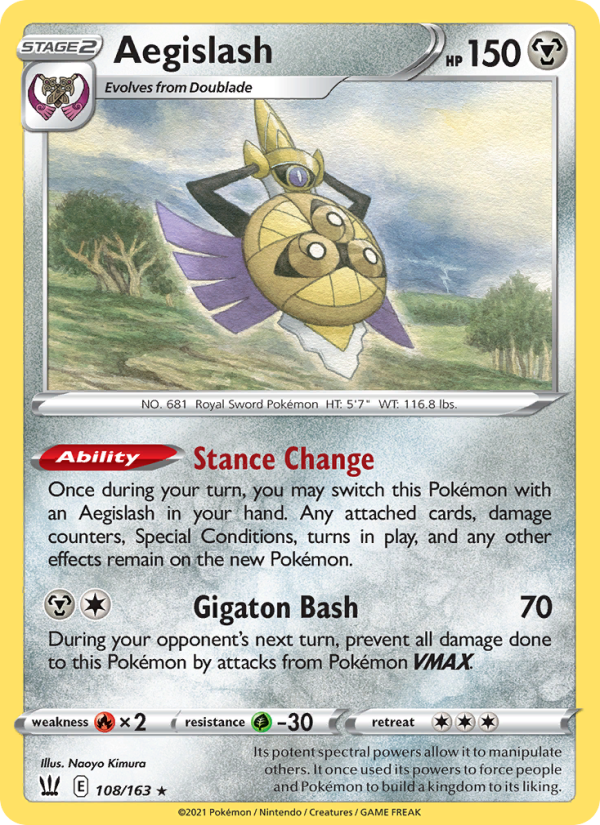
Image courtesy of TCGdex.net
Artwork and Perception: How Visuals Shape Strategy in the Pokémon TCG
Art in the Pokémon TCG isn’t just decoration. It’s a first line of communication between a card and the player, a sensory cue that informs how we perceive a card’s power, role, and potential fate in a match. Aegislash, a Rare Stage 2 Steel-type—evolving from Doublade—offers a compelling case study in how composition, color, and illustrative detail can tilt a player's expectations before a single attack is declared. The card, illustrated by Naoyo Kimura, uses a poised, metallic aesthetic to underscore its dual identity: a blade that can become a shield and a shield that can become a blade, depending on the moment of the battle. ⚡ From the moment you glimpse Aegislash on the field, the artwork communicates a narrative of control and discipline. The steel-toned palette evokes resilience and precision, while the steadfast stance hints at the card’s signature mechanic: Stance Change. ThisAbility, which lets you swap Aegislash with another Aegislash from your hand “once during your turn,” is more than a text box—it's a storytelling invitation. The image suggests that the true threat lies not just in raw numbers but in the strategic tempo you strike, switching between offense and defense as the battlefield shifts. In your mind, you’re not simply playing a 150 HP Steel Pokémon; you’re orchestrating a sequence where the silhouette’s balance mirrors the game’s rhythm. In gameplay terms, the artwork reinforces the card’s functional identity. Gigaton Bash, the primary attack, costs Metal and Colorless and deals 70 damage. But the art cues push players to think about timing: the blade-like silhouette conveys a moment of poised containment, aligning with the attack’s defensive twist. The art’s cool chrome glow, contrasted with Aegislash’s ominous, almost spectral vibe—described in the card lore as a Pokémon whose powers manipulate others—helps players imagine scenarios where Aegislash stands as a bulwark against VMAX threats. The visual language nudges you toward a cautious, tempo-based playstyle: protect with measured counterattacks, then strike when an opponent overextends. Naoyo Kimura’s illustration doesn’t merely present a fighting machine; it crafts an atmosphere. The character design emphasizes balance—blade and shield, offense and defense—mirroring the card’s dual potential. This is where perception becomes strategy: players who connect the art with the Stance Change mechanic might be more inclined to build playlines around field positioning and tempo, rather than chasing brute force alone. The image’s clean lines and metallic sheen also contribute to a tactile sense of durability, making Aegislash feel like a card you’d want at the center of a well-constructed deck, especially in formats where patience and planful play can outlast raw power. The collector’s eye isn’t left untouched by this art-driven perception either. Aegislash is a Rare from Battle Styles, a set whose thematic lean is metal-infused resilience and tactical cunning. The card’s HP sits at a stout 150, and its evolution from Doublade marks a pivotal upgrade in both power and presence. The rarity, combined with a striking illustration, often elevates this card in collection value discussions. While market fluctuations can be nuanced, the card’s expanded legality underscores its continued relevance for players who favor older rotations and deck-building diversity. In a world where art often becomes a mnemonic cue for performance, Aegislash’s visual identity helps it linger in memory as a strategic figure rather than a mere stat line. Of course, every Pokémon card exists within a broader ecosystem of pricing, accessibility, and playability. The data attached to this Aegislash card tell a nuanced story: pricing metrics across platforms place this card in a low-to-mid tier, with Cardmarket’s average hovering around a few tenths of a euro and TCGPlayer showing similar modest values for normal print runs. Those numbers reflect not only market dynamics but also the enduring appeal of a well-designed card whose art resonates with fans who remember the fossilized elegance of the steel-clad knight. For players, this means a balance between collecting value and constructing a deck that can leverage Stance Change to outmaneuver powerful opponents. If you want to explore the influence of artwork beyond Pokemon, you can see how design decisions mirror audience expectations across digital culture—whether in NFTs, digital organization, or NFT stats—as readers and fans seek coherent, evocative visuals that reinforce function. For instance, thoughtful file naming and organized references help maintain clarity in a sea of assets, much like a well-curated Pokémon deck helps you navigate complex matchups. The five linked articles below offer a broader look at how design, data, and perception interact across digital communities, providing a parallel lens to consider in the Pokémon TCG world. 🔎 - https://crypto-acolytes.xyz/blog/post/dapper-doggos-38-dapper-doggos-nft-stats/ - https://blog.digital-vault.xyz/blog/post/smart-file-naming-best-practices-for-digital-organization/ - https://blog.crypto-articles.xyz/blog/post/nft-data-2306-from-piggy-gang-collection-on-magiceden/ - https://wiki.digital-vault.xyz/wiki/post/pokemon-tcg-stats-porygon-card-id-ex11-80/ - https://crypto-acolytes.xyz/blog/post/nft-stats-solgod-57-from-solgods-collection/ But Aegislash’s story isn’t only about aesthetics; it’s about how those visuals translate to in-game decisions and the emotional arc of any duel. The ability Stance Change is a narrative hinge: you’re encouraged to imagine Aegislash as a moving fortress, switching forms to respond to the battlefield’s whispers. The card’s weakness, Fire ×2, and resistance, Grass −30, remind us that even the most stylish knight has vulnerabilities—an invitation to leverage board state and timing rather than merely stacking power. With a retreat cost of 3, Aegislash demands patience, positioning, and respect for tempo, which the artwork helps to reinforce by suggesting a measured approach to every encounter. As you curate a collection or test a build, consider how the art sets player expectations and how those expectations evolve as battles unfold. The visual storytelling of Naoyo Kimura, paired with a mechanically intriguing card like Aegislash, demonstrates why artwork matters: it shapes not only what you see on the table, but how you feel about it, and ultimately, how you play. PU Leather Mouse Mat - Non-Slip Vegan Leather Sustainable InkMore from our network
- https://crypto-acolytes.xyz/blog/post/dapper-doggos-38-dapper-doggos-nft-stats/
- https://blog.digital-vault.xyz/blog/post/smart-file-naming-best-practices-for-digital-organization/
- https://blog.crypto-articles.xyz/blog/post/nft-data-2306-from-piggy-gang-collection-on-magiceden/
- https://wiki.digital-vault.xyz/wiki/post/pokemon-tcg-stats-porygon-card-id-ex11-80/
- https://crypto-acolytes.xyz/blog/post/nft-stats-solgod-57-from-solgods-collection/
Aegislash
Set: Battle Styles | Card ID: swsh5-108
Card Overview
- Category: Pokemon
- HP: 150
- Type: Metal
- Stage: Stage2
- Evolves From: Doublade
- Dex ID: 681
- Rarity: Rare
- Regulation Mark: E
- Retreat Cost: 3
- Legal (Standard): No
- Legal (Expanded): Yes
Description
Its potent spectral powers allow it to manipulate others. It once used its powers to force people and Pokémon to build a kingdom to its liking.
Abilities
-
Stance Change — Ability
Once during your turn, you may switch this Pokémon with an Aegislash in your hand. Any attached cards, damage counters, Special Conditions, turns in play, and any other effects remain on the new Pokémon.
Attacks
| Name | Cost | Damage |
|---|---|---|
| Gigaton Bash | Metal, Colorless | 70 |
Pricing (Cardmarket)
- Average: €0.39
- Low: €0.02
- Trend: €0.45
- 7-Day Avg: €0.36
- 30-Day Avg: €0.35
Support Our Decentralized Network
Donate 💠More from our network
- https://crypto-acolytes.xyz/blog/post/dapper-doggos-38-dapper-doggos-nft-stats/
- https://blog.digital-vault.xyz/blog/post/smart-file-naming-best-practices-for-digital-organization/
- https://blog.crypto-articles.xyz/blog/post/nft-data-2306-from-piggy-gang-collection-on-magiceden/
- https://wiki.digital-vault.xyz/wiki/post/pokemon-tcg-stats-porygon-card-id-ex11-80/
- https://crypto-acolytes.xyz/blog/post/nft-stats-solgod-57-from-solgods-collection/